How to Measure Foot Traffic from Marketing Efforts
For physical stores, getting customers to come into the store is equally important as getting them engaged online. With digital marketing, there is no doubt about the metrics provided. For instance, clicks and conversions, but the merchants at the physical locations hardly ever consider marketing spending as a factor for the sales they make. Thus, it has become a major concern for the retail, restaurant, and local business sectors to learn how to measure foot traffic in terms of the number of people who have visited their stores.
In the absence of accurate statistics, companies take a shot in the dark to evaluate the performance of their ads, promotions, or campaigns in attracting customers to the store. A systematic method of foot traffic analysis obliterates this doubt. Modern foot traffic tracking techniques and thoughtful offline marketing performance measurement together can clarify the exact campaigns that trigger customers to enter the store.
The proper attribution of in-store visits brought about by marketing activities connects the various channels to physical behavior. It allows companies to give credit to the different marketing channels, such as flyers, billboards, email campaigns, paid ads, and even word-of-mouth promotions. Instead of relying on hunches, decision-makers get quantifiable insights into customer movement and purchase intention.
This blog will showcase an innovative and data-driven way of measuring foot traffic from marketing activities. You will discover the tried-and-tested tracking methods, attribution models, common obstacles, and best practices—so that you can convert foot traffic data into more astute marketing decisions and stronger store performance.
Why Businesses Must Measure Foot Traffic from Marketing Efforts

Comprehending the method to measure foot traffic stemming from marketing actions is a key thing for those companies whose main source of income is physical visitation. Marketing performance is still incomplete and sometimes misleading without such data.
Digital impressions and clicks do not mean that people will come to the stores. A lot of campaigns look successful in the virtual world, but do not really lead to any action in the real world. This is exactly when the offline marketing performance measurement becomes very important. Businesses that are able to monitor customer traffic can identify the channels that really affect customer behavior.
The tracking methods of foot traffic have turned modern times into a scenario where customers’ patterns, peak times, and visiting frequency become transparent. When combined with the customer attribution to the store visit, it offers the insights of which promotions or messages truly draw in customers.
Businesses That Focus on Foot Traffic Measurement Can:
- Reap the benefits of optimizing marketing budgets.
- Completely cut off those campaigns that do not perform well.
- Sharpen their location-based strategies.
In the end, foot traffic monitoring for marketing purposes changes the marketing department from a cost centre to a performance-driven growth engine.
Also Read: How to Track Local SEO Performance
How To Measure Foot Traffic from Marketing Efforts Using Baseline Comparisons
One of the easiest methods to evaluate the impact of marketing actions on foot traffic is by setting a baseline. The baseline means the regular foot traffic numbers before the start of the campaign.
Through the comparison of traffic during the campaign and after with the baseline, businesses can detect small increases. This technique is a direct way to measure foot traffic and the performance of offline marketing without the use of sophisticated tools.
The Important Steps Are:
- Monitor daily foot traffic for 2-4 weeks.
- Initiate a marketing campaign.
- Quantify traffic variations throughout the campaign period.
Even though this method is basic, it is very effective when used in conjunction with high-tech foot traffic monitoring systems such as sensors or POS data. The baseline analysis also enhances the attribution of in-store visits by differentiating the impact of the campaign from seasonal or random fluctuations. Comparisons of baselines lay down the groundwork for more intricate foot traffic analytics.
Using Location Data to Measure Foot Traffic from Marketing Efforts
The use of location data has radically changed the manner in which businesses evaluate the impact of their marketing through the counting of foot traffic. The mobile devices used by people produce location signals that are anonymized and show the time when the users go into a certain place. This information highlights the following aspects of foot traffic, all the way to the most sophisticated methods:
- One-off visits
- How long did the visits last
- Patterns of repeat visitations
The use of location data is particularly important for the attribution of in-store visits. By tracking whether the exposed users later enter a store, businesses can link digital ads or campaigns to the physical visits.
For the accurate measurement of offline marketing performance, location-based insights should be confidential and gathered. When applied responsibly, location data provides excellent and potent visibility into the actual customer behavior as well as the effectiveness of the campaigns.
How POS Data Helps Measure Foot Traffic from Marketing Efforts
Point-of-sale (POS) systems contribute significantly to the assessment of customer visits resulting from marketing activities. Although POS records the number of transactions and not the actual customer visits, it nevertheless gives reliable indirect indications. POS data, in conjunction with foot traffic analytics, unveils the following:
- Conversion rates
- Average spending per visit
- Revenue from campaigns
This information solidifies the attribution of in-store visits by associating marketing activities with the actual purchases. One way is to compare the volume of transactions before and after a promotional activity. This helps to increase the accuracy of measuring foot traffic and the offline marketing performance.
Purely relying on POS data does not help in estimating the number of non-buying visitors, but when it is used together with foot traffic tools, it provides a comprehensive view of the customers’ in-store movements and behaviors.
Measuring Walk-Ins to Measure Foot Traffic from Marketing Efforts
One of the most immediate signs of marketing success in terms of foot traffic is walk-ins. However, small businesses still find it useful to adopt simple manual tracking methods.
The Most Commonly Used Ways Are:
- Counting by staff members.
- Keeping records by visitors.
- Checking in at reception.
Although manual tracking is less accurate than digital ones, it still serves grounding for marketing performance measurement in offline places. If attached to certain campaigns, it can reveal in-store visit attribution, particularly for localized promotion.
Manual tracking is a good method only as an addition that supports the data collected through automatic systems.
Using Wi-Fi and Bluetooth to Measure Foot Traffic from Marketing Efforts
Wi-Fi and Bluetooth sensors are widely used methods for counting the number of people who come to a store as a result of marketing campaigns. These systems are able to tell when mobile phones are moving in and out of the area or staying in a certain location. The main advantages of these tracking methods for measuring foot traffic are:
- Real-time data collection
- Visitor dwell time analysis
- Repeat visit tracking
These tools make the offline marketing performance measurement more accurate by letting us know how long customers are interacting with the store. Besides that, they increase the attribution of in-store visits by connecting the time of the campaign with the rise in traffic.
If used properly and with consent, Wi-Fi and Bluetooth tracking can give very accurate and detailed information about customer movements in the store.
How QR Codes Help Measure Foot Traffic from Marketing Efforts
QR codes have a unique ability to serve as a simple but really effective assistant, letting dealers, especially those who make use of offline marketing, measure foot traffic that results from marketing activities. With the help of unique QR codes on flyers, posters, or ads, businesses can monitor three aspects:
- Campaign-specific scans.
- Kicking and engaging at the specified time and place.
- In-store redemptions.
This approach provides proof of offline marketing effectiveness while enhancing in-store visit attribution at the same time. Moreover, QR codes act as a bridge between different foot traffic monitoring methods by associating physical engagement with digital data.
Moreover, if QR codes are used uniformly, they will be able to give a clear measure of the aesthetic effect of offline promotions in the real world.
Measuring Coupon Redemptions to Measure Foot Traffic from Marketing Efforts
Coupon redemption continues to be an effective strategy to determine the number of customers in the store and how they came there as a result of marketing measures. Offering customers a coupon gives a strong reason to go and see the retailer’s product.
Monitoring The Rates of Redemption Backup:
- Campaign-level measurement of offline marketing performance.
- Attribution of in-store visits made clear.
- Analysis of ROI.
The best use of coupons is when they are combined with digital tracing or POS systems. Although not an absolute substitute for the sophisticated foot traffic tracking methods, they do provide undeniable evidence of the effectiveness of a campaign.
The measurement through coupons is especially useful for activities with a limited time frame and local advertising.
Using Surveys to Measure Foot Traffic from Marketing Efforts
Qualitative insights are given by customer surveys, which are then used to measure foot traffic from marketing efforts. In-store visit attribution is improved by asking customers how they found out about the store.
Amongst The Best Survey Questions Are:
- What reason forced you to visit my store today?
- Which way led you to discover our presence?
Data from customer surveys validate the assessment of the effectiveness of offline marketing by corroborating the conclusions reached through tracking customer movement methods. Although the self-reported data has its limitations, it nonetheless contributes to the sort of context which can never be offered by technology alone. Surveys receive maximum effectiveness when they are short, optional, and together with incentives.
How Geofencing Helps Measure Foot Traffic from Marketing Efforts
Geofencing is a technology that makes it possible for companies to track the number of people who come to their locations as a result of their marketing efforts by putting up invisible walls around their locations.
Whenever a person who has either seen or interacted with an advertisement enters the area covered by geofencing, the store in question is credited with a visit from that person. This method is a significant contributor to the already available performance measurement of mobile advertising in the case of offline marketing.
Geofencing revolutionizes traditional foot traffic monitoring by establishing a direct relationship between view and visit. Its application is most prominent in retail, dining, and event marketing.
Combining Online and Offline Data to Measure Foot Traffic from Marketing Efforts
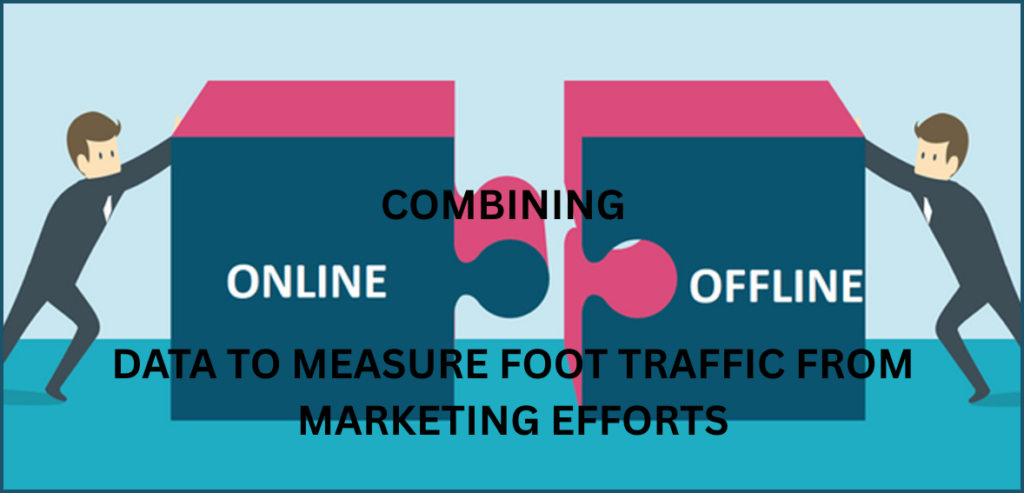
For the purpose of accurate measurement of foot traffic through marketing activities, companies have to use online and offline data sources at the same time. Only digital impressions do not give the whole picture.
Measure Foot Traffic by Uniting:
- Ad exposure data
- Location analytics
- POS transactions
A single perspective of offline marketing effectiveness measurement is provided by the businesses. This merging leads to better attribution of in-store visits and confirms the application to measure foot traffic methods across channels.
Analyses connecting different channels show the assistance of digital and physical touchpoints in boosting visits.
Avoiding Common Errors When You Measure Foot Traffic from Marketing Efforts
Data discrepancies are frequent in companies when they judge the foot traffic resulting from marketing activities. Among the most typical errors are assigning too much to one campaign and ignoring the impact of outside factors all.
The Key Methods to Avoid:
- Not being aware of seasonal variations
- Dependence on one source of data only
- Disregarding privacy regulations
Multiple methods of tracking foot traffic are used to get more precise results. A complete and open-minded review of the outcomes, together with setting realistic expectations, is a must for measuring the success of offline marketing strongly. Steering clear of these mistakes leads to more accurate in-store visit attribution.
How Attribution Models Improve How You Measure Foot Traffic from Marketing Efforts
Attribution models establish the method of assigning credit when companies gauge the number of visitors in their stores due to marketing activities. Single-touch attribution oversimplifies the journey of customers by assigning credit to just one interaction, very often neglecting the earlier influences.
On the contrary, multi-touch attribution models facilitate the correct attribution of in-store visits by recognizing the presence of various influences such as ads, emails, and offline promotions throughout the buying process. This, in turn, increases the efficiency of measuring the performance of offline marketing and also makes the more sophisticated foot traffic tracking techniques gain more realistic insights through validation.
Attribution modelling, therefore, improves the understanding of the full customer journey from getting to know the product to finally buying it, which in turn translates into better budget distribution, more intelligent campaign sequencing, and more precise performance measurement.
Using Benchmarks to Measure Foot Traffic from Marketing Efforts
The use of benchmarks can assist in businesses’ better understanding of the data when they evaluate foot traffic resulting from marketing sources. One would be able to gain more insights and accurately interpret the data through comparison of current results with past performance or industry averages.
Benchmarks act as a tool for validating offline marketing performance measurements. They not only draw attention to the trends in business but also to the data that is often overlooked because it was collected over a short time period.
In this way, benchmarking improves the quality of goal setting and optimizes content strategy for the business. It also assists with the creation of more realistic expectations, gap identification, and consequently the directing of continuous improvement efforts.
How Insights to Measure Foot Traffic Help Optimize Marketing Efforts

Initially, it is essential that companies first look to data for their next move and measure foot traffic from marketing activities. Changing the marketing strategy based on the analysis of customer behavior can lead to the effective use of company resources and better service to the customers at the same time.
The Insights Useful for Supporting:
- Budget reallocation
- Campaign timing optimization
- Location-specific messaging
Through the use of in-store visit attribution, retailers can not only evaluate the effectiveness of their offline campaigns but also fully utilize the foot traffic counting techniques. Measurement without action is not able to generate a great impact.
Conclusion
It is vital for businesses that depend on in-store visits to learn the way to measure foot traffic from their marketing efforts. The absence of accurate measurement means that marketing decisions will be made based on hypotheses instead of facts. Modern foot traffic tracking methods, however, open the door for businesses to see customer locations, forms of visits, and how well their campaigns are doing.
Grounded offline marketing performance measurement tightly links marketing activities to real-world results, while precise in-store visit attribution gives credit to the proper campaigns. These two strategies, when used in conjunction with each other, make foot traffic a vague metric transformed into a very powerful tool for decision-making.
Investing in foot traffic measurement lets businesses optimize their budgets, enhance customer experiences, and maintain growth steadily. It is the strategic necessity in a competitive environment to know what really attracts customers to the door, rather than just being aware of it.
FAQs
Why is it important to measure foot traffic from marketing efforts?
It provides valuable input in terms of offline marketing campaign measurement and helps in identifying which marketing efforts were responsible for real-life store visits.
What are the most effective foot traffic tracking methods?
Location data, Wi-Fi sensors, POS data, QR codes, and coupon tracking are among the most effective foot traffic tracking methods.
How does in-store visit attribution work?
In-store visit attribution links the exposure to the marketing campaign with the physical presence of customers in the store during a specific time.
Can offline marketing performance measurement work without digital tools?
Sure, but tracking foot traffic through digital means provides a better accuracy of results.
How often should businesses measure foot traffic from marketing efforts?
A business should continuously measure foot traffic from marketing activities and assess results every month.