Google Updates That Impact Local Rankings (2026-Ready Guide)
Local visibility is never “set it and forget it.” The map pack, local finder, and localized organic results keep shifting because Google updates that impact local rankings are often tied to broader Search quality systems, spam enforcement, and Google Business Profile (GBP) feature changes.
If your calls, direction requests, bookings, or foot traffic depend on local discovery, you need a practical way to track what changed, why it changed, and what to do next—without chasing rumors.
Google’s own guidance is consistent: local results are primarily driven by relevance, distance, and prominence. Those three pillars haven’t gone away, but Google updates that impact local rankings change how those pillars are interpreted, weighted, and protected from manipulation.
Google explicitly notes there’s no way to request or pay for better local placement, and it keeps ranking details confidential to protect fairness.
This guide focuses on the updates and system shifts that most commonly move local rankings: core updates, spam updates, policy enforcement (including site reputation abuse), and GBP platform changes. It also includes forward-looking predictions based on documented trends and public guidance.
What “Local Rankings” Mean in 2026
When people say “local rankings,” they usually mean one (or more) of these surfaces:
- Map pack results (the prominent local results block).
- Local Finder (expanded map results).
- Google Maps discovery (category and “near me” intent).
- Localized organic results (traditional listings influenced by location signals).
Google updates that impact local rankings can hit any of these surfaces differently. A website might drop in localized organic results while the GBP listing stays stable—or the opposite. That’s why you should separate your reporting into: (a) map pack visibility, (b) map actions (calls, directions), and (c) localized organic clicks.
The big picture is still grounded in Google’s local guidance: relevance (how well you match the query), distance (proximity or implied proximity), and prominence (how well-known or authoritative you appear).
But modern local SEO adds layers: entity understanding, spam suppression, review trust signals, content helpfulness, and “brand satisfaction” signals. Those layers are where Google updates that impact local rankings tend to bite.
Core Local Ranking Signals: Relevance, Distance, and Prominence (And What Updates Change)
Google’s official local ranking documentation emphasizes three drivers: relevance, distance, and popularity (commonly described as prominence). This matters because Google updates that impact local rankings rarely replace these fundamentals; instead, they refine what “relevance” and “prominence” mean in practice.
Relevance (Update-Sensitive)
Relevance is highly affected by Google updates that impact local rankings because it depends on Google’s ability to interpret:
- Your primary category and secondary categories
- Services and products (structured and unstructured)
- On-page content and topical focus
- Consistency across listings and citations
Core updates often improve query understanding, which can re-evaluate which businesses are “about” the query. If you rank for a service you barely mention, or you stuffed service terms without real supporting detail, a core update can reduce your relevance.
Distance (More Stable, But Not Untouchable)
Distance is usually the least “SEO-able.” But Google updates that impact local rankings can shift distance behavior when Google changes:
- How it interprets “near me” and neighborhood intent
- How it uses service-area business signals
- How it handles ambiguous location queries (“best dentist” vs “best dentist in [area]”)
Prominence (Where Spam and Trust Updates Hit)
Prominence incorporates offline and online signals: brand mentions, links, reviews, and general trust. Spam updates and policy enforcement often target fake prominence: review fraud, link schemes, doorway pages, and “parasite” placements. That’s why Google updates that impact local rankings can look like “random volatility” when they’re actually trust recalibration.
Google Core Updates: Why They Move Local Results Even When They “Aren’t About Local”
Google describes core updates as broad, significant changes to ranking systems that can affect many sites and topics. Even though core updates are not labeled “local updates,” Google updates that impact local rankings often include core updates because local results are partly powered by the same evaluation systems used across Search.
What recent core updates tell us
Google’s Search Status Dashboard shows multiple major “core update” incidents in 2024 and 2025, including a long December 2025 core update rollout. Industry coverage confirms the December 2025 core update began December 11, 2025 and rolled out over weeks.
Core updates can shift local outcomes by changing:
- Content quality evaluation (thin service pages, templated location pages)
- Entity understanding (brand vs lead-gen vs affiliate)
- Satisfaction signals (people pogo-sticking back to results)
- Trust signals (stronger emphasis on reliable sources)
When a core update tightens quality systems, businesses with “minimum viable” pages (generic copy, no proof, no local context) often slip—especially in competitive verticals. At the same time, established brands may rise due to stronger prominence signals.
Spam Updates: The Fastest Way to Lose (or Gain) Local Visibility
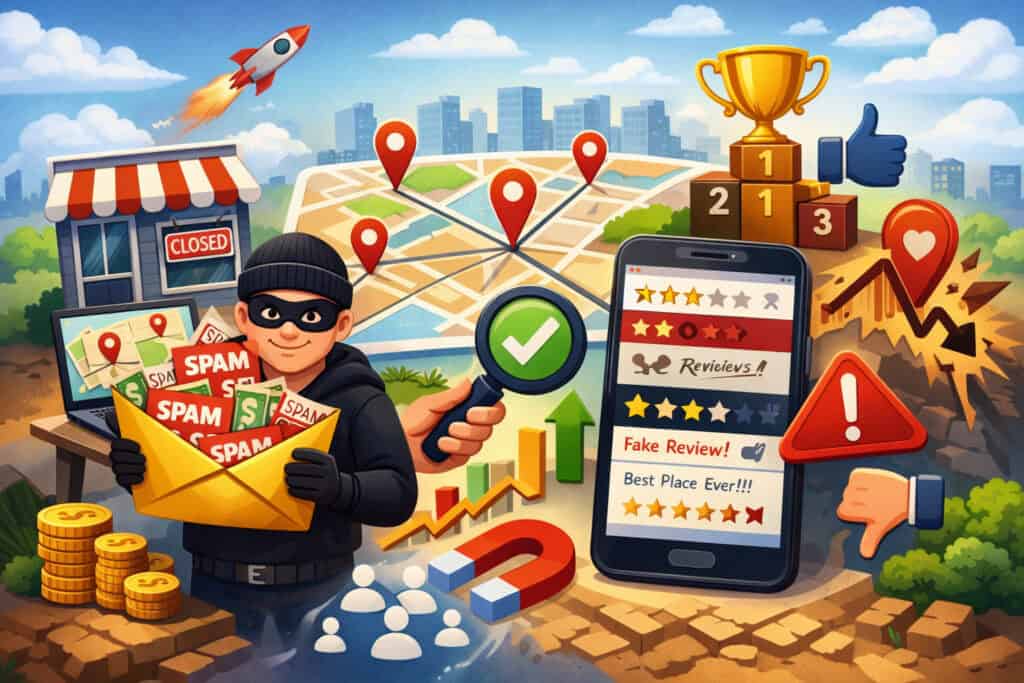
Google’s spam updates are notable improvements to spam detection systems; Google points site owners to a list of ranking updates and explains that SpamBrain is part of its spam-prevention approach.
Spam updates belong on any list of Google updates that impact local rankings because local SERPs are heavily spam-targeted.
Example: August 2025 spam update
Google’s Search Status Dashboard lists the August 2025 spam update, noting it applied globally and to all languages, with rollout completing in late September 2025.
Spam updates can affect local rankings when they target:
- Keyword-stuffed business names
- Fake locations / virtual offices presented as storefronts
- Lead-gen listings masquerading as real businesses
- Review manipulation and incentivized patterns
- Doorway pages and “near me” bait pages
- Link networks built to inflate prominence
Because spam enforcement is continuous, you might see smaller waves even outside official announcements. The key is that spam updates can create “winners” that are simply less spammy than the businesses around them.
Site Reputation Abuse and “Parasite SEO”: A Local Ranking Landmine

One of the most disruptive recent themes in Google updates that impact local rankings is enforcement against site reputation abuse—when third-party pages are published on a site to exploit the host site’s ranking signals. Google’s spam policies describe behaviors that can cause pages or entire sites to rank lower or be omitted.
This matters for local because many local and regional brands lean on:
- Hosted “best of” directories
- Coupon/deal subfolders
- Third-party lead-gen pages
- White-label service pages on powerful domains
In practice, parasite-style pages can distort local search by letting unrelated providers outrank legitimate local businesses—until enforcement hits. Public reporting shows Google strengthening crackdowns on parasite SEO and clarifying responsibility even when content is outsourced.
How to protect your business
- Keep your local content first-party where possible.
- If you publish partner content, ensure it’s topically aligned, transparently authored, and genuinely useful.
- Avoid “rent-a-subfolder” deals that promise rankings.
Google Business Profile Updates in 2025–2026: Features That Quietly Change Ranking Outcomes
GBP is not “just a listing.” It’s an entity layer Google uses to connect real-world businesses to queries. That means platform changes are also Google updates that impact local rankings, even when they look like “product features.”
Independent tracking shows 2025 included notable GBP changes affecting links, photos, reviews, and profile elements that influence visibility. At the same time, Google has introduced profile features that emphasize freshness and real-world activity (for example, “What’s Happening” for certain food and drink businesses), reinforcing the value of ongoing updates.
Why features change rankings indirectly
Even when Google says “this feature isn’t a ranking factor,” features can:
- Improve engagement (clicks, calls, direction taps)
- Increase conversions (behavioral satisfaction)
- Improve relevance (more complete attributes/services)
- Improve prominence (more reviews, more interactions)
Action checklist for GBP resilience
- Maintain accurate categories and services.
- Add attributes that match reality.
- Keep photos fresh and representative.
- Use posts/updates when available to show activity.
- Monitor review velocity and authenticity.
Local Documentation Changes: When Google Updates the Rules (Even If Rankings Don’t Move Overnight)
Sometimes Google updates that impact local rankings begin with documentation changes—signals that Google is reframing how it explains local ranking and spam. There have been observed updates to Google’s local ranking documentation, including changes in wording and detail level.
Documentation updates matter because they often precede:
- Increased enforcement
- Reinterpretation by support teams
- Shifts in what gets flagged as misleading
- New spam patterns being targeted
Even if the fundamentals remain “relevance, distance, prominence,” the practical meaning evolves. For example, tighter language can reduce loophole interpretations and raise the risk of borderline tactics.
Reviews, Reputation, and Trust: How Updates Reshape Prominence
Reviews are a core driver of prominence for many local categories, but the landscape has changed. The practical question is not “how do I get more reviews,” but “how do I build review trust that survives Google updates that impact local rankings?”
Updates commonly target:
- Review gating (only asking happy customers)
- Incentivized reviews
- Sudden unnatural review bursts
- Review farms and templated language
What works long-term:
- Ask every customer consistently (same process, same timing).
- Make leaving a review easy (short link, QR in-store, follow-up message).
- Reply to reviews with helpful specifics (without oversharing).
- Treat negative reviews as a service-recovery workflow.
Website Updates That Affect Local: Helpful Content, Service Pages, and Location Page Quality
Local businesses often underestimate how much their website influences map pack outcomes. Google updates that impact local rankings frequently hit the site layer via quality systems, including core update components that evaluate usefulness and satisfaction.
What “good local pages” look like now
A strong local service page should include:
- Clear service definition (what you do and don’t do)
- Service area explanation (where you serve and how)
- Pricing or pricing ranges where appropriate
- Proof (photos, certifications, case examples, before/after)
- FAQs that match real customer questions
- Clear contact paths (call, form, directions, booking)
- Internal links to related services
Avoid:
- Spun location pages with only city-name swaps
- Hundreds of near-identical “service in [town]” pages
- Content that reads like it was written for bots
Links, Mentions, and Local Authority: Why “Prominence” Is Getting Harder to Fake
Prominence isn’t just links—it’s corroboration. Google updates that impact local rankings frequently tighten how links and mentions are interpreted, especially in local SERPs where low-cost link tactics have been abused.
What tends to work:
- Local PR (community involvement, partnerships, sponsorships)
- Industry associations
- High-quality local citations (consistent NAP)
- Earned mentions in relevant local publications or community sites
What tends to backfire:
- Purchased links at scale
- Private blog networks
- Irrelevant guest posts with exact-match anchor text
Behavioral Signals and Engagement: The “Invisible” Layer Most Businesses Miss
Google rarely spells out how user interaction affects rankings, but it’s clear that search systems aim to surface results that satisfy users. Core updates are designed to improve results overall, which often correlates with satisfaction. In local search, engagement can become a differentiator when businesses look similar on paper.
Engagement signals that can improve outcomes:
- Higher click-through from the map pack
- More calls and direction requests from relevant queries
- Better on-site engagement (fast answers, easy conversion)
- Lower “bounce back to results” behavior
How to improve engagement ethically:
- Use a compelling primary category and accurate secondary categories.
- Add service menus and attributes that match buyer intent.
- Upload photos that show real outcomes (work, team, storefront).
- Ensure your landing page loads fast and answers the query quickly.
Tracking Volatility: How to Tell an Update from a Reporting Glitch
Local rank tracking is noisy. Google updates that impact local rankings can look like chaos if you don’t measure correctly.
A reliable approach:
- Track both map pack and localized organic separately.
- Use multiple grid points (not just one ZIP code).
- Compare GBP Insights trends (calls, directions) against ranking shifts.
- Monitor Search Status Dashboard announcements for confirmed updates.
Also expect unconfirmed volatility. Industry observers often report periods of ranking turbulence without confirmed announcements, which may reflect ongoing adjustments rather than a named update.
Recovery Playbook After Google Updates That Impact Local Rankings
When you drop after Google updates that impact local rankings, your goal is controlled diagnosis—not random changes.
Step 1: Identify what moved
- Map pack only?
- Website only?
- Specific queries or categories only?
- Specific locations only?
Step 2: Check for trust issues
- Any GBP suspensions, edits, or category changes?
- Any recent review spikes or removals?
- Any spammy backlinks or sudden citation inconsistencies?
Step 3: Strengthen relevance
- Improve service pages with real details.
- Align GBP services with on-page content.
- Add supporting content that answers local customer questions.
Step 4: Strengthen prominence
- Earn real mentions and links.
- Improve reputation and review consistency.
- Build brand signals (community, partnerships, recognizable footprint).
Step 5: Remove risk
- Clean up doorway pages.
- Avoid misleading names or stuffed categories.
- Eliminate parasite-style placements that could trigger site reputation abuse risk.
Future Predictions: What’s Likely Next for Local Rankings
Based on the direction of Google updates that impact local rankings—core updates, spam updates, and policy tightening—here are reasonable predictions:
- More aggressive spam suppression in local packs: The August 2025 spam update and ongoing spam-policy emphasis suggest continued investment in spam detection.
- Greater reliance on real-world corroboration: Expect stronger weighting of consistent business proof: photos, legitimate reviews, stable business info, and trustworthy mentions.
- GBP activity and freshness signals become more valuable: Features that highlight timely information push businesses toward maintaining active profiles.
- Less tolerance for mass-generated local content: Core updates that refine quality systems will continue to demote templated pages that don’t add unique value.
- Entity-first local SEO: Google will keep moving from “strings” (keywords) to “things” (entities). Businesses that clearly define who they are, what they offer, and where they operate will outperform keyword-stuffers.
FAQs
Q.1: Which Google updates that impact local rankings matter most for small businesses?
Answer: The biggest movers are typically core updates and spam updates, because they recalibrate quality and remove manipulative tactics at scale. Core updates are broad and can shift how Google evaluates local business websites and entities.
Spam updates can remove fake prominence signals and reward legitimate profiles. If you rely on quick-win tactics (stuffed names, doorway pages, purchased links), these Google updates that impact local rankings can cause sudden drops.
Q.2: How can I confirm whether a ranking drop is tied to a confirmed update?
Answer: Use Google’s Search Status Dashboard to check for confirmed “incident affecting ranking,” including core updates and spam updates. Then compare your traffic and visibility changes to the update’s rollout window.
For example, the August 2025 spam update has specific start/end times documented on the dashboard. This helps separate real Google updates that impact local rankings from normal day-to-day turbulence.
Q.3: Do Google Business Profile posts and features directly improve local rankings?
Answer: Google doesn’t always label features as direct ranking factors, but GBP features can influence outcomes indirectly by improving engagement, relevance, and perceived activity.
Feature rollouts like profile updates that emphasize timely promotions can increase interactions, which can correlate with stronger visibility. In practice, businesses that keep profiles complete and current tend to handle Google updates that impact local rankings better than inactive profiles.
Q.4: What is site reputation abuse and why is it dangerous for local SEO?
Answer: Site reputation abuse involves publishing third-party content on a site to exploit the host site’s ranking signals, which can lead to demotion or removal under spam policies.
It’s dangerous locally because it can tempt businesses into “hosted page” schemes that promise fast rankings. As enforcement tightens, these tactics become unstable, making them one of the riskiest Google updates that impact local rankings to ignore.
Q.5: How long does it take to recover after Google updates that impact local rankings?
Answer: Recovery depends on what caused the drop. If it’s a quality gap exposed by a core update, improvements may take weeks to months to be recognized and re-evaluated. If it’s a spam/policy issue, you may need cleanup first, then time for systems to reassess.
Google’s core update guidance emphasizes that changes can have broad effects and that improvement is about long-term quality. The most consistent recoveries come from building trust, not from chasing short-term hacks.
Conclusion
The businesses that consistently win are not the ones guessing at “secret tricks.” They’re the ones aligning with what Google publicly emphasizes: relevance, distance, and prominence—supported by strong quality systems and spam enforcement.
Google updates that impact local rankings will keep coming, including core updates and spam updates documented on Google’s own status dashboard.
If you want an approach that survives every wave of Google updates that impact local rankings, focus on three outcomes:
- Be the clearest match for your target services (relevance).
- Be easy to verify as a legitimate local business (trust + compliance).
- Be the most trusted choice in your market (prominence through reputation and real-world signals).
Do that consistently, and updates stop feeling like disasters—and start feeling like free competitive advantage when weaker players get filtered out.