
How to Recover From Local SEO Penalties (Latest Step-by-Step Guide)
Local search visibility can disappear overnight. One day you’re showing in the map results, the next day your calls drop, direction requests slow down, and your best “near me” keywords slip to page two (or worse).
When that happens, you’re often dealing with local SEO penalties—either algorithmic filters, policy enforcement on your business listing, or a manual action on your website.
Recovering is absolutely possible, but it requires a calm, evidence-based process. You don’t “trick” your way out of local SEO penalties. You restore trust signals, remove the specific triggers that caused the drop, and rebuild consistency across your website, business listing, citations, and reviews.
You also need patience: after spam systems are updated, improvements may take time as automated systems re-evaluate your site and listing.
This guide is designed for service-area businesses and storefronts in competitive metros and suburbs. If your goal is to recover from local SEO penalties and protect yourself from future enforcement waves, follow the steps exactly and document every change.
That documentation becomes your proof if you need to appeal a listing suspension or troubleshoot a second drop later.
What “Local SEO Penalties” Really Mean (And Why Recovery Is Different Than Normal SEO)
Local SEO penalties are not always “penalties” in the legal sense. In local search, visibility losses usually come from three realities: (1) automated spam filters, (2) policy enforcement on a business profile, or (3) manual actions on the website that reduce eligibility to rank.
The key is that local ranking relies on trust + proximity + relevance, and local SEO penalties typically damage the trust portion.
To recover from local SEO penalties, you must identify where the enforcement happened. If your website is indexed normally but your map listing disappeared, the root cause is usually your business profile compliance, duplicates, or suspicious edits.
If your map listing is visible but your organic local landing pages dropped hard, the trigger is often content quality, doorway-like pages, link manipulation, or other spam-policy issues.
Google’s own spam policies clearly state that sites violating policies may rank lower or be omitted, and enforcement can be automated or manual. That matters because you don’t recover from local SEO penalties by “adding more keywords.”
You recover by removing the violation pattern and making your entity (business) easier to validate across the web.
Also, local SEO penalties often have a multiplier effect. A messy listing (wrong categories, unnatural name, mismatched address) creates weak listing trust. Then inconsistent citations reinforce confusion.
Then thin location pages (created only to rank) finish the job. Recovery happens fastest when you treat your business presence as one connected system, not separate “SEO tasks.”
The Most Common Types of Local SEO Penalties You’ll See in Real Life
To recover from local SEO penalties quickly, you need to label the problem correctly. The most common “types” you’ll run into are:
Algorithmic Local Filters (Visibility Drops Without a Warning)
These are the most common. You won’t get a message in any dashboard. You just lose rankings in maps, local packs, or localized organic results.
Common triggers include aggressive keyword stuffing in the business name, suspicious review patterns, unnatural link velocity, thin local landing pages, and “fake location” signals. Recovery is primarily cleanup + trust rebuilding + time.
Google Business Profile Suspension or Restriction (Listing-Level Enforcement)
If your listing is suspended, disabled, or restricted, your map visibility can vanish fast. Google explicitly states that profiles can be suspended/disabled when guidelines are violated and offers an appeals process if you believe it should be reinstated.
This is one of the most damaging local SEO penalties because it can cut off calls, direction requests, and map discovery instantly. Recovery often requires proof documents, consistent business info, and removal of policy-violating elements.
Manual Actions on the Website (Search Console Warnings)
This is less common for small local businesses, but it happens—especially when a site uses scaled content, doorway pages, link schemes, or other spam tactics. Google’s spam policies note that human review can result in manual action.
To recover from local SEO penalties of this type, you must fix the issue and submit reconsideration (if available), then rebuild quality signals.
“Soft Penalties” From Data Conflicts (NAP, Duplicates, Entity Confusion)
Not every local SEO penalty is a formal enforcement. Many visibility drops happen because search engines can’t confidently verify your entity: your name/phone differs across listings, you have duplicates, or your address formatting is inconsistent. These problems behave like local SEO penalties because rankings drop and stay down until the data is cleaned.
Early Warning Signs You Need to Recover From Local SEO Penalties
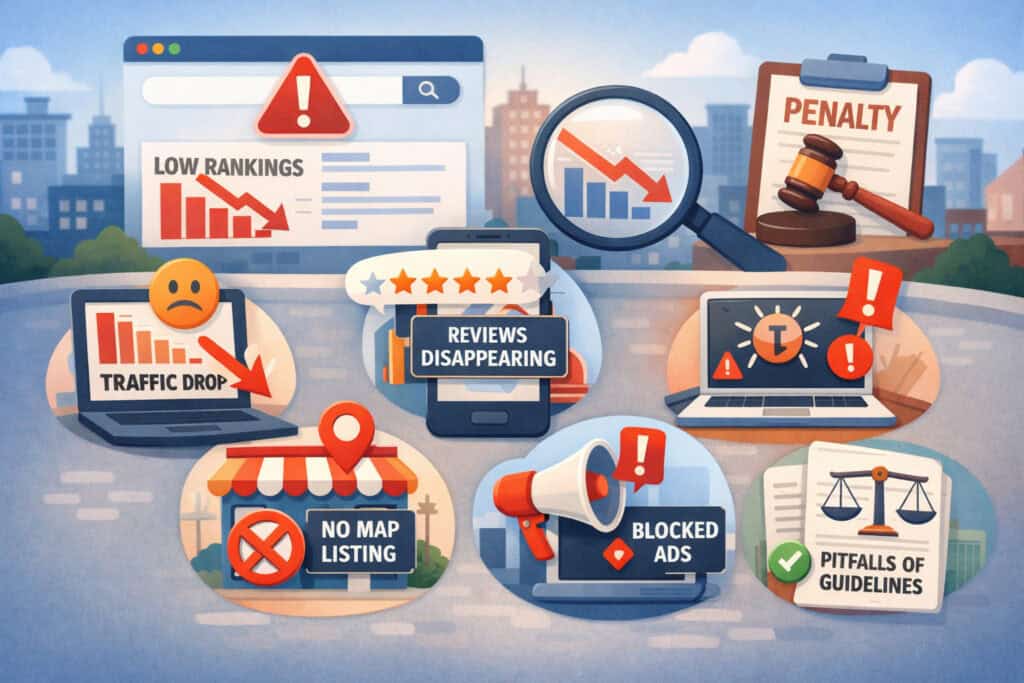
Many businesses don’t notice local SEO penalties until revenue drops. You can catch issues earlier by watching the right indicators.
If your map impressions suddenly fall while branded searches stay stable, that often signals a local filter or listing issue. If branded searches also drop, you may have a bigger trust/eligibility problem.
If your “near me” rankings vanish across multiple neighborhoods at once, it’s rarely normal competition—it often means local SEO penalties or a quality reassessment.
Also watch for “silent” listing issues: profile status changes, categories resetting, business name edits being rejected, photos removed, or review counts freezing. These can indicate heightened scrutiny.
After major spam system improvements, rankings can shift as enforcement increases and spam is filtered out. Google advises sites that see changes after spam updates to review spam policies and ensure compliance, noting it can take months for systems to learn compliance.
If you want to recover from local SEO penalties efficiently, treat early signals as your advantage. The faster you begin audits and documentation, the faster you can identify the trigger and reverse it.
Step 1: Stabilize the Situation in the First 48 Hours (Do This Before You “Fix SEO”)
When local SEO penalties hit, panic edits make recovery slower. In the first 48 hours, your job is to freeze risk, gather evidence, and prevent new triggers.
First, stop any automated listing tools that push edits to directories or your business profile. Bulk edits can look suspicious and may delay your ability to recover from local SEO penalties. Pause review generation campaigns that could create unnatural review velocity.
Pause link building, guest posts, and paid placements. You want a “quiet” environment so you can isolate cause and effect.
Next, take screenshots and export data. Capture ranking drops (by zip codes/areas), business profile performance trends, and Search Console graphs. Write down what changed recently: a new address, new suite number, a rebrand, a new website theme, a new location page campaign, or a spike in reviews.
Then check whether your issue is listing-level or site-level. If your profile is suspended or disabled, do not waste a week rewriting service pages. Your priority is to recover from local SEO penalties at the listing layer first, because map visibility drives a huge portion of local intent traffic.
Finally, decide on a single “canonical” business identity: exact business name format, address format, primary phone, and website URL. This becomes your master record for cleanup. Local SEO penalties thrive on inconsistency; recovery starts with one version of truth.
Step 2: Diagnose the Root Cause With a Local Penalty Audit (A Practical Checklist)
To recover from local SEO penalties, you need a structured audit that identifies the most likely trigger. The audit should cover four pillars: business profile compliance, website compliance, citations/entity signals, and reputation signals.
Business Profile Compliance Audit
Check your business name, address/service area, phone, primary category, secondary categories, hours, and attributes. Look for keyword stuffing in the name. Look for address issues: virtual offices, UPS stores, co-working spaces without proper signage, or suite numbers used inconsistently. Even “small” changes can trigger verification friction.
Website & Content Audit
Look for thin city pages that repeat the same content with swapped city names. Look for “doorway page” patterns: dozens of near-identical service-area pages created only to rank. Review your internal linking and headers for unnatural repetition.
If your site uses large volumes of AI-generated text, ensure it’s genuinely helpful, edited, and unique—spam policies focus on manipulative behavior, not the tool used.
Citations & Entity Signals Audit
Scan the top data sources that matter in your niche (maps apps, major directories, industry directories). Identify duplicates and conflicting NAP. Inconsistent NAP is a common reason businesses feel “penalized” locally because it reduces entity confidence and leads to ranking suppression.
Reviews & Reputation Audit
Look for review gating, incentivized reviews, or sudden bursts from the same source. Also check if negative reviews recently added keywords like “scam” or “fake location” (sometimes competitors attempt narrative attacks). You’re not just cleaning reviews—you’re cleaning trust signals.
A good audit doesn’t just list problems. It ranks them by likelihood of being the cause. That ranking is how you recover from local SEO penalties without wasting weeks on low-impact fixes.
Step 3: Recover From Google Business Profile Suspensions (The Correct Reinstatement Approach)
If your listing is suspended/disabled, your recovery plan must follow the platform’s rules. Google’s official guidance states that profiles may be suspended or disabled if they don’t follow guidelines, and if you believe your profile should be reinstated, you can submit an appeal. That means your job is to (1) remove violations, (2) prepare proof, and (3) submit a clean appeal.
Start by reverting any suspicious fields: business name with extra keywords, categories that don’t match your real services, and addresses that aren’t eligible for display. If you operate as a service-area business, use the correct service-area setup and avoid displaying an address if you don’t serve customers at that location.
Next, collect proof documentation that matches the exact business identity you’re using online. Typical proof includes business registration, utility bills, lease documents, and signage photos.
The most common appeal failures happen when documents show one name/phone/address but your profile shows another variation. Consistency is how you recover from local SEO penalties at the listing layer.
Then submit the appeal only after fixes are complete. Do not keep editing while an appeal is in progress unless the platform requests it. If you need to communicate, be concise and factual. Mention what you corrected and how it aligns with guidelines.
Finally, once reinstated, avoid “big edits” for a while. Many businesses get reinstated and then immediately re-trigger local SEO penalties by re-adding keywords to the name or swapping addresses again.
Step 4: Fix NAP Inconsistency and Citation Conflicts (The Trust Reset Local Businesses Miss)
If you’re trying to recover from local SEO penalties, citation cleanup is one of the highest-leverage moves—especially when your business has moved, rebranded, changed phone numbers, or used tracking numbers inconsistently.
NAP stands for name, address, phone. In local search, NAP consistency acts like an identity verification layer. When different sites show different information, search engines lose confidence and may suppress your visibility.
That suppression behaves like local SEO penalties because your rankings drop and stay down even when your on-page SEO looks “fine.”
Start with a citation audit. Identify:
- Old phone numbers still indexed
- Old addresses (especially previous suites)
- Duplicate profiles on major platforms
- Different business name formats (LLC vs no LLC, punctuation variations)
- Mismatched website URLs
Your goal is not to be “present on 200 directories.” Your goal is to be consistent on the sources that feed the ecosystem: major directories, maps providers, and niche authorities. Fix the top conflicts first. Then work outward.
Also, avoid creating new citations while cleanup is underway. New citations can propagate the wrong data again. To recover from local SEO penalties faster, lock your canonical NAP in a document and use it everywhere—website footer, contact page, schema, business profile, and directory profiles.
When the ecosystem converges on one identity, local rankings often stabilize. It’s not glamorous, but it’s one of the most reliable recovery levers.
Step 5: Eliminate Duplicate Listings and “Entity Splits” That Drag Down Rankings
Duplicate listings are a silent local visibility killer. Sometimes duplicates happen when a business moves. Sometimes they happen because multiple team members created profiles.
Sometimes a data provider accidentally spawns a new entry. Regardless of the cause, duplicates confuse the entity graph: reviews split, citations split, and your authority splits.
If you want to recover from local SEO penalties, treat duplicates like an emergency. Duplicates can cause map ranking volatility, incorrect pins, wrong hours, and even suspension risk when platforms interpret duplicates as spam.
Start by identifying duplicates on:
- Your business profile platform
- Major directories and maps apps
- Industry directories that rank in your niche
- Data aggregators (where relevant)
Then decide the “primary” entity. The primary should have the most accurate history, most reviews, and the correct canonical information. Merge or remove duplicates using each platform’s official process. Do not just “delete and recreate” unless a platform specifically recommends it; recreating can wipe trust.
After consolidation, re-check your citations. Many duplicates are fed by outdated citations. If your old address still exists on multiple directories, duplicates will keep resurfacing. Recovery from local SEO penalties often fails when businesses fix the listing but not the upstream sources.
Once duplicates are resolved, you typically see improvements in map pack stability, branded discovery queries, and direction requests.
Step 6: Clean Up On-Page Local Signals Without Keyword Stuffing (What Actually Moves the Needle)
A common mistake when trying to recover from local SEO penalties is over-optimizing. Stuffing city names into every header and paragraph can look unnatural and may worsen quality signals. You want to strengthen local relevance with clarity, not repetition.
Start with your core pages:
- Homepage (what you do + where you serve)
- Service pages (who it’s for, pricing approach, process, proof)
- Location pages (if you have real locations)
- Contact page (canonical NAP + map embed where appropriate)
Use local signals in a human way. Mention the city and nearby neighborhoods where it helps the user understand coverage. Include driving-distance context (“15 minutes from downtown”) if true. Add locally relevant proof: project examples, testimonials mentioning neighborhoods, photos of your team at real jobs, or case studies referencing local conditions.
Schema matters too. Add LocalBusiness schema with the same canonical NAP used everywhere. Ensure your phone number and address are consistent. These are not magic switches, but they reduce confusion—confusion fuels local SEO penalties.
Finally, refresh your internal linking structure. Your homepage should link to your primary services. Your service pages should link to your service area coverage page (if you have one). Don’t create dozens of thin city pages. To recover from local SEO penalties, fewer high-quality pages with real differentiation is usually better than a page for every suburb.
Step 7: Remove Doorway Pages and Thin “City Swap” Content (The Fastest Local Recovery Win)
If you have a page template that says the same thing with different city names, you are at risk. Search systems are designed to reduce low-value pages that exist mainly to rank. That’s especially true after broad spam improvements, where sites are encouraged to align with spam policies and quality expectations.
Doorway-like patterns often look like:
- “Plumber in [City]” pages with 90% identical text
- Pages that target every neighborhood without unique proof
- Multiple pages funneling to the same business location
- Pages with no unique photos, no unique testimonials, no unique offers, no unique service constraints
To recover from local SEO penalties, you have three options:
- Consolidate: combine many thin pages into one strong service-area page plus strong service pages.
- Differentiate: keep a limited number of location pages only if each has unique content, unique staff, unique photos, and real operational differences.
- Remove/Noindex: if pages exist only for SEO and add no user value, remove them or noindex them, then redirect thoughtfully.
When you reduce doorway patterns and improve depth, you often see “eligibility” return—first in organic results, then indirectly in map visibility (because your website is a primary corroboration source for the listing). This step alone helps many businesses recover from local SEO penalties faster than any link tactic ever could.
Step 8: Audit Your Backlinks and Stop Risky Local Link Tactics (And What to Replace Them With)
Link issues are a frequent cause of local SEO penalties—especially when a business buys “local backlinks” in bulk. The problem isn’t local links; it’s manipulative patterns: paid guest posts without disclosure, private networks, spammy directories, and unnatural anchor text (“best dentist in [city]”) repeated across many domains.
To recover from local SEO penalties, run a backlink audit and look for:
- Sudden spikes in referring domains
- Many links from unrelated sites
- Repeated exact-match anchor text
- Links from hacked pages or “casino/pills” neighborhoods
- Sitewide footer links from low-quality partners
If you find obvious manipulation, remove what you can (contact webmasters). For what you can’t remove, focus on replacing risk signals with positive ones: earn links through local PR, sponsorships, partnerships, scholarships (legit), local chambers, community events, supplier pages, and niche associations.
Also build “proof links” that validate entity legitimacy: vendor directories, professional memberships, and trusted community sites. When your link profile looks like a real business, you recover from local SEO penalties more reliably than trying to “outlink” competitors with risky tactics.
Your goal is not maximum link count. Your goal is a believable link story: local relevance + industry relevance + steady growth.
Step 9: Repair Review Signals the Right Way (Without Triggering More Local SEO Penalties)
Reviews are a huge local trust signal, but they’re also heavily abused—so platforms monitor patterns. If your recovery plan includes aggressive review pushes, you might accidentally trigger local SEO penalties again.
First, clean up process issues:
- Never gate reviews (asking happy customers to review, unhappy customers to email)
- Never incentivize reviews with discounts or gifts
- Avoid bursts (100 reviews in 10 days looks suspicious for most small businesses)
Second, build a compliant review engine:
- Ask every customer at the same point in the journey
- Use a short message with one link
- Spread requests consistently over time
- Respond to reviews professionally (especially negative ones)
Third, strengthen review diversity:
- Encourage reviews on the platform that matters most for maps visibility
- Also build on industry platforms where your customers actually look
- Use testimonials on your website (with permission) and connect them to service pages
To recover from local SEO penalties, your review strategy should look like normal business behavior: steady, customer-driven, and authentic. Platforms can spot manipulation faster than ever, and a “review hack” that worked years ago can now become the reason you lost rankings.
Step 10: Technical SEO Checks That Matter for Local Recovery (Speed, Indexing, and Trust)
Technical issues are rarely the sole cause of local SEO penalties, but they often block recovery. If search engines can’t crawl, render, and index your important pages, your other fixes won’t fully count.
Start with indexing:
- Ensure your key pages are indexable (no accidental noindex)
- Fix canonical issues that point to the wrong versions
- Confirm your XML sitemap includes your important pages
- Check for massive duplicate content caused by URL parameters
Then check performance:
- Slow pages hurt conversions and can reduce engagement signals
- Fix heavy scripts, uncompressed images, and bloated themes
- Ensure mobile usability is excellent
Also verify your on-site trust elements:
- Clear contact info and service coverage
- About page with real team/company details
- Policies (refunds, scheduling, warranties) where relevant
- Legit photos (not only stock imagery)
For local businesses, trust is practical. A fast, clear website that proves legitimacy supports your ability to recover from local SEO penalties because it reinforces the entity’s real-world presence.
Finally, ensure your tracking isn’t breaking user experience. Overloaded tracking can slow the site and create “janky” behavior. Keep what you need, remove what you don’t.
Step 11: Build a 90-Day Recovery Roadmap (What to Do Week-by-Week)
Recovering from local SEO penalties is not a one-day fix. You need a structured plan that prioritizes the biggest trust blockers first.
Weeks 1–2: Triage and Compliance
- Freeze risky changes and document recent edits
- Fix business profile violations and duplicates
- Standardize canonical NAP everywhere
- Remove doorway patterns and thin pages
This stage is about stopping the bleeding so you can recover from local SEO penalties without re-triggering enforcement.
Weeks 3–6: Trust Rebuilding
- Clean citations and resolve conflicts
- Improve core service pages with real differentiation
- Strengthen internal linking and schema
- Begin steady review collection (compliant pace)
This stage is where you rebuild entity confidence.
Weeks 7–12: Authority and Resilience
- Earn a handful of high-quality local/industry links
- Publish locally relevant content (guides, FAQs, case studies)
- Improve conversion elements (calls, forms, scheduling)
- Monitor rankings by area and adjust based on data
The goal is not just to recover from local SEO penalties, but to become harder to knock down in the next spam sweep.
Expect gradual improvements. Some recoveries are fast (especially citation/entity issues). Some take longer because automated systems need time to re-learn trust after spam filters tighten.
Future Prediction: Where Local SEO Penalties Are Headed (And How to Stay Safe)
Local spam detection is getting more automated and more entity-focused. Future local SEO penalties will likely increase around three themes:
Stronger Entity Verification
Platforms will continue tightening verification, especially for service-area businesses and categories with heavy spam. Expect more checks on address legitimacy, business name authenticity, and ownership signals. Businesses that keep clean documentation and consistent NAP will recover faster.
More Aggressive Filtering of Scaled Local Content
Large sets of near-identical city pages are an easy target for quality systems. The trend is toward fewer pages with more depth, real proof, and real-world differentiation. If your strategy is “publish 200 pages,” you’re increasing penalty risk.
More Pattern Detection Across Reviews, Listings, and Links
Spam systems increasingly connect the dots: review patterns, listing edits, link patterns, and content patterns. That means a “small” violation in one area can amplify local SEO penalties across the whole presence.
The safest strategy is simple: behave like a legitimate local business online. Publish what users need, keep identity consistent, avoid manipulative shortcuts, and invest in real community signals. That approach doesn’t just help you recover from local SEO penalties—it reduces the odds you’ll face them again.
FAQs
Q.1: How long does it take to recover from local SEO penalties?
Answer: It depends on the cause. Listing suspensions can be resolved quickly if documentation is clean, but some cases take longer due to review and verification steps. Algorithmic local SEO penalties can improve within weeks after cleanup, but after spam system changes, it may take months for automated systems to reassess trust and compliance.
Q.2: Should I create more location pages to recover faster?
Answer: Usually no. If your drop is connected to thin or doorway-like pages, adding more pages can worsen local SEO penalties. Consolidating and strengthening fewer pages with real differentiation often helps you recover from local SEO penalties faster.
Q.3: Can changing my business name back fix the issue?
Answer: If the name was keyword-stuffed or inconsistent, reverting to your real-world business name can be a major recovery step. Name manipulation is a common trigger for local SEO penalties. Keep your business name consistent with signage, documents, and citations.
Q.4: Do citations still matter for local recovery?
Answer: Yes—especially when your entity is confused. Citation consistency helps establish confidence in your business identity. If your drop followed a move, rebrand, or phone change, citation cleanup is often essential to recover from local SEO penalties.
Q.5: What if my competitors are spamming and ranking?
Answer: Spam sometimes works temporarily. But enforcement waves often reset the playing field. If you want durable rankings, focus on compliance, differentiation, and proof. Report egregious violations through appropriate channels, but don’t copy them—copying them increases your risk of local SEO penalties.
Q.6: Can I recover from local SEO penalties without an SEO agency?
Answer: Yes, if you’re systematic. The keys are documentation, consistency, policy compliance, and patience. Agencies can speed up auditing and cleanup, but the steps are the same.
Conclusion
To recover from local SEO penalties, you need a repeatable process: stabilize, diagnose, clean up violations, repair entity consistency, strengthen content quality, and rebuild trust signals over time.
The businesses that recover fastest are the ones that stop guessing and start documenting. They identify whether the issue is listing-level, site-level, or entity-level, then fix the biggest trust blockers first.
Local SEO penalties are increasingly tied to authenticity signals: real business identity, real service proof, and real customer experience. If your online presence matches your real-world operations—consistent NAP, compliant profile setup, strong service pages, steady reviews, and honest authority links—recovery is not only possible, it’s predictable.
Once you recover, keep monitoring. Don’t return to keyword stuffing, mass page generation, or risky links. The local search ecosystem is getting stricter, especially in competitive markets across the United States, and long-term winners will be the brands that build trust the right way.