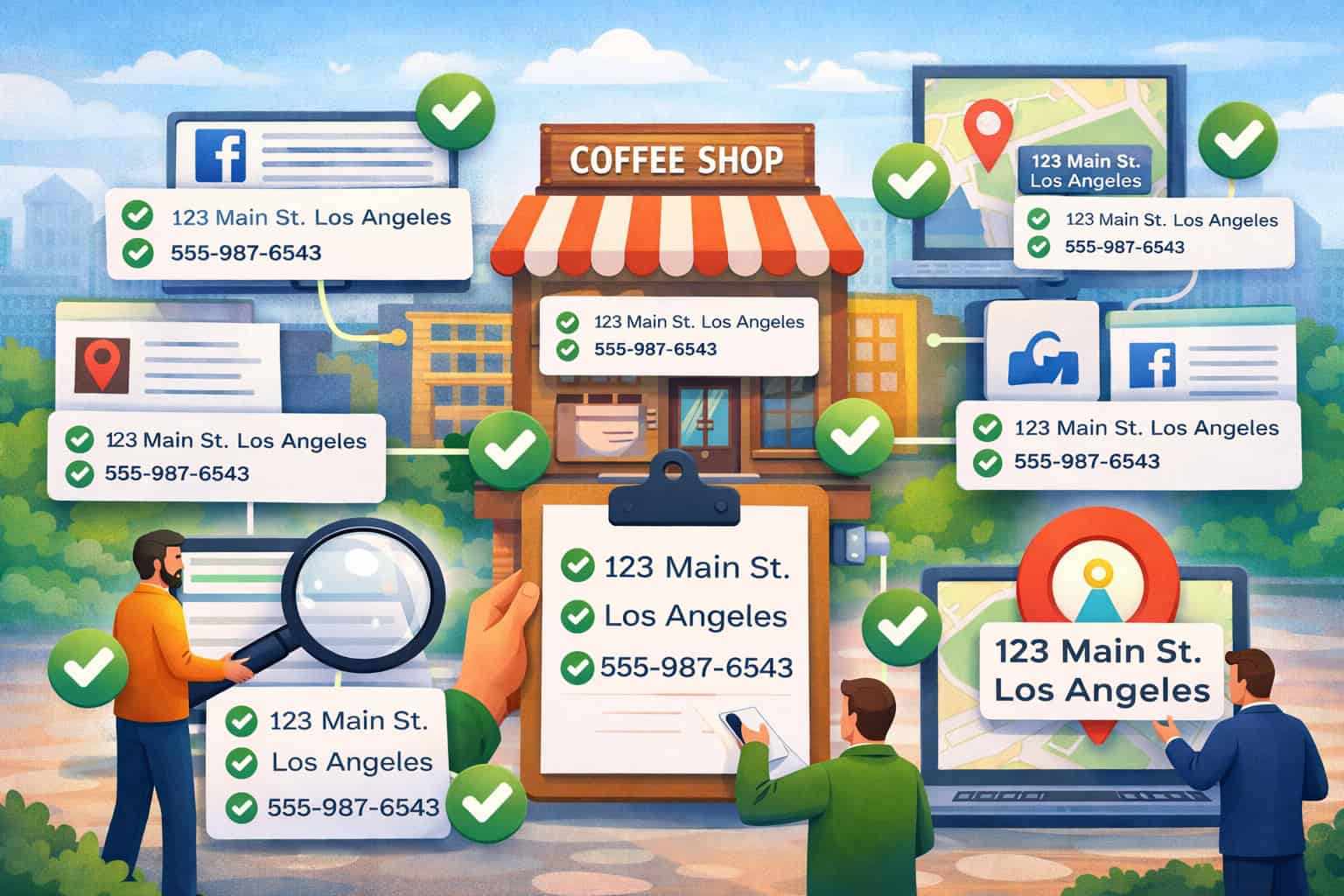
NAP Consistency: Why Your Business Address Must Be Identical Everywhere
If a customer finds your business in one place and sees a different address, phone number, or business name somewhere else, trust drops fast. Search engines notice that confusion too.
What feels like a small detail to a business owner can become a major local visibility problem when listing data starts to drift across directories, maps, review platforms, social profiles, and the business website.
That is why NAP Consistency matters so much. NAP stands for name, address, and phone number. In local search, those details act like identity signals.
When they match everywhere, search engines have more confidence in your business information. When they conflict, your local SEO signals weaken, citations lose value, and customers may hesitate to call, visit, or request directions.
For local business owners, marketers, agencies, and service providers, this is not just a technical cleanup task. It directly affects discoverability, trust, and conversions. A wrong suite number can lead to missed visits. An old tracking number can split authority. A duplicate listing can confuse both search engines and customers.
This guide breaks down NAP Consistency in Local SEO in a practical way. You will learn what counts as consistent, where businesses usually go wrong, how Local SEO NAP Accuracy supports better rankings and stronger customer confidence, and how to build a repeatable system for NAP Optimization for Local SEO across every important platform.
What NAP Consistency Actually Means for a Local Business
At the most basic level, NAP Consistency means your business name, address, and phone number appear the same way everywhere customers and search engines might find them. That includes your website, Google Business Profile, map platforms, directories, review sites, social profiles, appointment platforms, and industry-specific listing sites.
This sounds simple until real business operations get involved. A business moves. A franchise location uses a slightly different branded name. A marketing vendor adds a call tracking number to a directory.
An old listing created years ago still shows the previous address. A social profile uses one phone number while a map listing uses another. Suddenly, your business identity is scattered across the web.
For local SEO, consistency matters because search engines compare data from many sources to decide whether a business is legitimate, accurate, and relevant.
If your information matches across structured citations and unstructured mentions, those consistent references work together as trust signals. If they conflict, search engines are left with uncertainty.
Customers respond the same way. When people search for a local business, they often check several sources before taking action. They may see your Google Business Profile, visit your site, read reviews on a third-party platform, and pull up directions on a map app. If the details line up, your business feels dependable. If they do not, hesitation sets in.
Name Address Phone Consistency also affects the real customer journey. Someone calling the wrong number, driving to the wrong address, or seeing two similar business names may abandon the search and choose a competitor instead.
Why NAP data is more than just contact information
NAP is often described as simple contact data, but in local search it does much more than help people reach you. It tells search engines that your business is real, active, and tied to a specific location or service area. That makes it a core part of your local search identity.
When search engines crawl and compare local listings, they look for patterns. They want to see repeated confirmation that your business exists at the same address with the same core details. That repeated confirmation strengthens citation trust. It also supports the accuracy of map results, knowledge panels, and local pack displays.
For service providers, the importance is just as strong even when customers do not visit a storefront. A consistent service-area business listing still needs accurate name, phone, and website details. If the phone number changes between your Google profile and your website footer, you create uncertainty even without a publicly displayed address.
NAP also supports customer behavior far beyond discovery. It affects calls, direction requests, appointment bookings, and form submissions. If a prospect wants immediate help and sees conflicting contact details, they may not take the extra step to figure out which version is right.
That is why business information accuracy should be treated as both a marketing issue and an operations issue. It is not just about rankings. It is about giving people a friction-free path from search to contact.
Where NAP Consistency shows up online
Most businesses think about Google first, but NAP Consistency in Local SEO depends on a wider ecosystem. Search engines gather business data from many public and semi-public sources. If your information is aligned across those sources, your local profile becomes stronger and easier to validate.
Important places where NAP appears include:
- Google Business Profile
- Your website header, footer, and contact page
- Location pages
- Map apps and navigation services
- Local directories
- Industry directories
- Review platforms
- Social media profiles
- Booking and appointment platforms
- Chamber, association, and community listings
- Data aggregators and listing distribution networks
Each of these sources plays a role in your broader local citation profile. Some are structured citations, where your business data appears in dedicated fields. Others are unstructured citations, where your business is mentioned in an article, directory article, event listing, sponsorship page, or blog post.
The goal is not to be everywhere at once. The goal is to make sure the places that matter most reflect the same core business details. That is where directory listing accuracy and directory synchronization become essential. If one platform auto-syncs an outdated version of your information into several other sites, a small error can spread quickly.
Why NAP Consistency Matters for Local SEO, Trust, and Discoverability

Search engines want to show reliable local results. When they see the same business details repeated across trusted sources, that consistency becomes a confidence signal. It helps confirm that the business is legitimate, located where it says it is, and reachable through the details displayed in search results.
That is why NAP Consistency in Local SEO is closely tied to discoverability. It supports the broader network of local SEO signals that influence whether a business appears in map results, the local finder, branded searches, and location-based organic searches. While NAP is not the only local ranking factor, it strengthens the foundation that other signals rely on.
From a user perspective, consistency supports trust. Local customers are often making fast decisions. They may need a service urgently, want quick directions, or compare several options before choosing one. Conflicting business information creates friction at the exact moment the customer wants certainty.
Inconsistent NAP can also reduce the strength of local citations. Instead of several listings reinforcing the same business identity, you end up with fragmented versions of your business across the web. That weakens citation strength and can dilute the local authority you would otherwise build.
This is where Local SEO NAP Accuracy becomes practical, not theoretical. Accurate NAP helps search engines connect the dots between your website, profiles, citations, and reviews. It also helps customers move from search to action with less hesitation.
For local businesses competing in crowded categories, trust and clarity often make the difference. Stronger local search trust signals can lead to more calls, better click-through behavior, and higher conversion rates even before rankings improve.
How search engines use consistent business information
Search engines evaluate local businesses through layers of evidence. Your website provides one layer. Your Google Business Profile provides another. Citations, map listings, reviews, and mentions across third-party platforms add more layers. The more those layers agree, the easier it is for search engines to trust the information they display.
When your name, address, and phone number are consistent, search engines can connect listings confidently. That helps consolidate authority rather than splitting it between slightly different versions of the same business. A consistent citation profile also supports business profile accuracy, which can improve the reliability of local results tied to your location.
Problems begin when there are multiple signals pointing in different directions. Search engines may encounter:
- An old address in one directory
- A newer phone number on your website
- A shortened business name on a review platform
- Duplicate map listings with minor differences
- Multiple suite formats across directories
Each mismatch introduces uncertainty. A single small issue may not destroy visibility, but patterns of inconsistency can weaken confidence and reduce the benefit of your citation footprint.
This is especially important for businesses trying to improve map pack rankings. Local results depend on relevance, proximity, and prominence, and prominence is partly shaped by the trustworthiness and consistency of your wider business presence online.
Citation quality, profile completeness, reviews, and connected signals all work better when your core NAP data is stable.
Why customers trust identical details across platforms
People do not always notice good NAP data, but they notice bad NAP data quickly. If your Google listing shows one phone number and your website shows another, the customer may wonder whether the business is still active.
If a map platform shows a different address than a review site, the customer may worry about wasting time driving to the wrong location.
Trust is built through repetition. When the same business details appear across multiple sources, customers feel reassured that the business is established and reliable. That confidence matters even more in categories where the customer may be anxious, pressed for time, or making a higher-value decision.
Consistent NAP also affects offline experiences. A customer who arrives at the wrong suite, calls a disconnected number, or finds an outdated listing may not give you a second chance. In local search, convenience matters. Even small confusion can send the lead elsewhere.
This is why local business discoverability is not only about being found. It is also about being believed. You want a potential customer to move from discovery to contact without feeling the need to double-check every detail.
Exact consistency vs acceptable formatting variations

A common question in local SEO is whether everything has to match character for character. The practical answer is this: your business identity should be identical in meaning and highly consistent in presentation, but some formatting variations are usually acceptable if they do not change the underlying information.
For example, “Suite” versus “Ste” often does not create major issues when the address clearly refers to the same unit. “Road” versus “Rd” is usually understandable. But “Main Street Dental Clinic” in one place and “Main St.
Dental Center & Cosmetic Care” in another may create enough variation to confuse both users and search systems.
The goal is not robotic uniformity for every punctuation mark. The goal is a clear, repeated, stable identity. Your business name should not shift based on marketing campaigns. Your address should not appear with different suite handling in random places.
Your phone strategy should be deliberate rather than scattered. That is what strong location data consistency looks like in practice.
This is where businesses often get into trouble. They assume minor differences do not matter, then end up with many small differences layered across dozens of platforms. Those differences add up.
One abbreviation alone may be harmless. Ten variations across many citations can weaken confidence and make citation cleanup more difficult.
A smart local SEO approach focuses on standardization. Choose a preferred formatting version for your core NAP data and use it consistently across all major properties. The more disciplined you are, the easier your local listing management becomes over time.
Which NAP variations are usually harmless and which are risky
Not all variations carry the same weight. Some are cosmetic. Others change the identity enough to cause citation fragmentation or customer confusion. Knowing the difference helps you prioritize cleanup efforts.
Usually lower-risk variations include:
- “Street” vs “St”
- “Suite” vs “Ste”
- “Avenue” vs “Ave”
- Phone formatting differences like parentheses or dashes
- Minor punctuation differences
More risky variations include:
- Different business names across platforms
- Different phone numbers used publicly without a clear strategy
- Missing suite numbers in some listings
- Old addresses that remain live after a move
- Call tracking numbers replacing the main number in citations
- Franchise modifiers added inconsistently
- Multiple duplicate listings for the same location
The biggest rule is that the core identity should remain unchanged. If a customer or search engine could interpret two listings as different businesses, you have a problem.
For multi-location brands, the risk grows because one small inconsistency can spread across several locations. If one branch uses the parent brand name only and another uses a longer local variant, citation patterns become harder to unify.
Address formatting consistency is especially important where suite numbers, building names, floor numbers, or unit identifiers matter for navigation. A missing or inconsistent unit detail can lead to missed visits and poor customer experiences even when the street address is technically correct.
How to standardize NAP without becoming overly rigid
The best way to standardize NAP is to create a preferred version of your business details and treat it as your master reference. That version should be used on your website first, then rolled out to your Google Business Profile and other major listings.
A good standardization approach includes:
- One official business name format
- One primary business phone number for citation use
- One approved address format with consistent suite handling
- One website URL format
- One location-specific rule for multi-location naming
You do not need to panic about every tiny abbreviation. What matters is disciplined repetition. Standardization should reduce confusion, not create endless formatting debates inside the marketing team.
This is also where NAP Optimization for Local SEO becomes operational. It is not only about fixing errors. It is about reducing future inconsistency by giving everyone the same approved record to work from. That includes agencies, franchise teams, assistants, listing vendors, and anyone who touches local profiles.
Where NAP must match: Google, directories, maps, social profiles, and your website

When people talk about NAP, they often think first of directory sites. But Local SEO NAP Accuracy depends on a much broader footprint. Your website, your Google Business Profile, map apps, social channels, review platforms, and booking tools all contribute to the public identity of your business.
The most important place to start is your own website. If your site shows one version of your business details while third-party listings show another, you are weakening your own authority. Your website should be the anchor source. It should present your preferred NAP clearly in the header, footer, contact page, and location pages where relevant.
Google Business Profile is next because it is often the most visible local asset. Customers use it to call, request directions, read reviews, and decide whether to visit or contact you. Any inconsistency between your Google profile and your website can create confusion for both users and search engines.
Directories and review platforms matter because they act as validating sources. The stronger and more consistent your citation profile, the easier it is for search engines to trust your core business information.
Social profiles matter too, especially when they rank for branded searches. If a customer finds your social account before your website, those details still need to be right.
For businesses building stronger local visibility, it helps to connect NAP work with broader local SEO systems like tracking, on-site optimization, and schema. Resources such as How to Track Local SEO Performance and Schema Markup for Local Businesses can support that larger effort when you are improving business data across platforms.
Why your website should be the source of truth
Your website is the one digital asset you control most fully. That makes it the best place to establish your official NAP record. If your citations are inconsistent, your website should show the definitive version that every other platform is meant to match.
This means your core contact details should not be buried or inconsistent across pages. Businesses often make this mistake when:
- The footer shows an old phone number
- The contact page shows a newer one
- The homepage uses a call tracking number
- Location pages use slightly different brand names
- The schema markup contains outdated address data
These problems make it harder for search engines to trust your business information. They also make internal cleanup harder because your own site is no longer a reliable reference.
For single-location businesses, the solution is simple: use one clear NAP version across the site. For multi-location businesses, each location should have its own dedicated page with location-specific details, and the parent brand naming should follow a consistent rule.
Website consistency also supports conversion. A customer landing on your site after seeing your Google listing should immediately recognize the same business name, same contact details, and same location identity. That continuity reduces drop-off and improves confidence.
Why Google Business Profile consistency matters so much
Google Business Profile is often where local intent turns into action. A prospect may never even visit your website before calling or requesting directions. That makes Google Business Profile consistency one of the most important parts of your local presence.
Your profile should match your website on the essentials:
- Business name
- Address
- Primary phone number
- Website URL
- Hours and service area details, where relevant
If the business name in your profile is stuffed with keywords while your site uses a cleaner brand name, that disconnect can look suspicious. If the phone number differs from your main public number, citation strength may split. If the address format varies across Google, your site, and major directories, you risk customer confusion and weaker trust signals.
This consistency also matters when duplicate profiles exist. A duplicate listing can siphon reviews, split visibility, or show outdated information. That is especially damaging for businesses that moved, rebranded, or previously used temporary numbers.
For businesses recovering from visibility issues, NAP cleanup can be one part of a broader repair process. A guide like How to Recover From Local SEO Penalties can be useful when local problems go beyond basic listing corrections.
Pro Tip: If your Google profile, website, and top directory listings all match perfectly, you have already done the most important part of NAP cleanup.
How inconsistent NAP hurts rankings, citations, and customer conversions
Inconsistent NAP rarely causes one dramatic failure on its own. Instead, it creates a chain of small problems that quietly undermine your visibility and conversions over time. It weakens citation strength, introduces confusion into local search signals, and adds friction to customer actions.
One of the most common consequences is citation dilution. Instead of many listings reinforcing one business identity, you end up with several partial versions of the same business. Search engines then have to decide which version is correct, and the overall trust value of those citations becomes less effective.
Another issue is duplicate business listings. This often happens after a move, rebrand, or listing sync error. Duplicate profiles can compete with each other, split review signals, and show conflicting information to customers. That makes business listing consistency harder to maintain and can disrupt map pack rankings.
Then there is the direct customer cost. A wrong phone number can mean missed calls. A wrong address can mean lost visits. A missing suite number can frustrate a customer enough to give up before they ever reach your door. These are real conversion problems, not just SEO theory.
Inconsistent NAP can also weaken your credibility in more subtle ways. When business information varies across platforms, customers may assume the business is disorganized, outdated, or less established than competitors with cleaner listings.
The table below shows how common NAP issues create practical problems and what to do about them.
| Common NAP Inconsistency | Why It Hurts | How to Fix It |
| Old address still live on directories | Sends customers to the wrong location and confuses search engines | Update or suppress outdated listings and confirm the current address everywhere |
| Different phone numbers across platforms | Splits citation trust and causes missed calls | Choose one primary public number and use it consistently in citations |
| Missing suite or unit number | Can lead to failed visits or delivery issues | Standardize the full address format and update all major listings |
| Keyword-stuffed business name in some places | Creates brand mismatch and possible trust issues | Revert to the official business name across all platforms |
| Duplicate listings for the same location | Splits reviews, authority, and engagement signals | Merge, remove, or report duplicates and keep one canonical profile |
| Rebrand reflected only on some sites | Creates identity confusion for users and search engines | Roll out the new business name across all major citations and owned assets |
| Tracking number used in directory listings | Weakens Name Address Phone Consistency | Keep tracking numbers off core citation fields and use them carefully on site or in campaigns |
| Slightly different location naming across multi-location pages | Makes it harder to connect all signals correctly | Create a clear naming convention and apply it across every location asset |
The local SEO costs of inconsistent citation data
When citation data is inconsistent, the impact often shows up as slower local growth rather than a sudden drop. You may struggle to improve rankings even while doing other things right.
You may see one location perform well while another lags for no obvious reason. Or you may find that your visibility is unstable, with map results appearing and disappearing more often than expected.
This happens because citations help reinforce business identity. If your structured citations are fragmented, they cannot work together as strongly. Search engines may still understand your business, but their confidence level is lower than it should be.
This is why citation audit work is so important. You need to identify whether your citation network is supporting a single consistent business profile or several conflicting versions of it. The more competitive your local category is, the more these details can matter.
For agencies and in-house marketers, citation cleanup also creates leverage. It is one of the few local SEO tasks that improves both trust and usability. You are not only helping rankings. You are reducing customer friction at the same time.
The customer and conversion costs of wrong business details
Business owners sometimes underestimate how often customers rely on third-party listing data. Many prospects will never start on your website. They may search in a map app, ask a voice assistant, browse a directory, or check a social profile first. If those details are wrong, your marketing funnel breaks before the customer ever reaches your site.
Conversion losses from bad NAP data often look like:
- Calls going to an outdated number
- Lost walk-ins due to wrong map directions
- Appointment no-shows tied to incorrect location data
- Lower trust when branded searches show conflicting details
- Review complaints caused by inaccurate listings
These issues affect service businesses and storefront businesses differently, but both can lose revenue. A clinic with the wrong suite number may frustrate patients.
A home service company with inconsistent phone numbers may miss urgent calls. A restaurant with an outdated address on a review site may lose diners before they ever compare the menu.
The most common causes of NAP inconsistency
Most NAP problems do not begin with bad intent. They begin with business changes and messy execution. A business grows, moves, rebrands, adds locations, hires an agency, changes phone systems, or experiments with call tracking. Each change creates new opportunities for listing drift.
The challenge is that local data spreads far beyond the platforms you actively manage. One outdated directory can feed several others. A profile created by a former employee may remain live. A marketplace listing might pull old information from another source. By the time a business notices, the same error may appear across many sites.
Understanding the causes of inconsistency helps you prevent them. It also helps you prioritize cleanup. Some issues are easy to fix, such as updating your website and Google profile. Others require detective work, especially when duplicates or legacy listings are involved.
For service providers, one common mistake is treating the phone number casually. Different campaign numbers appear in different listings, and suddenly Name Address Phone Consistency is broken across the web.
For location-based businesses, address details tend to create the most trouble, especially when suite numbers, floor numbers, or cross-street descriptions are handled inconsistently.
Once you know the main triggers, you can build safeguards around them. That is where local listing management shifts from reactive cleanup to proactive control.
Moves, rebrands, franchise naming, and tracking numbers
A business move is one of the biggest NAP risk points. Even after you update the major platforms, older listings can remain live for a long time. Some directories may publish the new address quickly while others keep the old one. If the phone number changes too, the inconsistency multiplies.
Rebrands create a similar issue. The official business name changes, but old branded listings remain indexed. Customers searching for the new business may find the old name on review sites or niche directories, which can reduce trust and split citation signals.
Franchise and multi-location businesses face another layer of difficulty. One location may use the parent brand name only, while another uses a local descriptor or neighborhood label. If those naming rules are not documented, listing consistency becomes difficult to scale.
Tracking numbers can create major problems when they replace the primary business phone number in public citations. Call tracking has a place in marketing, but core listing data should remain stable. If different directories publish different public numbers, your citation profile becomes fragmented and customer confidence may drop.
Old directories, duplicates, and inconsistent address formatting
Not every NAP issue comes from a major business change. Many come from neglect. A profile created years ago is forgotten. A duplicate is never merged. A staff member creates a new listing instead of claiming the old one. These small mistakes pile up over time.
Address formatting is especially tricky because businesses often assume it does not matter. One listing may include a suite number. Another may leave it out.
A third may put the suite in a second line that some directories ignore. The result is inconsistent address formatting consistency, which can affect both discoverability and real-world navigation.
Duplicate business listings are often the most damaging version of this problem. They can happen because:
- A business moved and the old profile stayed live
- A staff member created a second listing by mistake
- A directory auto-generated a profile from public data
- A sync vendor pushed a second version into the ecosystem
Duplicate listings confuse customers and weaken trust signals. They also make review management harder because ratings and engagement can be split between versions.
How to perform a citation audit and clean up inconsistent listings
A strong citation audit is the fastest way to understand the real state of your NAP footprint. It shows where your business details match, where they conflict, and where duplicates or outdated records are creating risk. Without an audit, businesses often fix the obvious listings and miss the deeper issues still affecting local trust signals.
Start by defining your official NAP record. This should include your approved business name, address, phone number, website URL, and location naming convention if you have multiple locations. Once that is set, compare it against every major platform where your business appears.
Your first priority should be your owned and highest-impact assets:
- Website
- Google Business Profile
- Major map apps
- Top review platforms
- Core local directories
- Industry-specific directories
Then move outward into secondary listings and niche citations. The goal is to identify inconsistencies, not just collect links. You want to know which listings are correct, which are outdated, which are duplicates, and which need suppression or manual edits.
For teams managing several locations, create an audit sheet for each location separately. Multi-location cleanup gets messy when records are mixed together.
This process is not glamorous, but it is valuable. NAP Optimization for Local SEO becomes much easier once you can see the entire data picture rather than guessing from a few branded search results.
A practical citation audit process you can actually follow
A citation audit works best when it follows a repeatable process. The steps below keep it manageable for both single-location and multi-location businesses.
Start with your master record. Then:
- Search your business name, old business names, phone numbers, and addresses
- Record every major listing you find
- Mark each listing as correct, incorrect, duplicate, or unclaimed
- Note any differences in the business name, address, suite number, and phone number
- Flag listings that appear to syndicate data to other platforms
- Prioritize the highest-visibility platforms first
- Update, claim, suppress, or merge records based on the issue type
Also check your website carefully. Audit the footer, contact page, location pages, schema markup, and mobile click-to-call links. Sometimes the inconsistency begins on your own site.
For agencies, this is where documentation matters. Keep screenshots or notes for hard-to-edit platforms. Record login ownership where possible. Track what has been fixed and what still needs follow-up.
How to clean up listings and keep them clean
Once the audit is complete, cleanup should follow a priority order. Fix the listings that customers and search engines are most likely to see first. That usually means your website, Google Business Profile, major directories, major maps, and key review platforms.
Then tackle duplicates and outdated records. If the platform allows a merge, use it. If it allows suppression or closure, choose the option that best prevents confusion. If a listing cannot be edited directly, document the issue and follow the platform’s support process.
After cleanup, the next challenge is prevention. Businesses often clean up NAP once, then let it drift again because there is no system in place.
A better approach is to create a maintenance workflow:
- Keep one master business information record
- Require all staff and vendors to use it
- Review high-priority listings regularly
- Audit after any move, rebrand, phone change, or location update
- Watch for duplicates after sync changes or new listings
This is where directory synchronization can help, but only if your source data is accurate. Automation can spread correct data quickly, but it can also spread mistakes quickly if the original record is wrong.
Building a master NAP record and ongoing listing management system
The businesses that maintain strong NAP Consistency over time usually do not rely on memory. They rely on systems. The most useful system is a master business information record that acts as the official source for every platform, location, and partner involved in local marketing.
This record should be simple, clear, and easy to access. It should include your exact business name, full address, preferred suite formatting, primary public phone number, website URL, business hours, and any approved location naming conventions. For multi-location businesses, each location should have its own entry with no ambiguity.
A master record does more than support cleanup. It prevents future inconsistency by giving marketers, assistants, agencies, and franchise managers one approved version to use when creating or updating profiles. That reduces the chance of someone improvising details from memory and creating a new mismatch.
This system also supports local listing management at scale. When a business expands, changes vendors, or updates internal teams, documentation protects the quality of the citation ecosystem. It turns NAP work from a one-time repair job into an operational standard.
If your business handles local SEO internally, assign ownership. If you work with an agency, make sure listing governance is part of the relationship. NAP problems often reappear when nobody is clearly responsible for keeping location data accurate across all touchpoints.
What to include in your master business information record
A useful master record should go beyond just name, address, and phone. It should help your team publish the same details everywhere without guessing. That means including every field that commonly gets mishandled.
A strong master record typically includes:
- Official business name
- Alternate legal name, if different from public-facing brand name
- Full street address
- Approved suite or unit format
- Primary business phone number
- Website URL
- Approved location page URL
- Hours of operation
- Category notes for key platforms
- Service-area details, if relevant
- Old addresses or numbers to monitor during audits
- Platform owner or login responsibility
This document should live somewhere accessible and controlled. It should not be hidden in someone’s inbox or buried in a past project folder. The easier it is for your team to find, the less likely they are to create a new variation.
For agencies handling several client locations, this record becomes essential. It reduces rework, speeds up onboarding, and makes citation cleanup far more consistent.
How to maintain NAP Consistency after major business changes
Major changes are where strong systems prove their value. If your business moves, rebrands, changes its phone system, or opens a second location, you need an update process ready before the change goes live publicly.
A good update process includes:
- Revising the master record first
- Updating the website immediately
- Updating Google Business Profile next
- Updating major citations and directories
- Checking maps and review platforms
- Monitoring for duplicates or old listings
- Running a follow-up audit after the rollout
For multi-location businesses, consistency rules should be built into expansion plans. Every new location should launch with a documented naming structure, approved phone strategy, and standardized address format from day one.
Businesses that skip this often create avoidable cleanup work. They change the website but not the listings. Or they update Google but forget the review platforms. Or they launch a rebrand with inconsistent naming across locations.
NAP best practices for service businesses, retail stores, clinics, restaurants, agencies, and multi-location brands
While the principles of NAP Consistency apply to every local business, the way they show up can vary by business model. A retail store has different location needs than a service-area company. A clinic has different navigation concerns than an agency. A restaurant often depends heavily on map accuracy and third-party directory details. Multi-location brands have to coordinate everything at scale.
The good news is that the core rule stays the same: one clear business identity per location, repeated consistently across the web. The practical details change depending on how customers find and use your business information.
For storefront businesses, address precision is critical. For service businesses, phone number consistency often plays a bigger role because the customer may call before they ever visit. For agencies and professional service firms, branded trust can be heavily influenced by listing alignment across review sites, directories, and the website.
A category-specific approach helps because it keeps NAP work tied to real customer behavior. Instead of treating listing cleanup as generic SEO maintenance, you can connect it directly to the way people choose and contact your business.
What NAP Consistency looks like for customer-facing locations
Retail stores, clinics, restaurants, salons, fitness studios, and similar locations depend heavily on accurate physical location data. If the address is wrong, the suite number is missing, or maps point to the wrong entrance, the customer experience breaks fast.
For these businesses, focus on:
- Exact address accuracy across major platforms
- Consistent suite or unit handling
- Matching business name across website, Google, and review sites
- Correct map pin placement
- Updated phone and hours data everywhere
- Duplicate suppression after moves or renovations
Restaurants and clinics often see extra risk because customers may rely on third-party platforms first. A diner may look at a review app before the website. A patient may call from a map result without visiting the site at all. That means citation and profile accuracy directly affect customer actions.
Retail stores also benefit from strong location pages and structured data that reinforce the same identity your listings show publicly. The cleaner the alignment, the easier it is for both users and search systems to trust your location data.
What NAP Consistency looks like for service-area and multi-location businesses
Home services, mobile providers, consultants, agencies, and service-area businesses still need strong Name Address Phone Consistency, even when customers do not walk into a storefront. In these cases, phone consistency and website alignment often matter most.
Service-area businesses should be especially careful with phone strategy. If you use multiple public-facing numbers across directories, social profiles, and your website, you make it harder to build a unified citation profile. Use one primary public number wherever possible and handle campaign tracking carefully.
Agencies and professional services often face a naming challenge too. A business may use a formal legal name in some places and a shorter brand name elsewhere. That creates inconsistency that weakens branded trust. Pick one public-facing name standard and stick to it.
Multi-location businesses face the largest operational challenge. Each location needs its own clean, consistent record, but the brand also needs a clear naming convention. Without one, listings become uneven across locations and local signals get harder to manage.
For these businesses, business profile accuracy and directory synchronization are essential. But they only work well when the underlying location records are standardized first.
Step-by-step checklist to audit, standardize, and maintain NAP Consistency
The most effective way to improve NAP Consistency in Local SEO is to treat it like an ongoing process instead of a one-time fix. The checklist below gives you a practical system for getting your business data under control and keeping it that way.
Start with your source of truth. Then move outward through the platforms that matter most. Do not try to clean everything at once without a plan. A structured process is faster, cleaner, and much less likely to create new inconsistency.
NAP Consistency audit and standardization checklist
- Create your official master business information record
- Confirm the exact business name you want used publicly
- Confirm the exact address format, including suite or unit handling
- Choose one primary public business phone number
- Standardize your preferred website URL format
- Update your website header, footer, contact page, and location pages
- Check your site’s schema markup for matching business data
- Review your Google Business Profile for exact alignment
- Audit major map apps and navigation platforms
- Audit major review platforms
- Audit top local directories
- Audit industry-specific citations
- Search for old addresses, old phone numbers, and old business names
- Identify and document duplicate business listings
- Merge, remove, suppress, or correct duplicates
- Replace outdated NAP data on secondary listings
- Check social profiles for matching contact details
- Review appointment and booking platforms
- Confirm local landing pages match listing data
- Store all logins, ownership notes, and update dates in one place
- Set a recurring review schedule for priority listings
- Re-run the checklist after any move, rebrand, or phone change
Common mistakes to avoid during cleanup and maintenance
Many businesses create new problems while trying to fix old ones. A few common mistakes appear again and again during local listing work.
Avoid these pitfalls:
- Changing formatting repeatedly without a standard
- Using different phone numbers on different public platforms
- Forgetting old directories after a move
- Leaving duplicate profiles live
- Letting multiple agencies create listings independently
- Updating major listings but ignoring the website
- Rebranding inconsistently across locations
- Using keyword-heavy business names in some places but not others
- Assuming minor issues will fix themselves
Another mistake is treating listing work as separate from the rest of local SEO. Your NAP data should align with your website structure, local content, schema, and reporting. If you are working on broader performance improvements, guides such as How to Track Local SEO Performance can help connect listing accuracy with the metrics that matter.
What is NAP Consistency in Local SEO?
NAP Consistency in Local SEO means your business name, address, and phone number appear the same way across your website, Google Business Profile, directories, map apps, review sites, and social profiles. This consistency helps search engines trust your business data and helps customers feel confident that they are contacting the right business.
Does every NAP detail need to match exactly?
The most important goal is that the business identity stays the same everywhere. Small formatting variations like “St” versus “Street” are often less serious than bigger differences such as different phone numbers, missing suite numbers, or different business names. Still, the more standardized your formatting is, the easier it is to maintain trust and avoid listing confusion.
Why does Local SEO NAP Accuracy matter so much?
Local SEO NAP Accuracy matters because search engines compare business data across many sources. When those sources align, your citation profile becomes stronger and your local presence looks more trustworthy. Accurate listings also help customers call the right number, visit the right location, and trust your business faster.
Can inconsistent NAP hurt map pack rankings?
Yes, it can. Inconsistent business details may weaken citation strength, create duplicate listing issues, and reduce confidence in your business profile accuracy. While NAP is only one part of local ranking factors, poor consistency can make it harder to compete in map results and other local search placements.
What is the biggest NAP mistake businesses make?
One of the biggest mistakes is using multiple public phone numbers across platforms. Another is failing to update old listings after a move or rebrand. Duplicate business listings are also a major issue because they can split authority, reviews, and engagement signals.
How often should I audit my local citations?
A full citation audit should be done whenever there is a major business change, such as a move, rebrand, new phone number, or additional location. Even without major changes, it is smart to review your highest-priority listings regularly to catch duplicates, outdated details, and sync errors before they spread.
Is NAP Consistency important for service-area businesses too?
Yes. Even if customers do not visit your physical location, Name Address Phone Consistency still matters. Your business name and phone number should remain consistent across public listings, and your service-area information should align across your website and major profiles. Search engines and customers still rely on those details to validate your business identity.
What is the first step in NAP Optimization for Local SEO?
The first step in NAP Optimization for Local SEO is creating a master business information record. Once you define the exact version of your business name, address, phone number, and website URL, you can use that record to update your website, Google Business Profile, directories, and all other listings consistently.
Conclusion
NAP may look simple on the surface, but it plays a powerful role in local search performance, customer trust, and conversion quality.
When your business name, address, and phone number are identical everywhere that matters, you send stronger signals to search engines and reduce friction for customers. When those details drift, your citations weaken, your listings become less trustworthy, and your local visibility can suffer in ways that are easy to miss.
That is why NAP Consistency should be treated as a core local marketing standard, not a small cleanup task.
It supports local citations, business listing consistency, Google Business Profile consistency, and the broader network of local SEO signals that influence discoverability and map visibility. It also protects real-world customer actions like calls, direction requests, bookings, and visits.
The most successful businesses do not just fix NAP once. They document it, standardize it, and manage it over time. They use one master record, audit their citation profile regularly, and respond quickly to changes like moves, rebrands, or new locations. That is how NAP Optimization for Local SEO becomes sustainable.
If you want stronger local trust, better Local SEO NAP Accuracy, and a cleaner path from search to conversion, start with the fundamentals. Make your business address identical everywhere it appears.
Then do the same for your name and phone number. Local visibility gets stronger when your business identity becomes impossible to misunderstand.