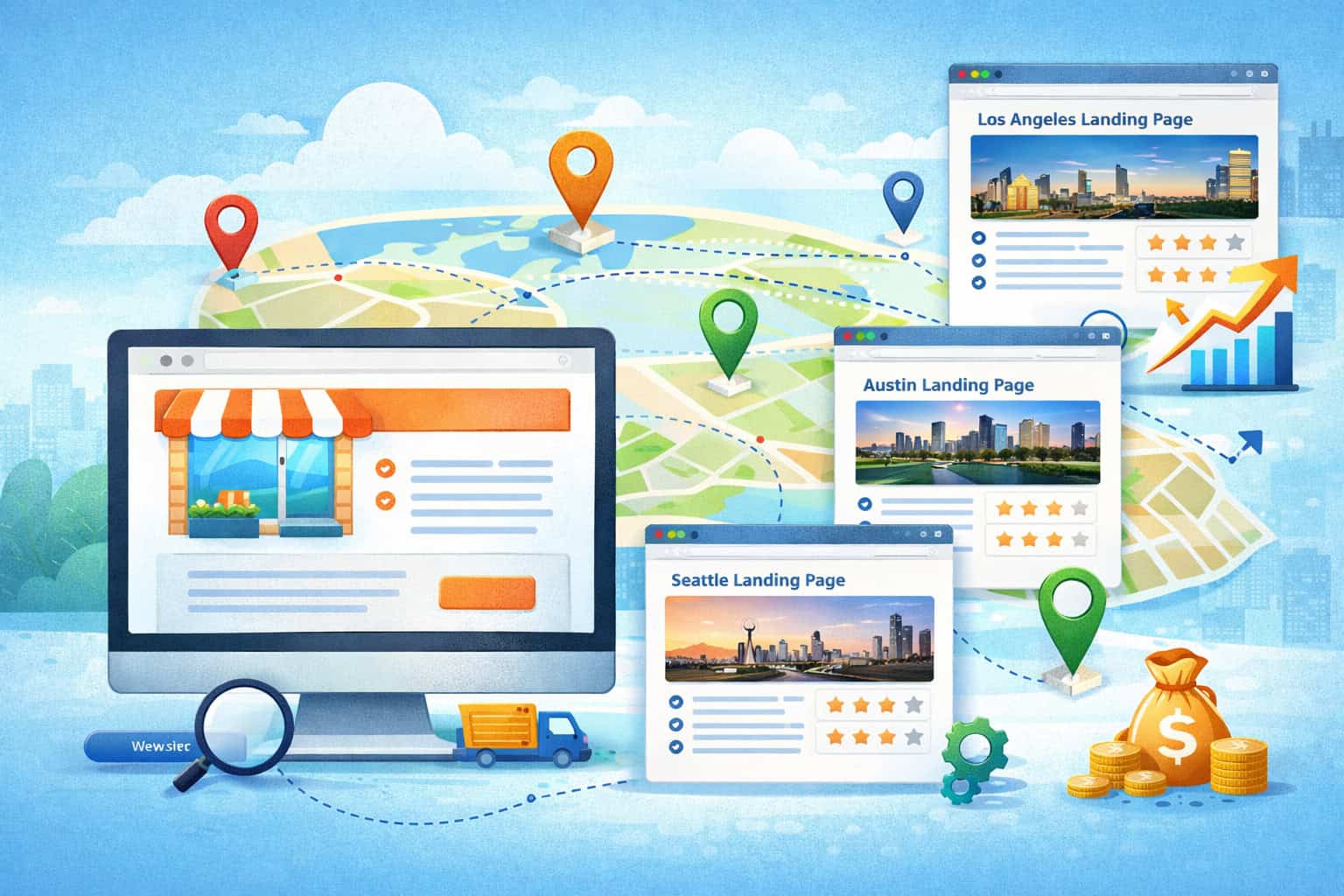
How to Create Location-Specific Landing Pages for Multiple Service Areas That Rank, Convert, and Scale
If your business serves more than one city, neighborhood, suburb, or region, your website needs to do more than say, “We serve everywhere.” That kind of broad message is too vague for search engines and too weak for real visitors.
When people search for a service near them, they want proof that you actually work in their area, understand local needs, and can help without friction. That is exactly why businesses need to create location-specific landing pages for multiple service areas instead of relying on one generic service page.
Done well, these pages improve visibility, build trust, and increase local conversions. Done poorly, they become thin, repetitive pages that offer little value and struggle to rank. The difference comes down to structure, usefulness, local relevance, and how clearly each page matches local search intent.
This guide explains how to build high-quality Location-Specific Landing Pages for Multiple Service Areas in a way that helps both users and search engines.
You will learn how to plan your page structure, choose the right locations, write unique local content, avoid duplicate content problems, strengthen internal linking, support Google Business Profile landing pages, and create pages that actually convert.
Whether you run a home service company, clinic, law firm, cleaning business, contractor brand, agency, or multi-location service business, the goal is the same: build local landing pages that deserve to exist, answer real questions, and support a strong multi-city SEO strategy.
What It Means to Create Location-Specific Landing Pages for Multiple Service Areas
To create location-specific landing pages for multiple service areas means building separate pages for the places your business serves, with each page tailored to the people in that market.
These are not random city pages created to catch traffic. They are focused local service pages that explain what you offer in a specific area, how you deliver it there, and why someone in that place should trust you.
A service-area business may serve customers at their homes or offices across many cities or neighborhoods. A multi-location business may have physical offices, stores, clinics, or branches in more than one place.
Both models benefit from Local Landing Pages for Multiple Locations, but the setup will differ depending on how the business operates.
A strong location-specific landing page usually includes the service offered, the area served, local proof, service details, and a clear next step. It also reflects local search intent.
Someone searching for a service in one suburb may want fast booking and availability. Someone in a downtown neighborhood may care more about parking, building access, or same-day response.
These pages also help you send stronger local relevance signals. Instead of forcing one generic page to rank for dozens of places, you give search engines a clear page for each important market. That improves location page optimization and makes your site easier to understand.
This is the core of Geo-Targeted Landing Pages. You match a defined service with a defined area and explain the connection in a helpful way. The result is a cleaner website structure, stronger local keyword targeting, and better support for local organic traffic.
A useful way to think about it is this: your main service page explains what you do, while your city-specific service pages explain where you do it and what that experience looks like in that area.
Who should use service area landing pages
Service Area Landing Pages are useful for more businesses than many owners realize. They are not only for franchises or large brands. Any business that serves multiple areas can use them if there is real local demand and the page offers unique value.
Home service businesses are a strong fit. Plumbers, roofers, cleaners, electricians, pest control companies, landscapers, and HVAC teams often travel across many cities and neighborhoods. A well-built page for each major service area can support service area SEO while also helping visitors quickly confirm coverage.
Professional services can benefit too. Law firms, clinics, agencies, consultants, tutors, and wellness providers often serve clients in multiple local markets. In those cases, city landing pages or neighborhood landing pages can help users find the nearest option, learn about services in that area, and move closer to contacting the business.
Multi-location brands with physical offices should also build pages tied to real locations. These pages can support branded local searches, non-branded local searches, directions queries, and Google Business Profile landing pages. The page becomes a local hub for both discovery and conversion.
Even businesses with a hybrid model can use this approach. For example, a clinic may have one office but serve patients from many surrounding areas. It may make sense to build city-specific service pages for major feeder markets if each page addresses real patient concerns and not just a swapped city name.
The key is not business size. The key is whether the business has enough relevance, demand, and substance to support local landing pages that are genuinely useful.
Why these pages matter for both users and search engines
Multi-Location SEO Landing Pages matter because local search is specific by nature. People rarely search in a generic way when they need help nearby. They often include city names, neighborhood terms, local modifiers, “near me” intent, or service-related phrases that reflect urgency and place.
Search engines try to return the page that best matches that local need. If your site has no clear local page, your business may be seen as less relevant than a competitor with better local business website structure and stronger city-specific content.
For users, these pages reduce uncertainty. A person landing on a page called “Drain Cleaning in Riverside Heights” immediately knows they are in the right place.
If that page also explains common local plumbing issues, neighborhoods served, appointment availability, and recent customer feedback from the area, trust grows quickly.
For search engines, these pages improve clarity. They help connect your services to specific locations, strengthen local keyword targeting, and support internal linking for local SEO. They also make it easier to organize content by region, city, or service type.
Good local SEO landing pages can also improve conversion paths. A generic page often makes people dig for coverage details, service boundaries, or contact options. A focused local page removes that friction.
That is why strong Service Area Landing Pages do more than chase rankings. They act as local sales pages, local information pages, and local trust pages at the same time.
Why Local Landing Pages for Multiple Locations Work So Well
Local Landing Pages for Multiple Locations work because they bring together relevance, clarity, and conversion. Search engines want to show pages that best match a user’s location-based intent. Users want pages that make it obvious the business understands their area and can solve their problem. A strong local page does both.
One of the biggest benefits is keyword relevance. When you create a focused page for a service and an area, you give yourself a better chance to rank for that combination.
A page about “family dental care in North Park” is far more relevant to that search than a broad sitewide dental services page that briefly mentions multiple neighborhoods in one paragraph.
Another benefit is better content organization. Instead of stuffing every city, suburb, and neighborhood into one page, you build a logical system. You can have a services section, a locations section, and local pages that connect the two. That improves user flow and strengthens internal linking for local SEO.
These pages also help with local conversions. People are more likely to call, book, or submit a form when the page feels close to their actual situation. Location-specific information reduces doubt. It answers questions like whether you cover the area, how fast you can respond, what service details matter locally, and what people nearby say about your work.
They also create stronger support for your broader service area content strategy. Instead of relying on ads or directory listings alone, you build owned website assets that can attract and convert local traffic over time. This is especially valuable for service-area businesses that want more control over lead generation.
The strongest multi-city SEO strategy is not based on making as many pages as possible. It is based on making the right pages for the right markets with the right depth. That is why high-quality Geo-Targeted Landing Pages continue to outperform thin location pages that say almost nothing.
The visibility benefit: stronger local relevance signals
Location-Specific Landing Pages send local relevance signals that help search engines understand where your business is relevant. That matters because local SEO is not just about your homepage, your service list, or your Google Business Profile. It is also about whether your website clearly supports your local presence.
These pages can reinforce location associations through the page title, headings, body content, internal links, structured data choices, service area details, testimonials, FAQs, and local proof. When the whole page consistently points to one service area and one service intent, it becomes a stronger match for local search.
That local clarity can support rankings for city landing pages, neighborhood landing pages, and city-specific service pages. It can also help your site appear more relevant for broad “near me” searches when the rest of your local signals are strong. Search engines need evidence that your website is not generic. Local landing pages help provide that evidence.
They also support visibility across different kinds of local search intent. Some users search by city. Others search by district, suburb, neighborhood, or region.
Some search for a problem rather than a service, like “water in the basement downtown” instead of “waterproofing contractor.” With a strong hyperlocal content strategy, you can build pages that better match those real-world search patterns.
This is one reason local landing pages are such a powerful part of location page optimization. They increase the number of useful entry points into your website without creating a messy, bloated experience.
A focused page can also attract local backlinks, citations, and engagement signals more naturally. Local organizations, partners, or publications are much more likely to reference a page that is clearly about their area than a generic company-wide service page.
The conversion benefit: meeting local search intent faster
The best Multi-Location SEO Landing Pages are not just ranking pages. They are decision pages. They help people move from search to action with less hesitation.
When someone lands on a generic page, they often have to figure out whether you actually serve their area, whether your team is nearby, how booking works, or whether your experience applies to their location. That extra effort creates drop-off. A local page shortens that path.
A strong location page quickly confirms service availability and local fit. It shows relevant services for that market, local response details, trust signals, and a clear call to action.
It may explain neighborhood coverage, common service issues in that area, what to expect when booking, or how your team handles local conditions. That makes the page feel tailored instead of recycled.
This matters even more for businesses where urgency, trust, or location sensitivity is high. A roofing company, urgent care clinic, attorney, pest control company, or emergency repair service cannot afford to make people guess whether help is really available nearby.
Local conversions improve when pages are designed around the questions people ask before they contact you. That includes practical details like service boundaries, appointment windows, insurance accepted, areas covered, estimated response times, building access notes, parking details, or project examples from nearby streets or neighborhoods.
The Difference Between Helpful Location Pages and Thin Duplicate Pages
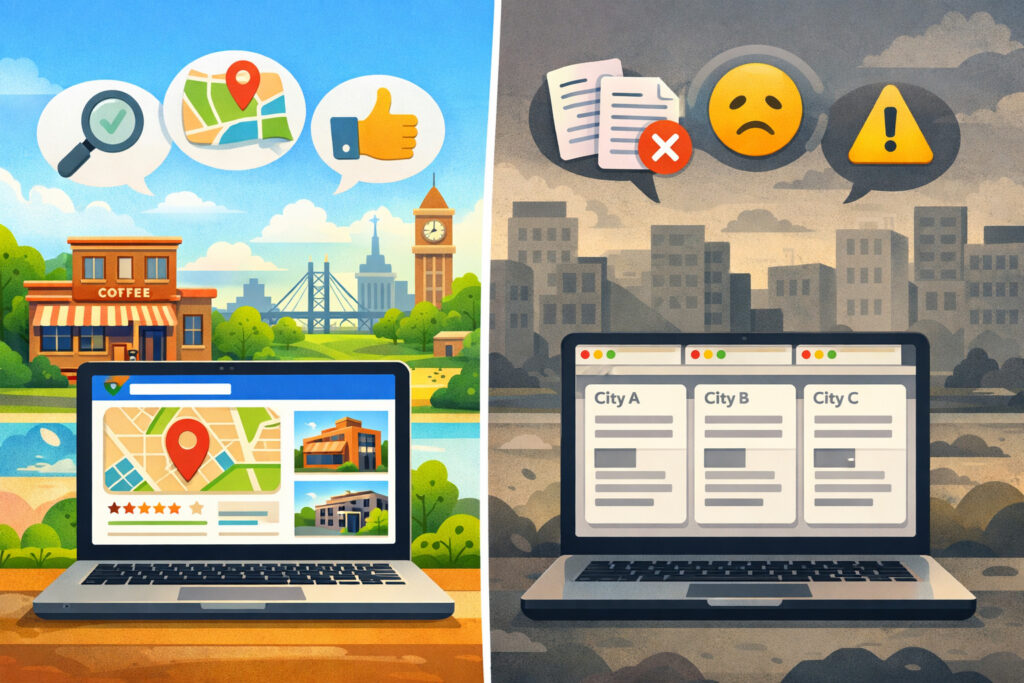
Not all location pages are worth publishing. Some are useful, local, and persuasive. Others are little more than doorway-style pages with city names swapped into a template. That difference matters for users, search engines, and long-term results.
Helpful Location-Specific Landing Pages provide a real reason to exist. They answer local questions, explain service specifics, show proof from the area, and help people take the next step. Thin pages do the opposite. They usually repeat the same copy across many cities, offer little unique detail, and exist mainly to target keywords.
A weak page often sounds like this: “We offer trusted service in City A. We are the best company in City A. Contact us for service in City A.” Then the same copy gets pasted onto pages for City B, City C, and City D. That is not a local content strategy. It is just duplication with a location swap.
A strong page feels grounded. It might mention common service requests in that market, neighborhoods served, service boundaries, team coverage, recent work nearby, local customer feedback, and area-specific FAQs. It may also adjust its call to action based on local needs, such as same-day availability or in-person consultation options.
The risk of weak pages is not only poor engagement. It is also lower trust, lower conversions, and potential quality issues. If your pages feel mass-produced, they often struggle to perform because they are not useful enough to stand on their own.
The goal is not to make every page completely different in structure. Consistency is fine. What matters is that each page contains enough unique local substance to justify its existence.
Weak vs strong location page elements
The table below shows the difference between low-value pages and pages that support a stronger service area content strategy.
| Page Element | Weak Version | Strong Version | Why It Matters |
| Headline | Generic headline with city name inserted | Clear service + area headline tied to real intent | Improves relevance and clarity |
| Intro copy | Same paragraph repeated across locations | Localized intro with area-specific service context | Shows unique value and better matches local search intent |
| Service details | Broad list copied from main services page | Location-aware service details based on demand or delivery model | Helps users see what is actually available there |
| Trust signals | No proof or the same generic testimonial everywhere | Reviews, case examples, photos, or credentials connected to the area | Builds trust and improves differentiation |
| FAQs | No FAQs or generic sitewide FAQs | Local FAQs about service boundaries, booking, timing, and common concerns | Supports conversion and local usefulness |
| CTA | One generic “Contact us” button | Action-focused CTA based on page intent and service model | Creates a stronger local conversion path |
| Internal links | Orphan page with few links | Connected to services, location hub, nearby areas, and contact options | Helps discovery and local SEO structure |
| Local content | Swapped location names only | Unique local content modules and specific area details | Helps duplicate content prevention |
| Service area clarity | Vague claim about serving the area | Clear map, neighborhood list, or coverage explanation | Reduces confusion and improves trust |
| Overall value | SEO-only page | Helpful page for users and search engines | Supports long-term rankings and conversions |
Why duplicate city pages fail even when they look optimized
Many businesses think a page is optimized because it has the target keyword in the title, heading, URL, and body text. But keyword placement alone does not make a page valuable. A page can look optimized on the surface and still fail because it offers nothing unique.
This is one of the biggest mistakes in multi-city SEO strategy. Businesses create dozens of city landing pages using one template, change the city name, and expect rankings to follow. Sometimes a few pages perform for a while, especially in low-competition markets. But that success is fragile because the pages are not truly different or especially useful.
Users feel the problem quickly. If the copy sounds generic, trust drops. If there is no local proof, visitors hesitate. If the page does not answer local questions, it does not help people move forward. That leads to weak engagement and fewer conversions.
Search engines also evaluate pages beyond basic keyword targeting. They look for signs of quality, uniqueness, usefulness, and clear site structure. A page that exists only to target a location phrase without enough distinct value may not be the best result for the search.
That is why duplicate content prevention is not just about changing words. It is about changing substances. The structure of your pages can stay similar, but the content should reflect actual differences in service delivery, local proof, local questions, and local relevance.
If your business cannot add enough unique value to a location page yet, it is usually better to hold off than publish a thin page that weakens the overall site.
How to Structure Multi-Location SEO Landing Pages the Right Way
A good page structure helps both users and search engines. It keeps the content easy to scan, supports local relevance, and creates a clear conversion path. The best Multi-Location SEO Landing Pages are organized around what a person in that area wants to know, not around what a template happens to include.
A useful structure usually starts with a strong H1 that combines the service and area in a natural way. Then it moves into a short introduction that confirms service in that location and explains what makes the page relevant. After that, the page should cover service details, service-area specifics, trust signals, FAQs, and a strong call to action.
The order matters. Most people do not read a local landing page top to bottom. They scan. That means the page should front-load the most important local information. Quickly answer the questions, “Do you serve this area?” and “Can you help with my specific need?”
The page should also connect to the rest of your site. A strong local page is not isolated. It links to related service pages, nearby locations where relevant, contact pages, booking options, and sometimes supporting resources. This makes your local business website structure stronger and helps visitors move naturally.
You should also decide whether your pages are service-first or location-first. Some businesses need a structure like “roof repair in Lakeside.” Others need “Lakeside office” or “Lakeside service area.” The best structure depends on search intent and business model.
Helpful location pages are usually built from repeatable sections, but those sections must allow for local variation. Consistent layout helps with scale. Unique local content is what makes the pages worth reading.
A page layout that works for most service-area businesses
Most service-area businesses can use a page layout that balances clarity, SEO, and conversion without feeling overloaded. The layout should guide a person from confirmation to trust to action.
A strong starting structure often looks like this:
- H1 with service + location
- Short local intro
- Key services available in that area
- Why customers in that area choose you
- Coverage details or neighborhoods served
- Testimonials or project examples from the area
- Local FAQs
- Clear CTA with contact or booking option
The intro should not be filler. It should immediately confirm that you serve the area and mention why the service matters there. For example, a cleaning company page might mention common property types in that neighborhood.
A contractor page might mention service timelines, permit familiarity, or local project styles. A clinic page might mention consultation options, treatment availability, or access details.
The service section should explain what is available in that market, not just repeat the entire services page word for word. If some services are more popular or more relevant in that area, say so. If scheduling, delivery, or response time varies by service area, explain that clearly.
Trust elements should appear before the final CTA, not only at the bottom. Reviews, local project examples, credentials, area familiarity, and service guarantees all help reduce hesitation.
How location pages should differ by city, neighborhood, suburb, or region
Not every location page should be built the same way because not every location behaves the same in search or in real life. City landing pages, neighborhood landing pages, suburb pages, and regional service pages each play a different role.
A city page often targets broader service demand. It should cover the main local service intent, the neighborhoods you serve within that city, and the types of customers or property needs common there. It works well when search demand is clear and the city is large enough to justify its own local service page.
A neighborhood page is more specific. It works best when the neighborhood has distinct search behavior, strong local identity, or unique service needs. These pages should feel hyperlocal. Mentioning common building types, access concerns, nearby landmarks, or neighborhood-specific project patterns can make them much stronger.
A suburb page often sits between the two. It may need a mix of broad local service explanation and practical coverage details, especially if the suburb is part of a larger metro service area. These pages should clarify whether your team is based nearby, how appointments work, and which nearby areas you also serve.
A regional page is broader and should not try to replace city pages where city-level demand exists. Regional pages work best as hubs that introduce a larger service territory and link down into city-specific or suburb-specific service pages.
This is where service area content strategy becomes important. You do not need every page type in every market. You need the page type that best matches local keyword targeting and real user intent.
How to Build Geo-Targeted Landing Pages With Unique Local Content
Geo-Targeted Landing Pages only work when the content feels local for real, not local by template. Unique local content is the heart of strong service area SEO because it is what separates helpful pages from recycled pages.
The good news is that you do not need to reinvent the wheel for every city. You need a repeatable system for creating unique local sections. Think in content modules instead of full-page rewrites. Each page can follow a familiar structure while still offering different local proof, service details, FAQs, and examples.
Local content can come from many sources. It might come from the kinds of jobs you do most in that area, the neighborhoods you cover, client questions you hear often, photos from recent work, common service issues, team availability, or service boundaries. These are all strong local relevance signals when used naturally.
A page becomes more useful when it reflects the real conditions of the area. A law firm page might talk about consultation availability and case types commonly requested in that city.
A clinic page might cover appointment flow, treatment focus, and nearby access details. A cleaning business page might explain how service packages fit local home types, office sizes, or recurring service needs.
You can also build unique local content by collecting information from your own business operations. Ask your team what clients in each market ask most. Review local testimonials. Look at job notes, intake questions, and service requests by area. Those real details are more useful than generic SEO copy.
This approach supports duplicate content prevention and helps create local SEO landing pages that feel experience-informed and trustworthy.
What counts as unique local content on a location page
Unique local content does not mean every sentence on the page must be original in isolation. It means the page as a whole should offer distinct value tied to that location.
Here are examples of content that can make a page truly local:
- An opening paragraph that reflects common customer needs in that area
- A service section that explains which solutions are most requested there
- A neighborhood list or service boundary section
- Local testimonials tied to that market
- Photos from projects, team visits, or office space in the area
- A short case example from a nearby customer
- Area-specific FAQs
- Appointment, delivery, or response details for that market
- Local trust signals, such as area familiarity or long-term service presence
A contractor page might mention that homes in one neighborhood often need a certain type of repair because of material age or design style.
A clinic page might explain which appointment slots are popular for patients commuting from that area. A law firm page might clarify whether consultations are handled in person, by phone, or at a nearby office for people in that city.
All of this helps your page do a better job matching local search intent. It also shows that you did not just create a shell page for SEO.
Unique local content is especially important if you are publishing many pages. The more service area pages you have, the more each page needs real substance. Otherwise, your site starts to feel inflated rather than helpful.
Local proof, testimonials, and examples that strengthen trust
Local proof is one of the most powerful ways to improve a location page because it is hard to fake well and easy for users to understand. It gives the page real-world credibility.
Testimonials work best when they clearly connect to the service area. That might mean mentioning the city, neighborhood, or type of client served there. You do not need to overdo it. Even a few well-placed local reviews can make the page feel much more credible than a block of generic praise.
Case examples are also strong. These do not need to be long formal case studies. A short section about a recent project in the area can work very well. It might describe the challenge, the solution, and the outcome.
For a home service company, that could be a repair or installation. For an agency, it could be a local campaign result. For a clinic, it could be a treatment journey in general terms while respecting privacy.
Photos matter too. A real image from a project, office, team visit, or service setup in that market adds local depth. Stock photos can fill design space, but they do not create trust like real local visuals do.
Trust signals can also include service guarantees, certifications, local partnerships, years serving the area, or team information. The goal is to help the person think, “This business does real work around here.”
URL Strategy, Local Keyword Targeting, Schema, and Internal Links
Good location pages need more than strong writing. They also need a clean technical and structural setup. That includes URL strategy, keyword targeting, internal linking, and thoughtful schema use.
Your URLs should be simple, readable, and consistent. Avoid stuffing them with too many words or location modifiers. A clean format often works best, such as /locations/city-name/ or /service/city-name/ depending on your site structure. Choose a pattern that scales and stick with it.
Local keyword targeting should be focused, not bloated. Each page should have one main target based on service + area, supported by natural semantic phrases. The page can also reflect related variations, but it should not try to rank for every nearby town at once. That creates diluted relevance and awkward copy.
Schema can help reinforce clarity when used properly. For a physical location, local business schema or a relevant subtype may support entity understanding.
For a service-area business, the page still needs accurate on-page information and should not misrepresent a physical presence where there is none. Structured data should support reality, not replace it. Helpful background on this can be found in schema markup guidance for local businesses.
Internal linking is what keeps local landing pages connected to the rest of your site. Without it, they become orphan pages that are hard for users and search engines to discover. Strong internal linking also helps distribute authority and supports a better local business website structure.
All of these elements work together. Great content with weak internal links can underperform. A perfect URL with thin content also fails. You need the full setup.
How to choose the right keyword focus for each location page
Every location page needs a primary keyword focus. That focus should match real local search intent, not just what looks attractive in a keyword list.
The most common pattern is service + location. Examples include “roof repair in Oak Hill,” “family therapy in Brookside,” or “commercial cleaning in Central Heights.” This is often the cleanest target because it matches how people search when they know what they need and where they need it.
Some pages also benefit from related intent phrases. These can include nearby modifiers, problem-based queries, service-area variations, or neighborhood terms. But these should support the main keyword, not compete with it. A page that tries to target five cities and six services at once usually becomes vague.
You should also map keyword intent to the purpose of the page. A page targeting a city-level search should usually be more service-focused. A page supporting a branded local office search may need contact details, directions, hours, and a map. A page serving informational local intent may need more educational content before the CTA.
One useful rule is this: each location page should answer one main local question. That question might be, “Who offers this service in this city?” or “Do you serve this neighborhood?” or “Where is your office in this area?” Once you know the question, the keyword focus becomes easier.
For more ideas on choosing good local phrases, the site’s local keyword research guide offers useful direction.
Internal linking for local SEO without creating a mess
Internal linking for local SEO should help users move logically through your site. It should not feel like a web of forced exact-match anchors pointing everywhere.
A strong setup often starts with a main location hub. That hub links to major city pages, regional pages, or office pages. From there, city pages can link to related service pages, nearby location pages where relevant, contact pages, and booking or estimate forms. Service pages can also link back to the most important locations they support.
The best links are the ones a visitor would naturally expect. If a city page talks about common services in that area, link to those service pages.
If a local service page mentions nearby neighborhoods covered by the same team, link where it helps the user. If you have a blog post that supports local understanding, link to it where context makes sense.
What you want to avoid is random over-linking. Do not add a giant paragraph at the bottom of every page with dozens of city anchors stuffed into it. That weakens readability and often looks like SEO padding.
Anchor text should be descriptive but natural. “Emergency plumbing in Westfield” can work, but so can “see our Westfield emergency service details” when it fits the sentence better.
For readers who want more practical guidance, how to optimize location pages for SEO and how to use local landing pages to drive traffic both support this approach.
What Makes Strong Service Area Landing Pages Convert Better
A lot of businesses focus so much on ranking that they forget why the page exists. The real purpose of Service Area Landing Pages is not just to attract local traffic. It is to turn that traffic into calls, leads, consultations, bookings, or visits.
A strong page converts because it feels relevant, trustworthy, and easy to act on. It does not overload the reader with fluff. It guides them from recognition to confidence to next step.
The headline matters because it confirms they are in the right place. The intro matters because it quickly explains local fit. The service details matter because they help the visitor understand what is available.
The local proof matters because it reduces doubt. The CTA matters because it tells the person what to do next without making them hunt.
Conversion also depends on how well the page addresses hesitation. Many visitors are thinking questions they never type into a form.
Do you really serve my area? How soon can someone help? Is this a good fit for my problem? Do you work with homes like mine, offices like mine, or cases like mine? A well-built page answers those questions before the person asks.
This is why local conversions rise when location pages are written for decision-making, not just indexing. The page should remove friction. It should use short sections, clear headings, practical detail, and visible contact options.
Strong CTAs are especially important. If you need help refining those, guidance on using calls to action effectively can support your conversion setup.
Conversion elements every location page should include
Most high-performing local landing pages share a set of conversion elements that make action easier. These do not have to be flashy. They just need to be clear, relevant, and visible.
Useful conversion elements include:
- A clear primary CTA near the top
- Contact options that match the business model
- Short forms with local context where appropriate
- Service boundary clarity
- Availability or response details
- Reviews or trust badges
- FAQ answers that reduce hesitation
- Repeated CTA placement after key sections
For a home service business, the CTA may be “Request service in Midtown” or “Get a same-day estimate.” For a law firm, it might be “Book a consultation for your area.” For a clinic, it might be “Check appointment availability near you.” These are stronger than a generic “Submit” button because they reflect local intent.
The page should also make practical details easy to find. If your service area has special booking rules, parking details, office entry instructions, or neighborhood coverage limits, include them. These are not small details. They often decide whether a person contacts you or leaves.
Forms should be as short as possible while still capturing the information you need. If you serve multiple areas from one page template, include a location selector or area field only if it truly helps.
Pro Tip: Your CTA should feel like the next logical step after reading the page, not an interruption dropped in from a generic site template.
Trust signals that matter most on city-specific service pages
Trust matters on every page, but it matters even more on city-specific service pages because users are often comparing nearby options. They want reasons to trust that your business is legitimate, established, and suitable for their local need.
The most persuasive trust signals are usually the most concrete ones. Reviews from nearby customers, photos of recent work, mention of specific areas served, team details, service guarantees, and evidence of responsiveness all work well because they are easy to understand.
For local service businesses, trust can also come from practical accuracy. If your page clearly explains the neighborhoods you cover, the service hours, the expected response time, and the steps after contact, that alone improves confidence. It tells people your business is organized and transparent.
Industry-specific trust signals matter too. A clinic may need provider credentials and patient process details. A law firm may need practice-area clarity and consultation information. A contractor may need insurance, warranty, and project photos. An agency may need local case examples and measurable outcomes.
What matters most is not how many trust signals you include. It is whether the signals fit the decision the visitor is trying to make. If the trust elements answer local concerns, the page will feel much stronger.
A good rule is to ask, “What would someone in this area need to see before feeling comfortable contacting us?” Then build those answers into the page naturally.
Practical Examples for Different Business Types
The best way to understand location page strategy is to see how it changes across business models. The structure stays similar, but the local detail and conversion path shift based on what the business sells and how customers buy.
A home service company may need to prove speed, area coverage, and trust. A law firm may need to prove experience, consultation availability, and local familiarity. A clinic may need to focus on provider confidence, treatment relevance, and ease of scheduling. An agency may need to demonstrate local market understanding and fit with business goals.
This is why copying one generic local page framework across every industry is a mistake. The page should reflect how local customers choose in that category.
You also need to think about whether the business has a physical location, a service area, or both. That changes what belongs on the page. A physical office page often needs directions, map support, office details, and Google Business Profile alignment.
A service-area page often needs coverage explanations, travel information, and local service proof without implying a physical office that does not exist.
Strong city-specific service pages are rooted in the customer journey. The local landing page should feel like it was built for that service type and that area, not pulled from a one-size-fits-all system.
How home services, clinics, law firms, and agencies should approach local pages
Home service businesses should lead with service coverage, fast response, and practical service detail.
A page for a plumber, roofer, electrician, or cleaner should explain what is available in that city, how quickly the team serves the area, and what common service requests look like there. Project photos, neighborhood coverage lists, and local reviews work especially well.
Clinics should focus on patient confidence and access. A local clinic page should clearly explain services offered for that area, whether appointments are in person or remote, what the intake process looks like, and what patients should expect. It should reduce uncertainty, especially around location, appointment flow, and treatment fit.
Law firms should emphasize case relevance, consultation options, and service model clarity. A city page should explain the legal services provided for that market, how consultations are handled, and what clients in that area often need help with. Trust comes from specificity and professionalism, not exaggerated claims.
Agencies need a slightly different angle. Their local pages should show that they understand the businesses in that area and the type of marketing or strategy support those businesses need. They can mention service specialization, local campaign examples, and the type of companies they typically work with in that market.
In every case, the local page should support both visibility and persuasion. It should show why this business is relevant in this area, for this service, right now.
What multi-location brands should do differently
Multi-location brands have an advantage because they can create stronger local relevance signals around real offices or branches. But they also have a greater risk of creating repetitive pages at scale.
The first priority is accuracy. Every location page should reflect the correct business details for that office or branch. That includes name format, address, phone, hours, available services, staff information where appropriate, and how the location fits into the larger brand.
The second priority is local differentiation. Even if every branch offers similar services, the pages should still differ based on local context. One location might focus on walk-ins, another on appointments.
One might have strong local reviews around family service, another around commercial work. One may serve a dense downtown zone while another covers suburban neighborhoods.
Brands should also build a clear location hub that helps users find the right branch. The hub can organize locations by city, region, or service type. Individual location pages can then link to relevant services, nearby branches, and contact options.
A common mistake is building pages that look polished but say almost nothing unique. Large brands often have the resources to avoid this by using local reviews, real photos, team details, area-specific FAQs, and actual branch-level differences.
For multi-location brands, scaling wisely matters more than scaling quickly. Fewer strong pages almost always outperform a larger set of thin ones.
Common Mistakes That Hurt Location Page Performance
Many local pages fail for predictable reasons. The business may have good intentions, but the execution undermines both search performance and user trust. Knowing these mistakes early can save time, money, and cleanup work later.
The most common mistake is copying the same content for every city and only swapping the location name. This creates weak pages that feel artificial and offer no real local value. Another common issue is stuffing the location name into every heading and paragraph. That makes the page awkward and can reduce readability without improving usefulness.
Businesses also create too many pages too soon. They publish pages for every possible suburb, district, and neighborhood before they have enough local content to support those pages. This leads to thin page clusters that are hard to maintain.
Weak internal linking is another frequent problem. Pages get published but not integrated into the site. They sit buried in the sitemap with few meaningful links pointing to them. That hurts discoverability and makes the pages feel disconnected from the site.
Ignoring search intent is a major issue too. A page may target a location phrase but fail to answer what users in that market actually want to know. Or it may focus on information when the query is clearly transactional.
These are not small technical errors. They are strategy errors. The fix is not only better optimization. It is building location pages with more intention and more value.
Signs your location pages are too thin or too similar
One warning sign is when you can copy most of one page and paste it onto another with only minor edits. If that is possible, the pages are probably too similar. Another sign is when the page has no original proof, no meaningful local FAQ, and no details that could help a local visitor decide.
Thin pages often have short, generic intros, shallow service descriptions, weak calls to action, and no real service-area clarity. They may mention the city name many times but say nothing useful about how the business serves that location.
A page may also be too thin if it adds no value beyond what already exists on your main service page or location hub. If the page does not answer any new local questions, it may not deserve to exist.
Look at the page through a user lens. Would someone in that area actually bookmark it, share it, or contact you after reading it? If the answer is no, the page probably needs more substance.
You should also compare your own pages side by side. If ten city pages have the same section order, same testimonial block, same service list, same CTA copy, and nearly identical intros, your uniqueness is likely too weak.
Mistakes in site structure, linking, and page expansion
Site structure problems can quietly limit the value of even well-written pages. One common issue is poor hierarchy. Businesses publish location pages without a clear locations hub, without regional grouping where needed, and without a strong connection between location pages and service pages.
This creates confusion for users and weakens local SEO structure. A person should be able to move from your homepage to your location’s area, then into the exact market they need, then into the relevant service or contact path. If that journey is hard, the structure needs work.
Another issue is over-expansion. Businesses often create pages for every small place they can think of instead of prioritizing the markets with meaningful demand and enough local detail. More pages do not automatically mean more traffic. In many cases, they create maintenance problems and dilute quality.
Linking mistakes are common too. Some businesses link every page to every other page, which creates clutter. Others barely link their location pages at all. The best approach is selective, helpful linking based on relevance and user need.
There is also the issue of maintenance. A location page is not “done” once published. Phone numbers change, service areas shift, testimonials age, offices move, and offers expire. Local landing pages need upkeep if they are going to remain useful and trustworthy.
A Step-by-Step Checklist to Plan, Write, Optimize, and Maintain Local Landing Pages
If you want a practical system, use the checklist below. It works for beginners building their first few pages and for experienced marketers improving a larger service area content strategy. The goal is to make sure every page has a reason to exist, enough local value, and a clear path to results.
Planning checklist before you create the page
Start by deciding which locations deserve dedicated pages. Focus on markets with real demand, real service relevance, and enough local substance to support unique content. Do not build pages simply because they are nearby.
Then define your page type. Is this a city page, neighborhood page, suburb page, region page, or physical location page? The page type affects the content, keyword focus, and conversion elements.
Next, gather your local inputs:
- Main service target for the page
- Primary local keyword focus
- Nearby terms or semantic variations
- Service boundary details
- Reviews from that market
- Photos or project examples
- Team or delivery details
- Common local questions
- Relevant CTA for that market
You should also map how the page will connect to the rest of the site. Decide which service pages, hubs, contact pages, and nearby locations it should link to.
Finally, confirm that the page will not misrepresent your business model. If you do not have an office in that area, do not create a page that implies you do. Be clear about whether you are a physical location or a service-area business.
Writing, optimization, and maintenance checklist after launch
Once planning is complete, build the page with a clear structure and local purpose. Write the headline, intro, service section, trust section, FAQs, and CTA in a way that reflects that market. Then review for readability, uniqueness, and action flow.
Use this post-launch checklist:
- Confirm the title tag and H1 are unique
- Make sure the intro clearly matches local intent
- Add unique local proof
- Include service-area clarity
- Check internal links
- Add a visible CTA
- Review for keyword stuffing
- Review for duplicate phrasing
- Confirm mobile usability
- Make sure contact details and hours are accurate
- Check schema where appropriate
- Link from the locations hub or key service pages
- Track page performance and conversion activity
- Refresh the page with new local proof over time
You should also review performance regularly. Look at rankings, traffic, engagement, leads, and conversion behavior. Some of the best local pages improve steadily because they are updated with new reviews, stronger examples, and better local detail. For measurement ideas, tracking local SEO performance is a useful supporting resource.
A location page strategy succeeds when publishing is followed by improvement, not abandonment.
A business should create only as many location-specific landing pages as it can support with genuine local value. It is usually better to publish a smaller set of strong pages for important service areas than a large group of thin pages with repetitive content.
Yes, using the same page layout is fine and can make the site easier to manage. What matters is that each page includes unique local content, area-specific service details, local proof, and a clear conversion path that fits that service area.
A city page usually targets broader local demand and may cover several nearby neighborhoods. A neighborhood page is more focused and works best when that area has a distinct identity, search intent, or service need that deserves its own dedicated page.
No, not always. If the business does not have a physical office in that location, the page should not imply otherwise. Instead, it should clearly explain that the business travels to customers in that area and define its service coverage honestly.
To avoid duplicate content, each page should include unique local information such as area-specific introductions, service details, FAQs, testimonials, neighborhood coverage, project examples, and trust signals. The goal is to create pages with distinct local value, not just swapped city names.
If each profile represents a real location or legitimate local presence, giving it a dedicated landing page is usually the best approach. That page should match the local services, business details, and user intent connected to that profile.
Above the fold, include a clear headline, a short local introduction, a visible call to action, and immediate proof that the business serves that area. This helps visitors quickly understand that they are in the right place and encourages them to take action.
No. Geo-targeted landing pages also help users confirm service availability, improve trust, support local conversions, and create a cleaner website structure across multiple service areas. SEO is just one of several benefits.
Location-specific landing pages should be reviewed regularly and updated whenever important business details change. Adding new testimonials, better service details, stronger local proof, and updated calls to action can help keep them useful and competitive.
A strong location-specific landing page combines local relevance, unique content, useful service details, trust signals, internal links, and a clear call to action. It should help both search engines and real visitors understand why the business is a strong fit for that area.
Conclusion
To create location-specific landing pages for multiple service areas, you need more than a template and a list of city names. You need a practical system that turns each page into a useful local destination for real people.
The best pages combine local keyword relevance with local value. They help search engines understand where you are relevant, and they help visitors feel confident that you truly serve their area. They use unique local content, strong Service Area Landing Pages structure, thoughtful internal linking, and clear conversion paths.
Local Landing Pages for Multiple Locations work best when they are built around real service coverage, real local intent, and real proof. That is what makes them strong enough to rank and convincing enough to convert.
If you take one lesson from this guide, let it be this: every local page should earn its place on your site. If it helps a person in that area understand your service, trust your business, and take action, it is doing its job.