
Local Keyword Research for Small Businesses
Local keyword research is the process of finding the exact words and phrases people use when they’re looking for nearby products and services—often with “near me,” neighborhoods, suburbs, ZIP codes, or city names included.
For small businesses, local keyword research is one of the fastest paths to higher-intent traffic, more phone calls, more direction requests, and more bookings—because the searcher is typically ready to act.
The challenge is that local searches don’t behave like broad, national searches. People search differently on mobile than desktop, they use informal neighborhood terms, and they often skip the city name entirely (“best brake shop near me”).
On top of that, local results are increasingly shaped by map visibility, business profile relevance, reviews, and proximity signals. That’s why local keyword research can’t be a one-time spreadsheet exercise.
It’s an ongoing workflow that connects what customers type, what search engines understand about your service area, and what your pages and listings actually say.
In this guide, you’ll learn a modern, step-by-step local keyword research workflow you can repeat monthly. You’ll also see how to prioritize keywords by revenue, map them to pages, discover hidden “near me” and neighborhood terms, and track what actually moves rankings and leads.
Throughout this article, you’ll find practical examples, relevant terms, and future-facing predictions so your local keyword research stays effective as search evolves.
Why Local Keyword Research Matters for Small Businesses

Local keyword research matters because it helps you show up when buyers are closest to purchasing. Someone searching “emergency plumber near me” or “roof leak repair [city]” is not casually browsing—they’re trying to solve a problem now.
Done right, local keyword research aligns your website content, service pages, and business profile with the real language of nearby customers, so you appear for the searches that drive revenue instead of vanity traffic.
Another reason local keyword research is essential is that local competition is often uneven. A small business can outrank larger brands in a specific neighborhood, suburb, or service radius by targeting location-intent phrases with strong relevance and clear landing pages.
This is especially true for service-area businesses, multi-location businesses, and niche services (like “mobile notary,” “pediatric dentist,” or “pool leak detection”). When local keyword research is focused on micro-areas and service combinations, you can win visibility without needing a huge backlink budget.
Local keyword research also reduces wasted effort. Many small businesses create generic “Services” pages that never rank because the page doesn’t match local intent.
With local keyword research, you’ll know which services should have dedicated pages, which cities deserve unique content, and which terms belong on your homepage versus a specific location page.
You also learn the difference between “map intent” keywords (often triggering map results) and “organic intent” keywords (favoring webpages), so you can optimize both.
Finally, local keyword research is becoming more important as search becomes more AI-assisted. Search platforms are integrating AI experiences and new interfaces that summarize answers and help users complete tasks.
That means clarity, specificity, and local relevance will matter even more—because systems need structured, consistent signals about what you offer and where you offer it. Publications have noted the ongoing evolution of AI features in search, which reinforces the need for precise local relevance signals across your web presence.
How Local Search Behavior Works (and What It Means for Keywords)

To do local keyword research well, you need to understand how people actually search locally. Many local searches include implicit location intent without naming the city—especially on phones. A person in a neighborhood might simply type “hair salon” or “tire shop open now,” and the search engine uses proximity signals to localize results.
This creates a major local keyword research insight: you must optimize for both explicit-location terms (“hair salon in [city]”) and implicit-location terms (“hair salon,” “hair salon near me,” “hair salon open now”).
Local queries also vary by urgency. “Same day,” “24/7,” “emergency,” “open now,” and “book online” are modifiers that can dramatically increase conversion rate. Your local keyword research should treat these as high-value “intent multipliers.”
Similarly, people search with trust modifiers: “best,” “top-rated,” “affordable,” “licensed,” “insured,” “family-owned,” or “5-star.” These can influence both rankings and click-through because they align with review signals and buyer psychology.
Another factor is the map vs. organic split. Some keywords trigger a map pack prominently; others show more traditional results. If your local keyword research only targets page-based rankings but ignores map visibility, you’ll miss calls and direction requests.
This is why many businesses combine local keyword research with business profile optimization and tracking performance metrics tied to discovery.
Google’s help documentation highlights that performance data can show how customers find your profile on Search and Maps and what actions they take afterward, which can directly feed your local keyword research priorities.
Seasonality matters too. Local keyword research must account for weather-related services, holiday demand, school calendars, and local events.
For example, “AC repair” spikes during heat waves, and “tax preparation” peaks in specific months. The best approach is to build a “core + seasonal” keyword set and refresh it monthly.
Step-by-Step Local Keyword Research Process (Repeatable Workflow)
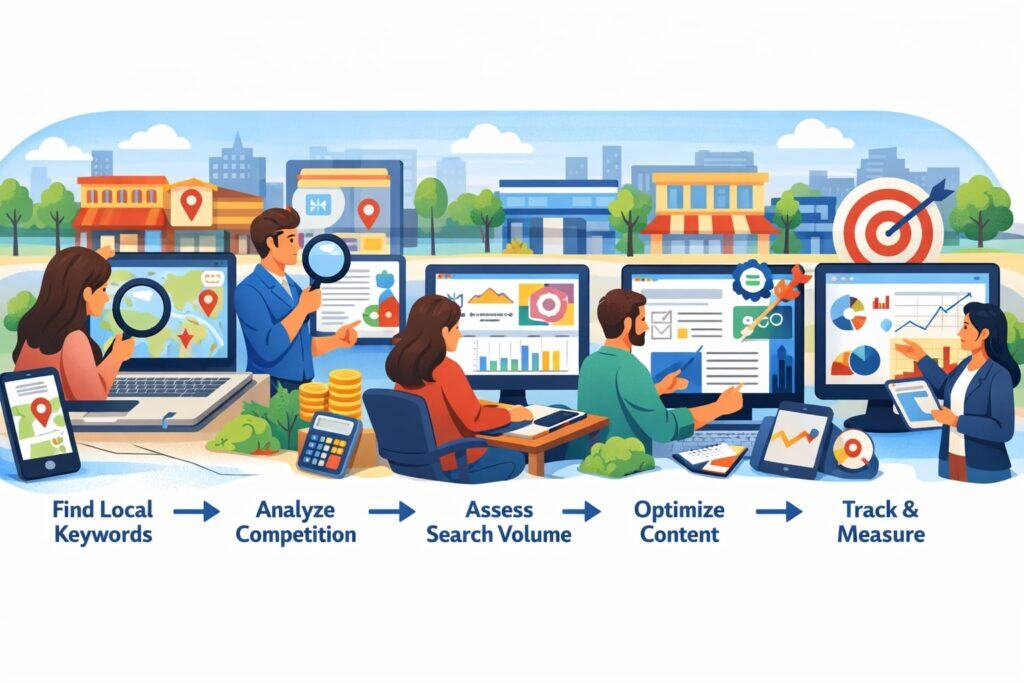
A reliable local keyword research workflow should be repeatable. The goal is to build a living keyword system you can update monthly without starting over.
Step 1: Define your service inventory and revenue priorities
Start with a complete list of what you sell (services, products, packages) and assign a revenue weight. Local keyword research works best when it is tied to margins, close rates, and average order value.
Example: A dental practice may prioritize “invisalign,” “dental implants,” and “emergency dentist,” because these produce higher lifetime value than a low-margin cleaning.
Step 2: Define your real service area (not your dream map)
List the cities, neighborhoods, ZIP codes, and landmarks you actually serve. Many businesses overstate their range. Good local keyword research reflects realistic travel distance, staffing, and delivery zones.
If you’re a service-area business, group locations into tiers: (1) core zone (highest priority), (2) near zone (moderate), (3) extended zone (only if competitive and justified).
Step 3: Build seed keywords (services + modifiers)
Create combinations like:
- [service] + near me
- [service] + open now
- [service] + [city]
- [service] + [neighborhood]
- best + [service] + [city]
This seed list is the foundation of local keyword research because it mirrors how real customers search.
Step 4: Expand with tools and real-world language
Use keyword tools (covered later) to expand seeds into hundreds of variations, including questions and long-tail phrases. Also collect language from reviews, call transcripts, and FAQs. These often reveal profitable keywords that tools miss (“water heater making noise,” “brake grinding sound,” “same-day passport photo”).
Step 5: Group keywords into topics and pages
Local keyword research becomes actionable only when keywords are grouped into page targets (homepage, service pages, location pages, blog posts). You’ll learn mapping in a later section, but the key is: one page should target one primary intent cluster.
Step 6: Validate with search results and competitors
Search the main terms and study what appears: maps, directories, “near me” pages, service pages, pricing pages, etc. This tells you what type of page you need to rank. If the top results are “service + city” landing pages, your local keyword research should produce that format. If they’re “how much does it cost” pages, create pricing content.
Step 7: Prioritize and publish (then measure)
Choose the top 10–30 keyword clusters to execute first. Publish pages, optimize listings, and track outcomes (calls, form fills, bookings). Then revisit your local keyword research monthly using performance data.
This step-by-step local keyword research framework prevents random content creation and ensures every page is tied to demand and intent.
Finding High-Intent Local Keywords (Service + Location + Modifier Strategy)
The most profitable local keyword research focuses on “high-intent” terms—phrases that strongly signal a buyer who is ready to call, visit, or schedule. These keywords often combine three ingredients:
- Core service (what they need)
- Local intent (near me, city, neighborhood, ZIP)
- Action modifier (open now, same day, emergency, quote, cost)
For example:
- “emergency HVAC repair near me”
- “same day garage door repair [city]”
- “best personal injury lawyer [neighborhood]”
- “pediatric dentist open Saturday”
- “tow truck near me 24/7”
A practical local keyword research tactic is building a “modifier library.” Create a list of modifiers in these categories:
- Urgency: emergency, 24/7, open now, same day, today
- Price: affordable, cheap (use carefully), cost, pricing, quote, estimate
- Quality: best, top-rated, 5-star, trusted, experienced
- Specific need: for kids, for seniors, for small businesses, for weddings
- Problem-based: leaking, clogged, broken, not working, replacement
Then combine modifiers with each priority service and each top location tier. This creates a structured local keyword research matrix you can scale without guessing.
Another powerful tactic is targeting “problem + solution” searches. People often don’t know the service name; they describe the symptom. Local keyword research should include these symptom queries because they can be easier to rank and convert extremely well. Examples:
- “water heater leaking from bottom”
- “car AC blowing warm air”
- “why does my breaker keep tripping”
- “toothache relief dentist near me”
Finally, don’t ignore branded local intent. Many customers search “brand + service + city” (for example, “Invisalign dentist [city]” or “Ring doorbell installation [city]”). If you offer popular brands, add them to your local keyword research list and build supporting content.
High-intent local keyword research is less about volume and more about conversion. A keyword with 30 searches per month that produces 5 calls can outperform a 500-search keyword that produces curiosity clicks.
Local Competitor Keyword Research (Steal What’s Working Ethically)
Competitor-driven local keyword research helps you stop guessing. If nearby competitors are ranking, they’ve already proven what search engines want to show for that query. Your job is to identify the patterns and build a better, clearer, more helpful page.
Identify your true local competitors
Your competitors in search may not be your competitors in real life. Search competitors include directories, marketplaces, and big brands. Start by searching your top services and noting who appears in:
- map results
- top organic results
- “people also ask”
- review platforms and local directories
Reverse engineer their page targets
Click the pages that rank. Ask:
- Is it a city service page?
- A neighborhood page?
- A pricing page?
- A guide or checklist?
Then align your local keyword research to match the format that’s winning.
Extract keyword patterns
Look for repeated phrases in:
- page titles
- H1 headings
- subheadings
- internal links
- FAQs
This reveals how competitors structure their local keyword research and what terms they emphasize.
Spot gaps you can exploit
The best local keyword research opportunities are gaps:
- competitors have no page for a high-value service
- competitors have thin city pages with duplicate text
- competitors ignore “open now,” “same day,” or “cost” queries
- competitors lack clear FAQs, service area details, or trust proof
Build “10x” pages, not copies
Ethical local keyword research means creating original content that is more useful. Add:
- clear service process
- transparent pricing ranges (if possible)
- before/after photos
- service area map explanation
- local proof (reviews, case studies, permits, warranties)
Competitor-based local keyword research is about understanding intent and improving relevance—not copying. When you do this consistently, you’ll often outrank older pages because freshness, clarity, and completeness win.
Mapping Local Keywords to Pages (Site Structure That Ranks)
Local keyword research becomes real SEO results only when keywords are mapped to the right pages. Many small business sites fail because they target everything on one page or create dozens of thin pages without purpose.
The basic page types you’ll use
- Homepage: targets the primary service category + primary location area
- Core service pages: one page per major service (not every micro-service)
- Location pages: one page per physical location (or per major city tier, if justified)
- Service-area pages (carefully): used when you truly serve multiple cities and can add unique value
- Supporting blog/guide content: targets questions, comparisons, costs, checklists
- Industry or customer-type pages: “for restaurants,” “for families,” “for property managers,” etc.
The keyword-to-page rule (avoid cannibalization)
Local keyword research works best when each keyword cluster has a “home.” If “brake repair [city]” and “brake pads replacement [city]” share the same intent, keep them on one strong brake service page with sections. If the intent differs (repair vs. replacement vs. cost), you may need separate sections or separate pages.
Build topic clusters around services
A strong structure looks like:
- /brake-repair/ (primary service page)
- /brake-repair-cost/ (pricing intent)
- /brake-repair-signs/ (symptoms intent)
- /brake-repair-[city]/ (only if needed and truly unique)
- /brake-repair-cost/ (pricing intent)
This approach turns local keyword research into a scalable content architecture that search engines understand.
Use internal linking as “intent guidance”
When your blog post answers “how long do brakes last,” it should link to the brake repair service page using relevant anchor text. This reinforces your local keyword research targets and distributes authority.
Location targeting without spam
Avoid stuffing a page with 30 city names. Instead, write naturally:
- explain where you serve
- mention 2–5 core areas per relevant page
- add a dedicated service area section
- include driving-time references and landmark cues where appropriate
Smart mapping is the difference between local keyword research that sits in a spreadsheet and local keyword research that drives leads.
Best Tools for Local Keyword Research (Practical Stack for Small Businesses)
You don’t need every tool. You need a stack that helps you discover keywords, validate local intent, and track results. Below are some of the best tools for local keyword research, including a mix of free and paid options.
Google Business Profile Performance (free)
Performance insights show how customers find your business on Search and Maps and what actions they take. This is incredibly useful for local keyword research because it reflects real discovery patterns and user behavior—calls, website clicks, direction requests, and more. Google’s documentation explains how profile performance reporting helps you understand visibility and customer interactions.
Google Keyword Planner (free with ads account)
Keyword Planner is often underestimated for local keyword research. Reporting and forecasting have increasingly supported more localized planning.
Industry reporting noted that Keyword Planner introduced enhanced localized forecasting, including breakdowns by city/region and device in some views, which can help local keyword research become more precise for metro areas and nearby cities.
Semrush (paid)
Semrush includes keyword discovery features and local SEO tooling that can support local keyword research, including finding location-modified keywords and tracking positions over time. Their local SEO tools overview highlights features and tool categories that are commonly used in local search campaigns.
BrightLocal (paid, local-focused)
BrightLocal is designed specifically for local SEO workflows. It’s widely used for citation management, local rank tracking, and audits—tasks that complement local keyword research by showing where you appear across a geographic grid and which terms move your visibility. BrightLocal positions its platform around monitoring and improving local search presence.
Google Search Console (free) and Google Analytics 4 (free)
Search Console helps validate which queries actually trigger impressions and clicks for your pages. GA4 helps measure what those visitors do (calls, form fills, bookings). Many local keyword research plans fail because they stop at “search volume” and never measure outcomes.
Google Trends (free)
Trends is a simple way to spot seasonal patterns and rising local interest. It’s not a local-only tool, but it supports local keyword research by helping you time content and campaigns.
Recommended small business stack:
- Start: Business Profile Performance + Search Console + Keyword Planner
- Scale: add BrightLocal (tracking/citations) + Semrush (keyword expansion/competitive insights)
Tracking and Improving Your Local Keyword Research Results (KPIs That Matter)
Local keyword research isn’t complete when you publish pages. It’s complete when you can prove improvement in visibility and leads—and then use the data to refine your next round of local keyword research.
Track rankings the right way
Local rankings change by neighborhood and even by street. A keyword may rank well near your address but poorly across town. That’s why local keyword research measurement should include:
- map visibility tracking (grid-based, if possible)
- organic ranking checks from multiple nearby points
- mobile vs. desktop differences
Track conversions, not just traffic
The best local keyword research KPIs are lead actions:
- phone calls
- direction requests
- appointment bookings
- quote form submissions
- chat leads (if used)
Use GA4 events and call tracking where appropriate. Pair this with Search Console query data to see which local keyword research targets bring the highest-intent visitors.
Use Business Profile data to refine keywords
Business profile performance insights can reveal how customers discovered you on Search and Maps and what actions they took. Treat those discovery terms as your “ground truth” local keyword research list—then build supporting pages and FAQs around them.
Refresh content based on performance
Every 30–60 days, update:
- titles and headings (to better match intent)
- FAQs (based on customer questions)
- service area sections (based on where leads come from)
- internal links (to strengthen priority pages)
This “publish → measure → refine” loop turns local keyword research into a compounding growth engine.
Common Local Keyword Research Mistakes (and How to Avoid Them)
Many small businesses struggle with local keyword research not because the concept is hard, but because the execution is misaligned with intent and structure.
Mistake 1: Chasing volume instead of revenue
High-volume terms like “lawyer” or “dentist” are often too broad. Local keyword research should prioritize service-specific intent (“emergency dentist open now”) that converts better.
Mistake 2: Creating thin city pages
Dozens of near-duplicate pages for each city can dilute quality. If your local keyword research suggests a location page, make it truly useful with unique content: local proof, driving info, service specifics, and FAQs.
Mistake 3: Stuffing keywords unnaturally
You can maintain strong local keyword research keyword usage without awkward repetition. Use natural variants:
- “nearby,” “in the area,” “around [neighborhood]”
- service synonyms
- problem-based language
Mistake 4: Ignoring map intent
Some keywords mainly drive map visibility. Local keyword research must include business profile optimization and review signals, not just website pages. Business profile performance data is a key feedback loop here.
Mistake 5: Not updating the keyword set
Local keyword research should be revisited monthly because seasonality, competition, and search interfaces change. If your keyword list is from last year, you’re likely missing new modifiers and rising demand.
Avoiding these mistakes keeps your local keyword research sustainable and helps your content actually rank and convert.
Future Predictions: Where Local Keyword Research Is Headed
Local keyword research is evolving because search itself is evolving. Over the next 12–24 months, several trends are likely to matter for small businesses.
More AI-shaped discovery and summarization
Search platforms are integrating AI-driven interfaces and task features that can summarize options, suggest businesses, and streamline actions.
Reporting has highlighted AI enhancements and new ways users interact with search, which signals that clarity and trust signals (reviews, consistent business info, strong service pages) will matter even more.
Local keyword research implication: you’ll need cleaner topical coverage. Instead of one generic service page, you may need strong supporting content answering the “why,” “cost,” “how fast,” and “what to expect” questions—so systems have more confidence in recommending you.
More localized planning data inside keyword tools
Keyword tools are adding more granular location capabilities. Industry coverage noted Keyword Planner’s move toward city and device-level forecasting views in certain contexts, which can help businesses refine local keyword research by metro area and device behavior.
Local keyword research implication: expect better segmentation by city/region and mobile behavior, making it easier to prioritize neighborhoods and suburbs.
Stronger emphasis on “proof” signals
Local search results increasingly reward evidence:
- reviews and review velocity
- accurate categories and services
- consistent business details
- helpful photos and updates
Local keyword research will increasingly intersect with reputation and profile optimization, not just web pages.
Hyperlocal content will win
Neighborhood-level terms, landmarks, and “service near [place]” language will become more valuable as competition rises. If you build a structured local keyword research system that includes micro-areas and problem-based terms, you’ll be ahead of businesses that only target “[service] + [city].”
FAQs
Q1) How often should I do local keyword research?
Answer: For most small businesses, local keyword research should be refreshed monthly and reviewed more deeply every quarter. Monthly refreshes help you capture seasonal changes, new service demand, and competitor shifts.
Quarterly reviews help you restructure page targets and expand into new neighborhoods or services based on performance. If you run promotions, add a short local keyword research check before each campaign to confirm wording and intent modifiers.
Q2) What’s the difference between “near me” keywords and city keywords?
Answer: “Near me” keywords are implicit-local phrases where the search engine uses the searcher’s location to localize results. City keywords are explicit-local phrases that include a location name.
Strong local keyword research includes both because customers use both—especially across mobile and desktop behavior. Your pages should naturally cover both by clearly stating your service area and using location context where it fits.
Q3) Do I need a separate page for every city I serve?
Answer: Not always. Local keyword research should justify pages based on demand, competition, and your ability to add unique value.
If you can’t make a city page meaningfully different, you may be better off building stronger service pages and a clear service area section. For multi-location businesses with physical addresses, separate location pages are usually appropriate.
Q4) Which free tools are best for local keyword research?
Answer: A strong free local keyword research stack includes business profile performance reporting, Search Console, Keyword Planner, and Trends. Business profile reporting helps you see how customers find you and what actions they take, which is extremely useful for refining local keyword research priorities.
Q5) How do I know if my local keyword research is working?
You’ll know local keyword research is working when you see improvements in:
- impressions and clicks for target queries (Search Console)
- calls, bookings, and direction requests (analytics + business profile performance)
- rankings across your service area (not just near your address)
If rankings improve but leads don’t, your local keyword research might be targeting low-intent phrases or the page experience might not match the searcher’s needs.
Conclusion
Local keyword research is one of the most practical growth levers for small businesses because it connects you with customers who are ready to take action nearby.
The businesses that win aren’t the ones with the biggest budgets—they’re the ones that run consistent local keyword research, target high-intent modifiers, map keywords to the right pages, and use performance data to improve month after month.
If you implement the workflow in this guide—service inventory, service area tiers, modifier libraries, competitor validation, page mapping, and performance tracking—you’ll build a local keyword research engine that compounds.
And as search evolves with more AI-driven experiences and more granular planning data, businesses with clear topical coverage and strong local relevance signals will be the ones that get recommended, clicked, and chosen.