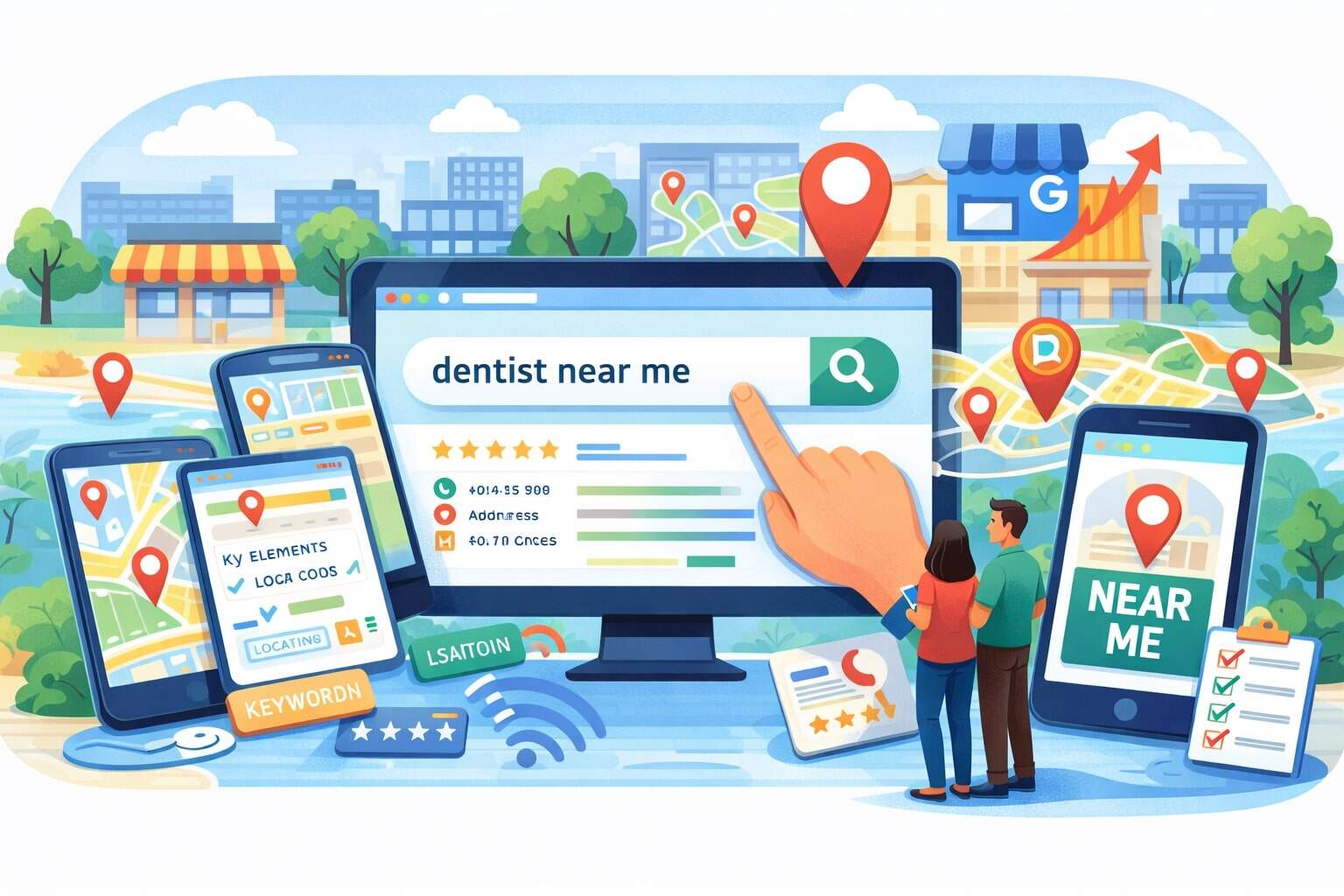
Optimizing Website for Near Me Searches
“Near me” searches happen when someone wants an answer right now and nearby—like “emergency plumber near me,” “best dentist near me,” or “brake repair near me open now.”
These near me searches are high-intent queries, which means the person is often ready to call, visit, book, or buy. If your website and local presence are not built to match that intent, you can lose customers to competitors who show up in the map results and local listings.
This guide explains how to win near me searches with a complete, search-engine-friendly strategy: local relevance, strong location signals, a fully optimized business profile, fast mobile UX, review momentum, and content that matches real local needs.
You’ll also get future-proofing advice for what’s changing in local search and how to stay visible as “near me searches” evolve.
What “Near Me” Searches Really Mean (And Why They Convert)
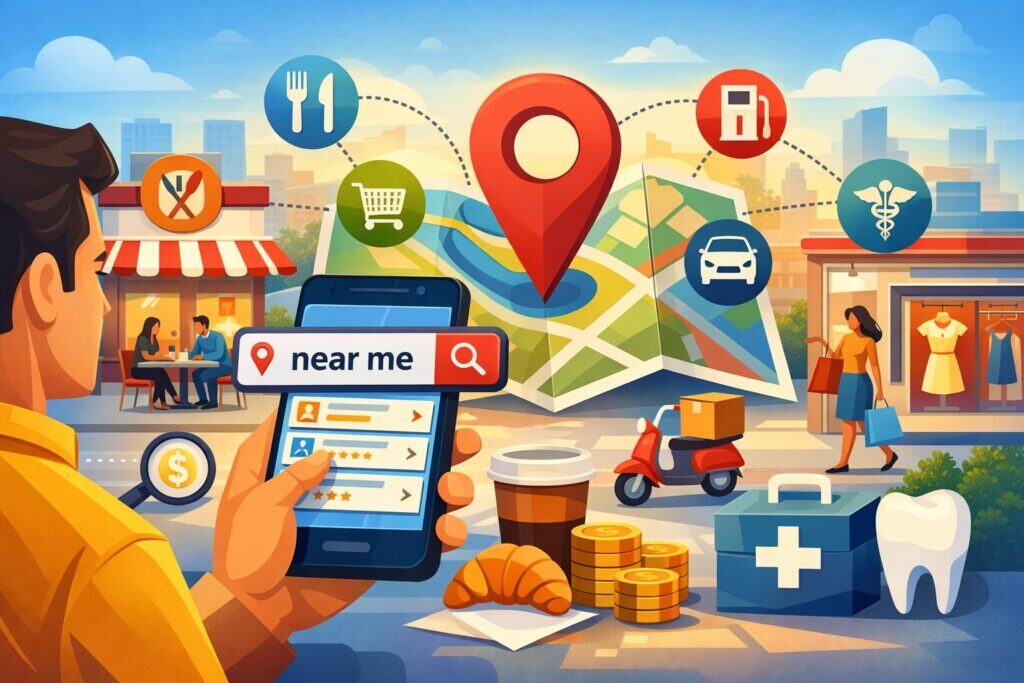
A “near me” query is less about the words “near me” and more about local intent. Search engines can detect local intent even when users don’t type “near me.”
For example, someone who types “coffee shop” on a phone is often treated like they searched “coffee shop near me.” That matters because local intent triggers local results: map listings, call buttons, directions, hours, reviews, and other quick actions.
To rank for near me searches, your goal is to send clear signals that you are:
- Relevant to the service/product requested,
- Close enough to the searcher or the searched area, and
- Trusted and prominent compared to competitors.
Google publicly describes local ranking signals around relevance, distance, and prominence, and those concepts still guide how local results are selected and ordered.
Why these queries convert so well:
- They’re often urgent: repairs, clinics, towing, restaurants, same-day services.
- They are mobile-first: people search while driving, walking, shopping, or comparing options.
- They have built-in action intent: calls, bookings, navigation, and store visits.
So when you optimize for near me searches, you are not chasing traffic—you are building a lead engine that captures ready-to-act customers.
How Local Rankings Work: Relevance, Distance, and Prominence
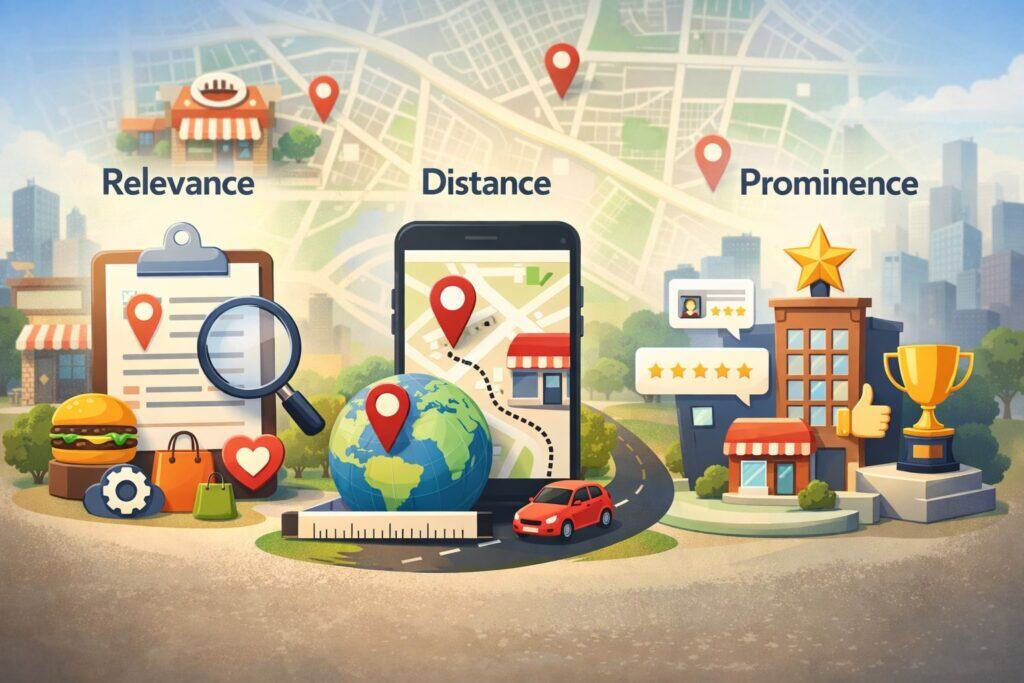
Before tactics, you need the system. Local rankings generally come from a blend of signals that map to three pillars: relevance, distance, and prominence. Google explains these as core factors used to show the “best match” for local searches.
Relevance: Proving You Match the Query
Relevance is how well your business matches what someone searched. You increase relevance by aligning your services, categories, content, and on-page keywords with real customer language. This includes:
- Service pages that clearly describe what you do
- Accurate business categories and attributes
- Content that answers common questions and local concerns
- Consistent mentions of your services across your site and listings
If you want near me searches to trigger your brand, your relevance signals must be unmissable.
Distance: The Proximity Factor You Can’t Fully Control
Distance is how close you are to the searcher or the location they specify (like a neighborhood). You can’t “SEO” your way into being closer, but you can:
- Confirm your address/service area is accurate everywhere
- Create location pages that legitimately reflect where you serve
- Avoid fake locations that cause suspensions and ranking drops
Distance is why near me searches can look different on two phones sitting a mile apart.
Prominence: Authority, Reviews, and Real-World Trust
Prominence is the strongest long-term advantage. It includes:
- Review quantity, quality, and freshness
- Local backlinks and mentions
- Brand searches and engagement (calls, direction requests, clicks)
- Consistent citations across directories
Industry resources consistently reinforce that these pillars define local visibility and map pack competition. When you build a plan for near me searches, every step should strengthen one of these pillars—ideally two or all three at once.
Build a “Near Me Searches” Foundation: Location Signals That Never Break

Many sites near me search visibility because the basics are inconsistent or unclear. Search engines want confidence: who you are, where you are, what you offer, and how customers experience you.
Here are the foundation signals that drive stable performance:
- Name, address, phone consistency across your website and major directories
- A clear service area statement (where you go, where you don’t)
- A location-aware site structure (so crawlers understand geographic relevance)
- Contact page details that match your business profile exactly
- Correct hours, categories, and service descriptions everywhere
If your business information differs from one listing to another—like Suite numbers, abbreviations, old phone numbers, or mismatched business names—your local trust weakens. That confusion can reduce your presence for near me searches when competition is tight.
Single-Location Businesses: Make the One Location Extremely Clear
If you have one storefront/office, you want one dominant location entity:
- One primary location page (often your homepage or a dedicated location URL)
- Embedded map, parking notes, landmarks, and “nearby” context
- Unique photos of the actual location (inside, outside, signage)
- Click-to-call and directions as primary CTAs
This improves conversions from near me searches because users can instantly confirm they found a real place.
Multi-Location Businesses: Build Unique Pages, Not Duplicates
If you serve multiple areas, do not clone the same page and swap city names. Thin location pages can fail to rank and can dilute your brand.
Instead:
- Create a unique page for each location with staff, services, photos, FAQs, and local proof
- Add location-specific reviews and case studies
- Use internal linking so each location page is accessible from navigation and footer
A multi-location strategy turns near me searches into predictable, local pipelines.
Service-Area Businesses: Define “Where We Go” With Proof
If you travel to customers, you still need strong local signals:
- Clear list of service areas (cities/neighborhoods you truly serve)
- Service pages that mention service-area specifics naturally
- Reviews that reference those areas
- Local links and partnerships that confirm presence
For service-area companies, the best near me searches come from combining strong content relevance with reputation and consistent data.
Google Business Profile Optimization: Your Map Pack Power Center
If you want to dominate near me searches, your business profile is not optional—it’s foundational. Google itself recommends using your Business Profile to improve local ranking and visibility.
Think of your profile as your “local homepage” inside the search results. It influences map visibility, click-to-call behavior, direction requests, and overall trust—especially for mobile near me searches.
Choose the Right Primary Category and Supporting Categories
Your primary category is one of your strongest relevance signals. Choose the category that matches your core service (not a vague or “almost right” category). Then add secondary categories that reflect legitimate offerings.
Also:
- Fill out “services” with real service names customers search
- Add attributes that matter (accessibility, payment types, on-site services)
- Keep business hours accurate, including holiday hours
Category clarity helps you appear for the right near me searches, not just more impressions.
Use Photos, Posts, Q&A, and Product/Service Sections Strategically
Profiles with frequent updates tend to look more “alive.” Add:
- Exterior/interior photos and team photos
- Before/after photos (when appropriate)
- Short weekly posts: offers, updates, tips, seasonal services
- Questions and answers (seed common questions and answer them clearly)
Many local SEO playbooks emphasize ongoing profile activity—photos, posts, Q&A, and completeness—as practical ways to strengthen engagement signals for local visibility.
For near me searches, photos and reviews often decide the click.
Messaging, Booking, and Tracking: Turn Visibility Into Leads
Enable features that reduce friction:
- Messaging (if you can respond quickly)
- Booking links (if your business supports scheduling)
- Clear primary CTA: call, quote, appointment, directions
Also use tracking:
- Add UTM parameters to your website link
- Track calls and form submissions to understand which near me searches generate revenue
Website On-Page SEO for “Near Me” Searches: Pages That Match Local Intent
Your website still matters—especially for “local organic” results and for reinforcing relevance. To win near me searches, your site needs pages that map to how people search locally.
Build Service Pages That Answer Local Questions
A strong local service page includes:
- Who the service is for, common problems, and outcomes
- Pricing factors (even ranges or “what affects cost”)
- Timeframes, availability, emergency options
- Trust proof: reviews, certifications, warranties, guarantees
- Clear CTA above the fold
Add local context naturally: neighborhoods, nearby landmarks, and service constraints. Avoid stuffing city names in every sentence—write for humans first. The best near me searches pages read like the most helpful local expert, not a keyword robot.
Title Tags and Headings: Localize Without Looking Spammy
Use clear patterns:
- Title tag: Primary service + primary area + value prop
- H1: Service name + local context
- H2s: Problems, process, pricing, FAQs, service areas, reviews
Example structure (conceptual):
- Title: “Emergency AC Repair in [City] | Same-Day Service”
- H1: “Fast Emergency AC Repair for [City] Homes”
This improves relevance for near me searches while keeping your site readable.
Internal Linking and Navigation: Help Crawlers Understand Your Geography
Local SEO benefits when search engines can crawl a logical structure:
- Services hub → service pages
- Locations hub → location pages
- Footer links to core services + top service areas
- Blog posts linking back to the most relevant service page
When you do this well, your entire site becomes more eligible for near me searches, because each page supports the others.
Local Schema and Structured Data: Make Your Location Machine-Readable
Structured data helps search engines interpret your business details and page intent. It doesn’t guarantee rankings, but it can reduce ambiguity—especially with multi-location and service-area setups.
LocalBusiness Schema: Confirm Identity, Address, and Hours
Use schema to reinforce:
- Business name
- Address (or service area where appropriate)
- Phone number
- Hours
- SameAs links (major directory profiles)
- Geo coordinates if relevant
Schema is most useful when your real-world business data is consistent. If your data is messy, the schema won’t save your near me searches visibility.
FAQ Schema: Earn More SERP Real Estate
Add FAQs to service pages and location pages, then mark them up (when appropriate). This can improve click-through and help you match voice-style queries.
For near me searches, FAQs often reflect real objections:
- “How fast can you arrive?”
- “Do you serve my neighborhood?”
- “Do you offer weekend appointments?”
- “What payment types do you accept?”
Those questions are exactly what searchers want answered before they call.
Reviews and Reputation: The “Prominence” Engine Behind Near Me Searches
For many local results, the deciding factor is not just ranking—it’s conversion. Reviews shape both.
Prominence is heavily influenced by review signals: quantity, rating, freshness, and responses. Local ranking guidance frequently highlights reviews as a key local visibility and trust factor.
How to Generate Reviews Without Breaking Rules
Build a review system:
- Ask at the moment of success (after service completion or purchase)
- Use a short link or QR code
- Train staff on one simple script
- Send follow-up texts/emails within 24–48 hours
Don’t gate reviews (only asking happy customers) and don’t offer incentives if that violates platform rules. Focus on volume through consistency.
Responding to Reviews: Turn Feedback Into Local SEO Fuel
Respond to every review—positive and negative:
- Thank the customer
- Mention the service naturally
- Mention the area naturally (when the customer does)
- Offer a resolution path for complaints
This keeps your profile active and builds trust for future near me searches visitors deciding between you and a competitor.
Citations and Local Links: Proving You’re a Real Local Entity
Citations are mentions of your business details on directories and platforms. Links are endorsements from other sites. Both support prominence and trust.
Citation Consistency: Clean Data Wins
Start with core platforms and industry-specific directories. Make sure:
- Business name is identical everywhere
- Address formatting is consistent
- Phone number matches your website and profile
- Hours are accurate
A clean citation footprint reduces confusion and helps you appear more reliably for near me searches.
Local Link Building That Actually Works
The best local links are earned through real connections:
- Sponsoring local events
- Partnering with nearby businesses
- Joining local associations
- Local press mentions and community features
- Vendor and supplier links
These links do more than rankings—they build brand awareness so people search your name directly, which can strengthen prominence signals over time.
Mobile UX, Speed, and Technical SEO: The Hidden Weapon for Near Me Searches
Most near me searches happen on phones. If your mobile experience is slow, confusing, or hard to use, you leak leads even if you rank.
Speed and Core Performance: Reduce Friction
Practical improvements:
- Compress images (especially hero banners)
- Use modern formats where possible
- Minimize heavy scripts and third-party trackers
- Improve server response time
- Keep pages lightweight and focused
A fast site improves engagement metrics and conversion rates from near me searches traffic.
Mobile-First Conversion Design: Click-to-Call and Directions
Your top actions should be effortless:
- Sticky call button on mobile
- Tap-to-map directions
- Short forms with minimal fields
- Visible hours and service area
- Trust blocks: reviews, badges, guarantees
When users come from near me searches, they often decide in seconds. Make the next step obvious.
Accessibility and Trust Signals
Accessibility improvements (readable fonts, contrast, keyboard navigation, descriptive buttons) also improve usability for everyone. Add trust signals:
- Real team photos
- Clear policies
- Transparent service guarantees
- Straightforward pricing explanations
Trust is a conversion multiplier for near me searches, especially in high-stakes services.
Content Strategy That Wins Near Me Searches Without Keyword Stuffing
Content is how you scale relevance across services and locations. But for near me searches, you need content that feels local, practical, and immediate.
Service + Problem Content: The Local Demand Capture Model
Create pages and articles around:
- “How much does [service] cost in [area]?”
- “Best time of year for [service]”
- “Emergency vs routine options”
- “Repair vs replace” decisions
- “What to do before we arrive” checklists
These topics match real search behavior and bring in users earlier in the decision journey—then convert them when they’re ready.
Local Guides That Earn Links and Mentions
Local guides build prominence:
- Neighborhood guides (only where relevant)
- Local regulations or permit basics (where applicable)
- Seasonal checklists tied to local climate patterns
- “Moving to the area” service checklists (home services, utilities, etc.)
This content attracts links, shares, and brand searches that strengthen your ability to win near me searches over time.
Voice Search and Conversational “Near Me” Queries: The Next Layer of Local SEO
Voice search tends to be longer, more conversational, and often local—making it closely connected to near me searches.
Voice-search trend reports commonly emphasize that people use voice assistants to find local businesses and that voice queries are often phrased as questions.
How to Optimize for Voice-Driven Near Me Searches
Focus on:
- FAQ-style headings (who/what/where/when/how)
- Short, direct answers near the top of pages
- Natural language phrases (“open now,” “best,” “fast,” “affordable”)
- Local context (“near downtown,” “near [landmark]”)
- Strong business profile data (hours, categories, services)
Voice users want an immediate answer. If you structure pages around fast clarity, you increase your chances across both typed and spoken near me searches.
Featured Snippets and “Best Answer” Formatting
Use formatting that wins snippets:
- Bullet lists
- Short definitions
- Step-by-step blocks
- Clear headings that mirror questions
This improves visibility when voice assistants pull answers from the web, and it can lift CTR for near me searches on mobile.
Tracking and Measuring Near Me Searches Performance (So You Can Improve Faster)
If you don’t measure, you can’t scale. Local SEO measurement should connect near me searches visibility to actual leads.
Profile Insights and Website Analytics
Track:
- Calls, direction requests, website clicks from your business profile
- Form submissions, call clicks, bookings from your site
- Top pages that convert local traffic
- Search queries driving impressions and actions
Use UTM tags on profile links so you can see profile-driven traffic clearly.
Rank Tracking the Right Way: Grid and Neighborhood Visibility
Local rankings vary by location. Use a grid-based approach (even manual checks) to understand:
- Where you rank strongly
- Where you disappear
- Which neighborhoods need stronger signals
This helps you decide where to create location content, earn links, and collect reviews that mention those areas—improving near me searches coverage across your service radius.
Common Mistakes That Kill Near Me Searches Rankings
Many businesses do “some local SEO” and still don’t rank for near me searches because of avoidable errors:
- Fake locations or virtual offices presented as real storefronts
- Duplicate or thin location pages with swapped city names
- Inconsistent business name/address/phone across directories
- Wrong categories or missing services in the business profile
- No review strategy (or ignored negative reviews)
- Slow mobile site, hard-to-find phone number, confusing navigation
- Over-optimized pages that read spammy and reduce trust
Also be cautious with “shortcuts.” Local visibility is increasingly tied to real-world signals: real engagement, real reviews, real local mentions, and real service quality. If you want reliable near me searches rankings, build something that deserves to rank.
Future Prediction: Where Near Me Searches Are Headed (2026–2028)
Local search is becoming more dynamic, more personalized, and more AI-assisted. That doesn’t remove the basics—it makes them more important.
Here’s what’s likely to matter even more:
1) Engagement Signals Will Keep Growing
Search engines learn from actions: calls, direction requests, bookings, repeat searches, and review velocity. Businesses that generate consistent engagement will hold visibility for near me searches even when algorithms shift.
2) “Entity Trust” Will Beat Keyword Tricks
Profiles and websites that clearly represent a real entity—consistent data, strong reputation, and local corroboration—will outperform sites that rely on keyword-heavy tactics.
3) Voice, Visual, and AI Interfaces Will Blend Into Local Results
Voice-driven “near me searches” and camera-based discovery will push businesses to:
- Keep photos updated
- Improve product/service clarity
- Use structured data
- Provide concise answers to common questions
Voice trend analysis continues to highlight local business discovery as a major use case for voice assistants, which suggests conversational optimization will remain a strong advantage.
4) Businesses With Strong Brands Will Win More Map Pack Space
Brand searches (people searching your business name) are a powerful prominence signal. The best long-term near me searches strategy is building a brand people remember locally—through partnerships, community presence, and consistent customer experience.
FAQs
Q1) Do I need to put “near me” on my pages to rank for near me searches?
Answer: Not usually. Search engines understand local intent from context like device location, query type, and local modifiers. Instead of forcing “near me” into every paragraph, focus on strong local relevance: service pages, location signals, and clear business info.
You can include “near me searches” in educational content like this guide, but your money pages should prioritize natural language and clarity.
Q2) How long does it take to see results for near me searches?
Answer: It depends on competition, your current visibility, and how consistent your business data is. Some improvements (profile fixes, category updates, adding services, improving CTAs) can lift conversions quickly.
Ranking improvements from reviews, links, and content typically take longer because prominence grows over time. The most reliable approach is steady weekly progress, not one-time changes.
Q3) What matters more for near me searches: my website or my business profile?
Answer: Both matter, but for map results and the local pack, your business profile is often the biggest lever. Google encourages businesses to use their profile to improve local ranking. Your website supports deeper relevance, local organic rankings, and conversions—so they work best together.
Q4) Should I create pages for every city I serve?
Answer: Only if you can create useful, unique pages that reflect real service, proof, and local details. Thin “doorway” pages can fail to rank and create trust issues. For service-area businesses, it’s often better to build strong service pages plus a structured service-area hub, then expand carefully where you have real demand and proof.
Q5) Are reviews really that important for near me searches?
Answer: Yes. Reviews influence both trust and prominence. People choose based on rating, recency, and how you respond. Also, strong review signals are repeatedly emphasized in local ranking guidance and local SEO resources.
Q6) What should I do if my rankings drop suddenly for near me searches?
Answer: Start with basics:
- Verify business profile status (no suspensions, correct categories, correct hours)
- Check for NAP inconsistencies or duplicate listings
- Review recent website changes (titles, redirects, indexation)
- Compare review velocity with competitors
- Look for spam competitors and report only if clear policy violations exist
Then rebuild the pillars: relevance (content + categories), distance (accurate location/service areas), prominence (reviews + links + citations).
Conclusion
To win near me searches, you’re not chasing a single trick—you’re building a complete local presence that search engines and customers trust.
If you want a simple focus model, commit to these:
- Make your location and services undeniable (consistent data + strong service pages)
- Optimize your business profile like a living storefront (categories, services, photos, posts, Q&A, tracking)
- Build prominence steadily (reviews, local links, community presence)
- Deliver a fast mobile experience that converts “near me” clicks into calls and bookings
- Future-proof with conversational content for voice-driven and AI-assisted local discovery
Do these consistently, and you’ll build a local engine that captures near me searches today—and stays resilient as local search evolves into 2026 and beyond.