Top Local SEO Ranking Factors Every Business Should Know
Local SEO is one of the most critical strategies for businesses that rely on local customers, foot traffic, and community visibility. Whether you own a brick-and-mortar store, run a service-based business, or operate as a multi-location brand, ranking higher in local searches can significantly increase revenue and brand recognition.
This comprehensive guide covers the top local SEO ranking factors every business should know. Each section dives deep into actionable insights, strategies, and technical details, giving you a clear roadmap for dominating local search results.
Understanding Local SEO and Why It Matters
Local SEO (Search Engine Optimization) focuses on optimizing a business’s online presence to attract more customers from relevant local searches.
Unlike traditional SEO, which targets a national or global audience, local SEO is laser-focused on ensuring that people in your immediate geographical area can find your business when they search for services or products you offer.
For example, if someone searches for “best coffee shop near me” or “plumber in Chicago,” Google uses local SEO ranking factors to display relevant businesses in the “Local Pack” (Google Maps results) and organic search listings. Businesses that rank here gain prime visibility, which often leads to more calls, website visits, and store visits.
The importance of local SEO has grown exponentially in recent years due to the rise of mobile usage. A large percentage of searches now include location-based intent.
Studies show that nearly 46% of all Google searches have a local intent, and over 75% of consumers who search for a local business on their smartphones visit that business within 24 hours. Without a strong local SEO strategy, businesses risk losing potential customers to better-optimized competitors.
Local SEO also helps build trust. Appearing in Google’s Local Pack signals credibility and relevance, making users more likely to choose your business over others that aren’t as visible. Furthermore, optimizing for local SEO enhances brand awareness, supports community engagement, and drives both online and offline conversions.
Simply put, if your business depends on local customers, mastering local SEO is non-negotiable. The remainder of this article will break down the most important ranking factors you must understand and optimize to succeed.
Google Business Profile (GBP) Optimization
Your Google Business Profile (formerly Google My Business) is arguably the most powerful factor influencing local SEO. This free tool allows businesses to manage how they appear in Google Search and Google Maps. A well-optimized GBP listing can determine whether you show up in the top results or get buried beneath competitors.
Key elements that affect GBP rankings include:
- Business Information Accuracy
- Ensure your business name, address, phone number (NAP), website, and business categories are correct and consistent with other listings.
- Misleading or inaccurate data can hurt trust and rankings.
- Ensure your business name, address, phone number (NAP), website, and business categories are correct and consistent with other listings.
- Categories and Services
- Select the primary business category that best represents your business.
- Add secondary categories and detailed service offerings for better relevance.
- Select the primary business category that best represents your business.
- Photos and Videos
- High-quality photos of your storefront, products, staff, and customer experiences can improve engagement.
- Businesses with photos receive 42% more requests for driving directions on Google Maps.
- High-quality photos of your storefront, products, staff, and customer experiences can improve engagement.
- Posts and Updates
- Regularly publish updates, offers, events, or news to your profile.
- Google values active profiles and may reward them with better visibility.
- Regularly publish updates, offers, events, or news to your profile.
- Reviews and Responses
- Reviews strongly influence rankings and customer decision-making.
- Responding to both positive and negative reviews demonstrates professionalism.
- Reviews strongly influence rankings and customer decision-making.
- Attributes and Business Details
- Add specific details like wheelchair accessibility, payment methods, or “women-owned business” tags.
- These can improve visibility for searches with intent-based modifiers.
- Add specific details like wheelchair accessibility, payment methods, or “women-owned business” tags.
Optimizing your Google Business Profile is not a one-time task. It requires consistent updates and engagement. Businesses that treat GBP as a dynamic extension of their online presence often see dramatic improvements in local rankings.
NAP Consistency and Local Citations
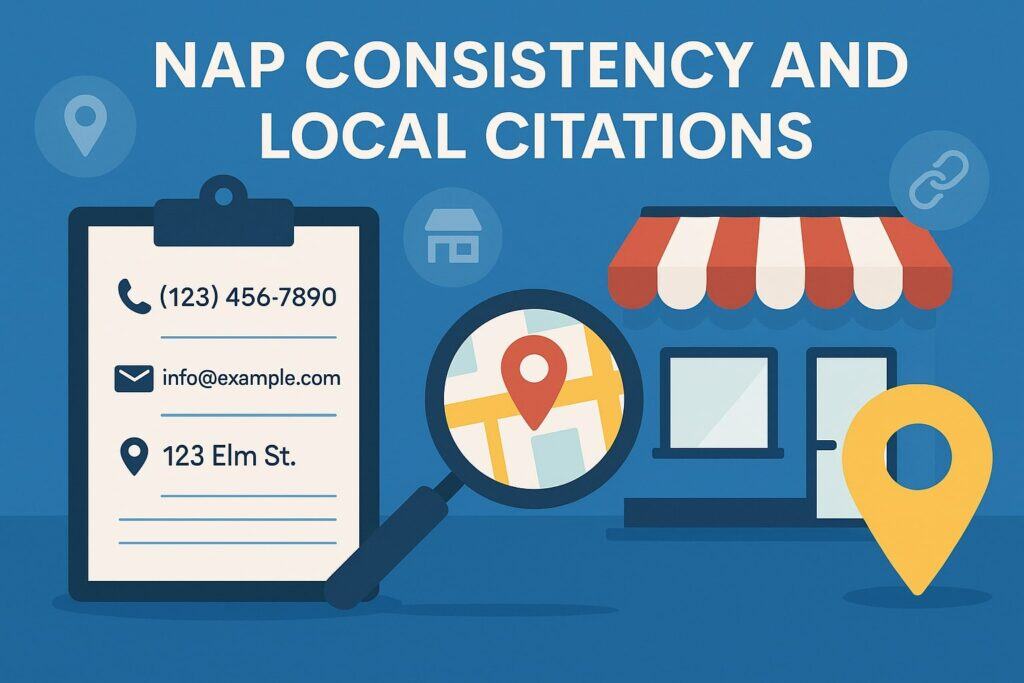
Another critical ranking factor is NAP consistency, which stands for your Name, Address, and Phone number. Google uses this data to verify that your business is legitimate and trustworthy.
Any inconsistencies—such as a different phone number on your website versus your social media page—can confuse both users and search engines, leading to ranking penalties.
Why NAP Matters
- Google cross-references your business data across the web. If it finds variations, it may question the accuracy of your listing.
- Customers who encounter mismatched contact details may lose trust in your business.
How to Ensure NAP Consistency
- Audit all online listings (directories, Yelp, Yellow Pages, Facebook, LinkedIn, industry-specific directories).
- Use tools like Moz Local, BrightLocal, or Yext to find and correct inconsistent listings.
- Always display NAP details in a crawlable format on your website (not just in images).
Local Citations
Citations are mentions of your business’s NAP on external sites and directories. They play a crucial role in building local authority. The more high-quality citations you have, the more signals Google receives about your business’s legitimacy.
- Focus on building citations on authoritative directories relevant to your niche (e.g., TripAdvisor for restaurants, Avvo for lawyers).
- Don’t overlook smaller, local directories that may be highly relevant to your geographical area.
- Ensure each citation matches your GBP and website information exactly.
Consistency and accuracy in NAP data may not seem glamorous, but they serve as the foundation of any strong local SEO strategy. Without it, even the best-optimized website may struggle to rank.
Online Reviews and Reputation Management
Reviews are among the most influential local SEO ranking factors. Not only do they impact rankings, but they also directly affect consumer trust and conversions. Over 90% of consumers read online reviews before visiting a business, and many consider them as trustworthy as personal recommendations.
Google prioritizes businesses with:
- A higher number of positive reviews.
- Recent and regularly updated reviews.
- Consistent responses from the business owner.
Why Reviews Affect Rankings:
- Google sees reviews as a form of social proof, signaling that a business is active and trusted by the community.
- Keywords within reviews can also help your business rank for those specific terms.
Best Practices for Review Management:
- Ask Customers for Reviews:
- Politely request reviews after successful transactions.
- Provide easy-to-use review links via email, SMS, or QR codes.
- Politely request reviews after successful transactions.
- Respond to All Reviews:
- Acknowledge positive feedback and thank customers.
- Address negative reviews respectfully and offer solutions.
- Acknowledge positive feedback and thank customers.
- Avoid Fake or Incentivized Reviews:
- Google penalizes businesses that try to manipulate review systems.
- Google penalizes businesses that try to manipulate review systems.
- Diversify Review Sources:
- Aim to collect reviews not only on Google but also on Yelp, Facebook, and niche-specific platforms.
Reviews serve a dual purpose: improving rankings and shaping public perception. A business with a strong review profile is more likely to win customers over even if they don’t rank first in the Local Pack.
On-Page SEO for Local Rankings
While GBP, reviews, and citations are critical, your website’s on-page SEO also plays a huge role in local rankings. Google uses your website content to confirm your business’s relevance for local searches.
Key On-Page Factors for Local SEO:
- Local Keywords Optimization:
- Use geo-specific keywords (e.g., “plumber in Dallas” or “Miami coffee shop”) in titles, headings, and meta descriptions.
- Incorporate location-based keywords naturally within your content.
- Use geo-specific keywords (e.g., “plumber in Dallas” or “Miami coffee shop”) in titles, headings, and meta descriptions.
- NAP on Website:
- Display consistent NAP information on your contact page and footer.
- Use schema markup to help Google understand your business details.
- Display consistent NAP information on your contact page and footer.
- Location Pages:
- If you serve multiple areas, create unique, optimized landing pages for each location.
- Include details such as services, maps, customer testimonials, and FAQs.
- If you serve multiple areas, create unique, optimized landing pages for each location.
- Mobile Optimization:
- A large percentage of local searches come from mobile devices.
- Ensure your website loads fast and has a responsive design.
- A large percentage of local searches come from mobile devices.
- Content Strategy:
- Publish locally relevant blog posts (e.g., “Best Coffee Shops in Brooklyn for Remote Workers”).
- Cover local events, news, and collaborations.
- Publish locally relevant blog posts (e.g., “Best Coffee Shops in Brooklyn for Remote Workers”).
Strong on-page SEO helps ensure that once potential customers click through from Google, they stay engaged with your business. It improves rankings while simultaneously supporting better user experience.
Link Building and Local Authority
Backlinks remain one of the most powerful ranking signals in SEO, and this holds true for local SEO as well. However, the focus should be on building local authority rather than chasing high domain authority links from irrelevant sites.
Effective Local Link-Building Strategies
- Local Partnerships: Collaborate with local businesses, chambers of commerce, or community organizations for backlinks.
- Sponsorships and Events: Sponsor local events, charities, or sports teams and earn backlinks from event pages.
- Local PR and Media Coverage: Pitch stories to local newspapers, blogs, and online magazines.
- Guest Posting: Write content for local business blogs or industry-specific sites.
Why Local Backlinks Matter
- They validate your geographical relevance to Google.
- They boost trust and credibility in your community.
- They can generate direct referral traffic, not just SEO benefits.
Building backlinks takes time and effort, but a strong local backlink profile can push you ahead of competitors in highly competitive markets.
Mobile SEO and User Experience
Local searches are dominated by mobile users. Whether someone is searching for “nearest gas station” or “restaurants open now,” they’re often doing so on the go. That’s why mobile optimization and user experience (UX) are critical ranking factors.
Important Aspects of Mobile SEO:
- Page Speed: Mobile users expect fast-loading websites. Delays can result in higher bounce rates.
- Responsive Design: Your site must adapt seamlessly to different screen sizes.
- Click-to-Call Buttons: Make it easy for mobile users to call your business directly from search results or landing pages.
- Maps Integration: Embed Google Maps on your website to help customers find you.
Google also considers engagement signals such as bounce rate, time spent on site, and click-through rates. If your mobile site delivers a poor user experience, it can hurt rankings even if other SEO factors are in place.
Local Content Marketing and Engagement
Beyond traditional SEO tactics, content marketing tailored to local audiences can set your business apart. Local content demonstrates to Google—and your customers—that you are deeply embedded in the community.
Types of Local Content:
- Blog posts about community events, local partnerships, or success stories.
- Videos showcasing behind-the-scenes looks at your business.
- Guides like “Top 10 Attractions in [City].”
- Collaborations with local influencers or bloggers.
Benefits of Local Content:
- Builds trust and familiarity within your community.
- Generates natural backlinks from local sources.
- Increases brand awareness and engagement across social media.
Businesses that consistently produce local content establish themselves as thought leaders in their area, which strengthens both rankings and customer loyalty.
FAQs
Q1. How long does it take to see results from local SEO?
Answer: Local SEO is not an overnight strategy. Most businesses begin to see noticeable improvements in visibility within 3 to 6 months, depending on their industry, competition, and starting point.
However, businesses in highly competitive industries may need 9 to 12 months of consistent effort to rank prominently. The key is patience and persistence—Google rewards consistent optimization, quality content, and trustworthy signals. Shortcuts like buying fake reviews or spammy backlinks can backfire and cause long-term penalties.
Over time, as your Google Business Profile strengthens, reviews accumulate, and local backlinks grow, you’ll see compounding benefits. The more active and optimized you are, the faster your results will accelerate.
Q2. Do I need a website if I already have a Google Business Profile?
Answer: Yes. While a Google Business Profile is essential, it should complement—not replace—your website. GBP provides visibility in Maps and the Local Pack, but your website offers far greater control over branding, messaging, and lead capture.
Google also considers website authority when ranking local businesses, so a professional site improves your chances of showing up higher.
Additionally, many customers want more information than a GBP can provide. A website allows you to publish in-depth service pages, blog posts, case studies, and resources that build trust. In competitive markets, businesses without a website are at a major disadvantage.
Q3. How important are reviews compared to backlinks in local SEO?
Answer: Both reviews and backlinks are crucial but serve different purposes. Reviews directly influence consumer trust and click-through rates, while backlinks signal authority and relevance to search engines.
A business with hundreds of positive reviews but no backlinks may still struggle to rank, and one with strong backlinks but poor reviews may fail to convert visitors.
The best local SEO strategy integrates both. Encourage satisfied customers to leave reviews while building relationships that lead to quality backlinks. Think of reviews as the trust signal for customers and backlinks as the trust signal for Google.
Conclusion
Local SEO is more than just a digital marketing buzzword—it’s a necessity for businesses that depend on local customers. By focusing on Google Business Profile optimization, NAP consistency, online reviews, on-page SEO, backlinks, mobile experience, and local content marketing, you can significantly improve your visibility and credibility.
Each ranking factor works together to create a powerful local presence. Businesses that invest consistently in these areas not only climb search rankings but also build lasting relationships with their communities.
If you’re serious about growing your business locally, now is the time to implement these strategies. Local SEO is a long-term investment, but one that yields ongoing traffic, calls, and revenue for years to come.