How to Use Direct Mail Campaigns Effectively
Direct mail campaigns remain a powerful marketing tool in the digital age. Even as consumers are bombarded with emails and social media ads, a well-crafted physical mail piece can cut through the noise and engage your audience in unique ways.
In fact, 84% of marketers say that direct mail delivers the best return on investment (ROI) of any channel they use. Whether you’re a small business owner, marketing professional, or nonprofit organizer, understanding how to use direct mail effectively can help you reach customers and donors across the U.S. with tangible, personalized messages.
This guide will explain the benefits of direct mail, compare it with email and social media, and walk you through step-by-step best practices to plan, execute, and optimize a successful direct mail campaign.
Understanding Direct Mail Campaigns
Direct mail marketing refers to sending physical promotional materials directly to people’s mailboxes – such as postcards, letters, brochures, catalogs, or flyers – with the goal of driving a response or conversion.
Unlike digital ads or emails that flash on a screen, direct mail gives the recipient something tangible to hold and read. This physical presence often makes direct mail stand out. For example, consumers typically sift through only a few pieces of mail each day, versus dozens or hundreds of digital messages.
As a result, open rates for direct mail reach 80–90%, far higher than the ~20% average open rate of email marketing. Simply put, people are more likely to see and open your message when it arrives in their mailbox.
Another defining feature of direct mail is its personal touch. A printed mailer can feel more personal and trustworthy than an impersonal digital blast. In one survey, 70% of people said direct mail is less intrusive and more personal than online advertising.
Generations that hold significant spending power – like Gen X – actually prefer physical mail for promotional content; 71% of Gen X consumers say mail feels more personal than email or online communications.
Even younger generations appreciate mail: 72% of Gen Z consumers would be disappointed to no longer receive physical mail and look forward to checking their mailbox. These attitudes show that direct mail, when done thoughtfully, can create a genuine connection with audiences of all ages.
Benefits of Direct Mail in the Digital Age
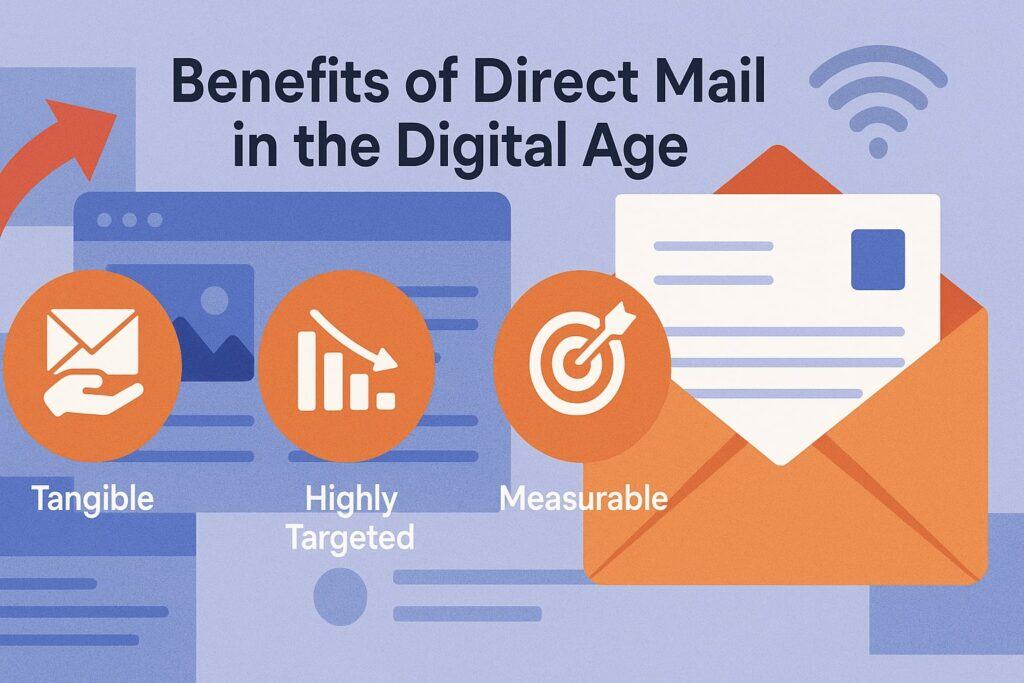
In today’s marketing mix, direct mail offers distinct advantages that digital channels struggle to match. Here are some key benefits of using direct mail campaigns:
- High Visibility and Engagement: Because physical mailboxes are far less crowded than email inboxes or social feeds, your direct mail piece is likely to be noticed. Most recipients at least glance at their mail, giving direct mail an engagement rate around 90% as they open or read it.
Moreover, people tend to spend more time with physical mail. One study found that consumers spend 45% longer viewing direct mail ads than digital ads (1.6 minutes vs. 1.1 minutes on average). This extra attention can lead to better absorption of your message. - Strong Response Rates: Direct mail consistently generates response rates higher than many digital channels. On average, direct mail campaigns see about a 3–5% response rate, compared to response rates often well under 1% for email marketing.
For instance, one analysis showed direct mail’s response rate at 3.7% vs. roughly 1% for email. In some cases (such as mailings to your current customers), response rates can be even higher.
These figures mean direct mail can produce more tangible leads or conversions per recipient than an email or social media ad typically would. - High ROI and Conversion Potential: Thanks to those strong response numbers, direct mail can deliver an excellent return on investment.
Recent data shows direct mail campaigns achieve an average ROI around 29–43% (depending on the study) – in 2022, direct mail’s ROI was about 43% on average, meaning marketers saw a strong payback from their mail efforts.
By some measures, direct mail currently yields the highest ROI of any marketing medium – up to 112%, higher than digital channels like email, paid search, or social media.
Direct mail recipients also tend to spend more; one USPS study noted that mail can drive larger purchases and more loyalty compared to digital touchpoints. For businesses and nonprofits, this translates to potentially greater revenue or donations from a well-run mailing. - Tangible and Memorable Impact: A physical mail piece engages multiple senses – sight and touch – creating a more memorable experience for the recipient. Direct mail allows you to send real, tactile objects that digital marketing can’t match.
For example, a postcard can include a textured finish, or a mailer might contain a small free sample (such as a perfume scent or a coupon card). These tangible elements not only grab attention but also help forge an emotional connection with your brand.
Recipients might pin a colorful postcard on their fridge or keep a letter on their desk, giving your message a longer life. In contrast, emails are easily deleted or forgotten once read. - Less Competition and “Digital Fatigue” Relief: As consumers, we’re experiencing digital fatigue from the constant stream of online ads, emails, and notifications.
Many people have become numb to banner ads and mass emails – 86% of web users experience “banner blindness,” tuning out digital ads, and a large majority feel overwhelmed by the volume of marketing emails they receive daily.
Direct mail faces far less competition for attention. Only 23% of consumers say they receive “too much” direct mail, compared to 46% who say they get too many emails. A thoughtfully designed mail piece arriving in a relatively empty mailbox can be a welcome change of pace.
It reaches customers when they are in a different, perhaps more receptive, frame of mind – like sorting through their daily mail at home rather than hurriedly clicking through emails at work.
In short, direct mail can cut through the digital clutter and engage prospects who might ignore another email or Facebook ad. - Credibility and Trust: Receiving a physical letter or postcard from a business often feels more legitimate and trustworthy than seeing an ad online. The effort and cost involved in sending mail can signal that a brand is established and serious.
Consumers tend to trust print mail more – for example, 70% believe mail is more personal and less invasive than digital messaging, and many view mail as a safer way to receive personalized offers (over half of people are more comfortable seeing personal details in a mailed ad than in an online ad).
This trust factor can improve how recipients perceive your offer. For nonprofits, in particular, direct mail appeals often build credibility with donors (a printed letter on letterhead can feel more official and heartfelt). Across industries, incorporating direct mail in your marketing can enhance brand credibility and recall.
While direct mail has clear benefits, it’s important to acknowledge it’s not a magic bullet. There are challenges too – such as higher upfront costs, longer lead times for printing and delivery, and the need for accurate addresses.
In the next sections, we’ll cover how to overcome these challenges and use direct mail campaigns effectively to maximize their impact.
Addressing Common Direct Mail Challenges
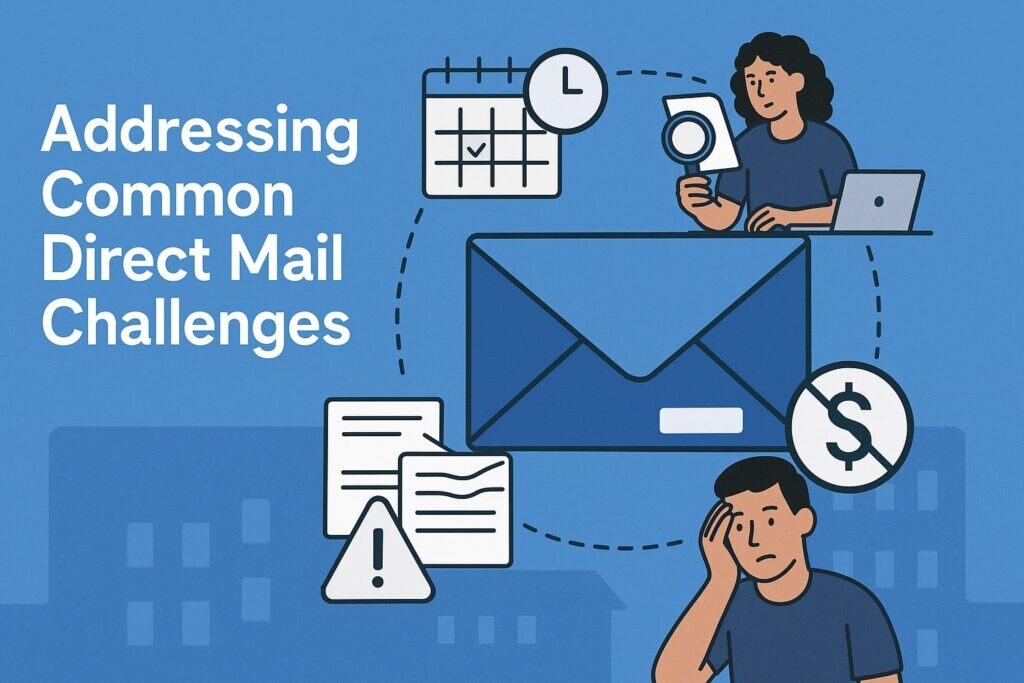
Before diving into how to execute a campaign, let’s briefly address a few challenges of direct mail and how you can mitigate them:
- Higher Costs: Direct mail requires printing materials and paying postage, which makes it more expensive per contact than email (which is virtually free to send). To control costs, be strategic about your mailing list and mail piece.
Target the right audience so you’re not wasting mail on unqualified leads – a smaller, well-targeted list can yield better ROI than a huge, untargeted blast. Also consider postcard mailers, which are generally cheaper to print and mail than letters in envelopes.
You can use bulk mailing rates via USPS for large campaigns, and plan mailings in advance to batch print jobs efficiently. While direct mail is pricier upfront, remember its response rate is higher – often making the cost per response competitive with, or even better than, digital channels once the campaign is done.
In short, invest wisely in quality over quantity: a well-designed mail piece sent to 1,000 carefully chosen recipients is money better spent than a mediocre flyer mailed to 10,000 random addresses. - Longer Lead Time: Unlike an email you can design and send in a day, direct mail campaigns need more lead time for design, printing, and postal delivery. Expect a direct mail campaign to take weeks from planning to hitting mailboxes.
To work around this, plan your campaigns early, especially if they’re tied to events or holidays. Coordinate with your printer or mail service to get realistic timelines. You can also use tools to expedite parts of the process – for example, some direct mail automation services can print and mail for you within days.
While you can’t match the instant speed of digital, you can still time your direct mail strategically. For urgent announcements, one approach is to send an email first (for speed) and follow up with a direct mail piece for maximum visibility. We’ll discuss integration strategies later. - Tracking and Measuring Results: With digital marketing, it’s easy to track opens, clicks, and conversions automatically. Direct mail doesn’t have built-in tracking – you can’t “see” how many people opened your letter. This can make it challenging to measure campaign performance.
However, there are workarounds to track direct mail response. Include unique response mechanisms on your mail piece: for example, a promo code or coupon that’s unique to that mail campaign, a custom URL or QR code that leads to a campaign-specific landing page, or even a dedicated phone number to call.
By counting how many people use that code, visit that URL, or call that number, you can gauge your response rate and conversion rate. We’ll cover more on measurement later, but know that with planning, you can collect good data from direct mail.
Additionally, modern tech like QR codes has made tracking much easier – you can see scans in real time. (Notably, QR code use in direct mail has exploded, from about 4% of mail pieces in 2020 to over 34% in 2023, as marketers leverage them to bridge mail with online tracking.)
By anticipating these challenges – budget, timing, and tracking – and addressing them in your campaign strategy, you can ensure your direct mail efforts are effective and efficient. Now, let’s walk through the concrete steps to create a successful direct mail campaign.
Steps to Launch a Successful Direct Mail Campaign
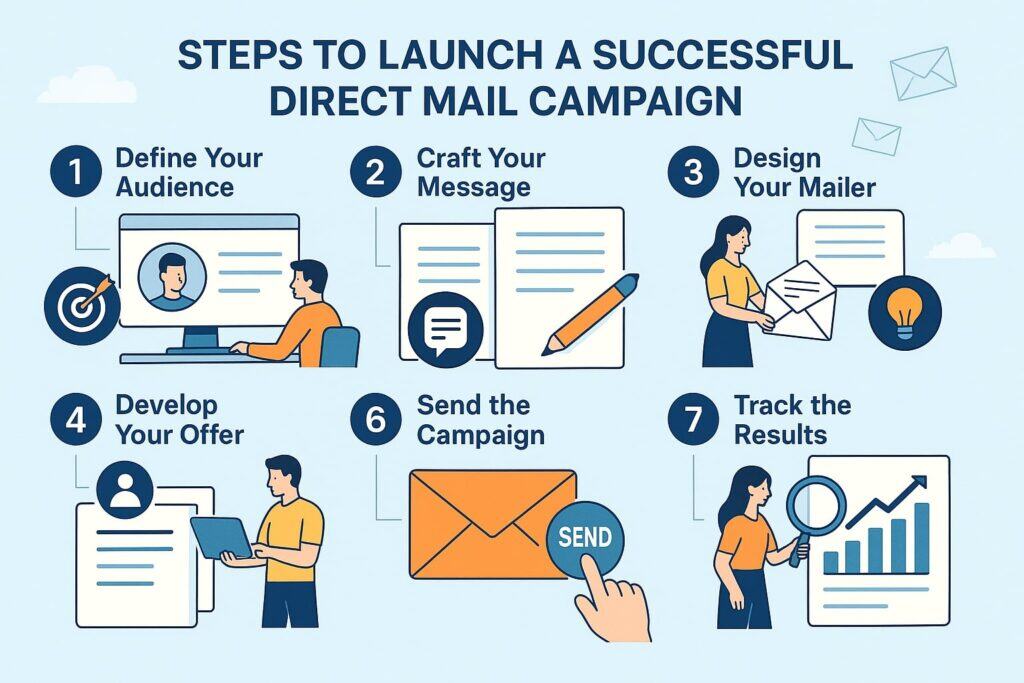
Using direct mail effectively involves careful planning and execution. Below is a step-by-step guide to help you create and run a direct mail campaign that gets results:
- Define Your Campaign Goals and Audience: Start by clearly identifying what you want to achieve and who you want to reach with your direct mail campaign. Are you trying to generate leads for a new product, drive customers to a store or website, solicit donations for a nonprofit, or increase loyalty among existing clients?
Define a specific call-to-action (e.g., “Visit our website and use this discount code” or “Donate using the enclosed form”). Knowing your goal will guide the rest of your campaign decisions. At the same time, pinpoint your target audience.
Direct mail works best when it’s targeted to the right people. Consider factors like geography (e.g., local neighborhoods, specific ZIP codes for a retail store’s radius), demographics (age, income, home ownership, etc.), or behavior (past purchases, lapsed customers, donors who gave last year, etc.).
For instance, a small business might target residents within 5 miles of its location, while a nonprofit might mail past donors or a purchased list of likely supporters. Define your audience as precisely as possible, because a high-quality mailing list will make or break your campaign’s success. - Build and Clean Your Mailing List: Once you know your audience, assemble your mailing list. You might use an in-house list (e.g. your customer database or donor list) or rent/purchase a targeted list from a reputable provider for prospecting.
Quality of the list is crucial – outdated or inaccurate addresses will waste your budget and lower response rates. Clean your list by removing duplicates and correcting bad addresses.
It’s wise to verify addresses against the USPS National Change of Address (NCOA) database or use address validation tools so you don’t send mail to people who have moved.
Ensuring addresses are deliverable means more of your mailers will reach the intended recipients (and you won’t pay postage on mail that just comes back as undeliverable). Also, segment your list if appropriate.
For example, you might separate current customers from new prospects, or small donors from major donors, to send each group a slightly different mail piece that speaks to them directly. Taking time to build a clean, targeted list will significantly improve your direct mail campaign’s effectiveness. - Craft a Compelling Offer and Message: With your audience in mind, decide on the core offer or message that will drive your campaign. What value are you offering the recipient, and what do you want them to do?
In direct mail, specificity and benefit-focused messaging are key. Write a strong headline or opening line that immediately tells the reader what’s in it for them – for example, “Save 20% on your next order” or “You’re invited to an exclusive event”.
Keep your language clear and persuasive but also concise, since many people will skim. Feature the main benefit prominently and early in the content. If appropriate, include a time-sensitive incentive (a limited-time discount, a bonus gift for responding by a certain date, etc.) to spur action.
Also, ensure your call-to-action (CTA) is crystal clear. Whether it’s “Visit our store,” “Use this promo code online,” “Call us for a free quote,” or “Mail back the enclosed donation card,” state the desired action plainly and highlight it on the mail piece.
Many successful direct mail pieces have the CTA in multiple places – e.g., in the body text and again in a P.S. – to make sure it’s seen. Remember, direct mail is often a “one shot” chance to reach someone, so your offer and message need to grab attention and drive action quickly. - Design an Eye-Catching Mail Piece: The design and format of your mail piece play a huge role in getting attention and communicating your message effectively. Whether you choose a postcard, letter, brochure, or catalog, follow best practices for direct mail design.
Use a clean layout with a clear visual hierarchy – place the most important message or headline at the top in a bold, easy-to-read font. Include appealing imagery that supports your message (for example, product photos or a picture of happy customers), but avoid clutter.
Whitespace is your friend; a less crowded design can actually draw the eye to key elements. Make sure your branding (logo, colors, fonts) is consistent with your other marketing so recipients recognize it’s your company.
If using an envelope, consider teaser copy or visuals on the outside to entice the recipient to open it. Inside, or on a postcard, prominently feature your call-to-action – often this means giving it a distinct color or button-like design, or a big font, so the reader can’t miss it.
Also, design with the postal regulations in mind: leave space for addressing and postage, and ensure the back of a postcard isn’t too glossy for ink if addresses will be printed there.
If you’re not a design expert, it can be worth hiring a graphic designer or using direct mail template services to create a professional-looking piece; strong design has a direct impact on response.
An attractive, easy-to-read mailer will reflect well on your brand and improve the likelihood that recipients engage with it. - Personalize Your Content: Whenever possible, personalize your direct mail to each recipient – this can dramatically boost response.
Something as simple as including the person’s name in the greeting or headline can grab their attention (“John, a special offer for you…”) and make the message feel more relevant.
In fact, adding a recipient’s name or other personal data can increase response rates significantly – studies have shown lifts of up to 135% when a name is included in direct mail campaigns.
Beyond names, you can tailor the content to the individual’s demographics or past behavior. For example, if you’re a retailer, you might reference a customer’s last purchase: “We hope you’re enjoying your new lawnmower – here’s 20% off accessories.”
For nonprofits, you might segment by donation history: “Thank you for your past support in 2022 – would you consider renewing your gift this year?” Segmentation is key to effective personalization.
Divide your mailing list into meaningful groups (by location, purchase history, interests, etc.) and adjust the offer or copy for each group. Modern printing technology (like variable data printing) makes it easier to swap out text or images on the fly so each piece is customized.
You can also personalize at scale using techniques like personalized URLs (PURLs) or unique QR codes – for example, your mailer might say “Visit JohnSmith.example.com to view your custom offer”.
When John Smith visits that URL, it’s a landing page tailored for him. This level of personalization connects the physical mail to an individualized digital experience. The more relevant you can make your mail piece to each recipient, the more likely they are to respond positively. - Choose the Right Format and Size: Direct mail is not one-size-fits-all. You should select a mail format that fits your message, budget, and audience. Common direct mail formats include:
- Postcards – Great for brief messages, announcements, or simple offers. They are cost-effective and ensure your message is seen immediately (no envelope to open).
However, space is limited. Postcards work well for things like store openings, event invites, or quick promos. - Letters in Envelopes – Ideal for more formal communications or detailed messages. Letters give you more room to tell a story (for example, nonprofit appeal letters often run 1-2 pages) and can include additional inserts (flyers, response forms, return envelope for mail-back response, etc.).
Envelopes add a layer of curiosity (a well-crafted teaser on the envelope can urge people to open it), but some mail might get discarded unopened if it looks too promotional. Consider using a handwritten font or a real stamp to give envelopes a personal, less “mass mail” feel. - Self-Mailers (folded brochures mailed without an envelope) – These offer more space than a postcard and can be visually engaging, while still avoiding an envelope.
They are often used for mini-newsletters or multi-panel offers. Just ensure they’re securely tabbed or glued per USPS requirements. - Catalogs or Booklets – Multi-page mailers like catalogs are more expensive but can showcase a range of products or information.
They tend to have higher response rates for targeted audiences because recipients might save them and browse multiple times. For example, a retailer might mail a seasonal catalog to top customers. - Dimensional Mailers (boxes or bulky packages) – These include anything 3D or with unusual shapes (even tubes or padded envelopes). They are costly per piece but have very high open rates due to curiosity.
Often used in B2B marketing for key prospects (imagine sending a small gift or gadget in a box with a clever message). Response rates for dimensional mail can reach double digits, but use them sparingly for high-value targets due to the expense.
- Postcards – Great for brief messages, announcements, or simple offers. They are cost-effective and ensure your message is seen immediately (no envelope to open).
- Each format has pros and cons. As a rule of thumb, simpler and smaller (postcards) is good for broad outreach and quick impact, whereas letters and catalogs suit more complex or high-value communications.
Also pay attention to size and weight – oversized mail (e.g. larger envelopes) can stand out and actually often get the highest response rates, but they may cost more in postage.
Balance creativity with practicality. If in doubt, test different formats on small subsets of your list to see which performs best before rolling out to everyone. - Plan Timing and Frequency: Timing can influence a direct mail campaign’s success. Schedule your mail drop with your goal in mind. For example, if you’re promoting a weekend sale, ensure the mail pieces arrive a few days before the sale starts.
Keep in mind mailing lead times – First Class mail within the U.S. usually arrives in 1-5 days, whereas Standard (Marketing) Mail can take 1-2 weeks depending on distance and USPS processing.
Also consider the time of year: avoid having your mail arrive on major holidays when it might get overlooked, and be mindful of seasonal factors (a lawn care service might do a big mailing in early spring, for instance).
Frequency is another consideration. One mailing alone might not yield the best results – often, a sequence of touches works better. You might send a follow-up mailer or integrate other channels (see next section) to reinforce the message.
However, don’t bombard the same people with too much mail, or it could be seen as junk. Many businesses find that a regular cadence (e.g., a newsletter every quarter, or a promotional postcard every month or two) keeps them in customers’ minds without causing fatigue.
Test different frequencies to find the sweet spot for your audience. For fundraising, nonprofits might mail donors 2-4 times a year with updates and appeals.
For a business, even one well-timed mail piece for a campaign can outperform numerous emails that might have gone unnoticed. So plan your timing deliberately around your audience’s likely receptiveness and your campaign goals. - Integrate with Other Channels (Multi‑Channel Approach): Direct mail works best as part of an integrated marketing strategy. You can greatly boost effectiveness by coordinating your mail with digital outreach like email, social media, or SMS.
For example, if you send a direct mail offer, you could follow up with an email to the same list about a week later, reminding them of the mail offer – this kind of one-two punch can increase response rates significantly (one study found a follow-up email after a mail piece boosted response by 63% compared to mail alone).
Similarly, you can target recipients with online ads around the time they receive the mail (Facebook and Google allow you to upload customer lists or target ZIP code areas). Seeing the same message both in hand and online reinforces brand recall.
Retargeting is effective: for instance, show a social media ad to people who visited the custom URL from your mailer, to keep nurturing that lead.
Conversely, you can use direct mail to follow up digital engagement – say, sending a postcard to website visitors who abandoned a shopping cart (if you have their address), which is an example of trigger-based direct mail.
This multi-channel synergy meets customers along their journey: one channel prompts them to check another. Importantly, ensure your branding and messaging are consistent across channels so it feels cohesive.
By integrating direct mail with email and social media, you create multiple touchpoints that surround the consumer with your message.
In fact, 85% of consumers prefer a combination of physical and digital brand communications, and 97% of marketers report that an omnichannel approach has improved campaign results.
The takeaway is that direct mail shouldn’t exist in a silo – tie it into your broader marketing calendar for maximum impact. - Track Responses and Measure Results: As you launch your direct mail campaign, set up ways to track the outcome. As mentioned earlier, using unique identifiers in your mail is crucial.
Typical tracking methods include: coupon or promo codes (unique to the campaign or even unique per recipient), personalized URLs or landing pages (to see who visits and possibly capture their info), QR codes (scans can be tracked and tied to each mail drop), and dedicated phone numbers or extension lines (services can provide a special number that forwards to your main line but logs calls from that campaign).
Additionally, if you ask people to bring something in (like bringing the postcard to the store for a discount), your staff can tally those redemptions. Make sure to monitor these metrics closely.
Key direct mail performance metrics include the response rate (what percentage of recipients responded in any way), the conversion rate (percent who not only responded but completed the desired action, like a purchase or donation), and the overall ROI (revenue generated minus campaign cost, divided by cost, as a percentage).
For instance, if you spent $5,000 on a mailing and it brought in $20,000 in sales, your ROI is 300%. You might find that 50 people responded out of 2,000 mailed (2.5% response), 30 of those made a purchase (1.5% conversion), yielding that $20k revenue. Tracking these results lets you gauge success.
Don’t forget to also gather qualitative feedback if possible. You could include a short survey URL on the mailer or ask customers how they heard about you when they respond.
Some companies include a reply card not just for orders but for feedback. Even monitoring social media or customer service for mentions (“I got your mailer and…”) can provide insights. - Analyze and Optimize for Next Time: After the campaign, take the time to analyze what worked and what didn’t. Calculate your cost per response and cost per conversion.
Did you achieve your goal (e.g., number of sales or donations)? Which segment of your audience responded best? For example, you might discover that current customers responded at a much higher rate than cold prospects – a sign that future campaigns might focus more on your customer base or that you need a stronger offer for prospects.
If you included an A/B test (say, two different versions of the mail piece sent to split samples), compare the results. A/B testing is extremely valuable in direct mail: you can test different headlines, designs, or offers to see which pulled a better response.
For instance, perhaps the version of your postcard with a bold headline got a 4% response vs. 2.5% for the version with a smaller headline – that’s a clear winner to carry forward. Even small improvements, like a more prominent CTA or a more accurate list, can compound into significantly better performance over time.
Document your learnings for the next campaign. Direct mail allows for continuous improvement: with each mailing, apply the insights (e.g., keep using the better-performing design, or adjust your messaging if certain phrasing resonated).
Over time, you can build a highly optimized direct mail strategy tailored to what your customers or donors respond to.
By following these steps – from planning and list prep through design, integration, and post-campaign analysis – you’ll set up your direct mail campaigns for success. Remember that effective direct mail marketing is an iterative process: plan thoroughly, execute carefully, and then learn and refine.
Next, let’s examine how direct mail compares to other marketing channels and why it remains a valuable complement to your digital efforts.
Direct Mail vs. Email Marketing vs. Social Media
Marketers often wonder how direct mail stacks up against popular digital channels like email and social media. Each channel has its strengths, so the best approach is usually to use them together strategically rather than choose one over the other. Nonetheless, it’s useful to compare their characteristics:
Direct Mail vs. Email Marketing
Both direct mail and email aim to deliver a targeted message to a mailbox – one physical, one virtual. Here’s how they compare:
- Reach & Visibility: Email is essentially free and instantaneous, allowing you to send to thousands of contacts with a click. However, inboxes are extremely crowded – the average office worker receives over 100 emails a day, and over 333 billion emails are sent daily worldwide.
Because of this overload (and spam filters), many marketing emails go unopened or unseen. Direct mail, by contrast, reaches a less cluttered mailbox, often at a time when the recipient can physically sort and look at their mail.
Direct mail open rates (often 80% or more) far exceed email open rates (20-30%), so your message is much more likely to actually be seen with direct mail. - Response Rates & ROI: Direct mail generally produces higher response rates than email. As noted earlier, direct mail averages around a 3-5% response rate, whereas marketing emails average around 0.6% response (or roughly 1 in 100-200 recipients).
One reason is that people tend to give physical mail more attention; another is that mail can reach those who ignore emails entirely. In terms of ROI, direct mail and email both can be profitable, but studies indicate direct mail often edges out email – e.g., one source puts direct mail’s ROI at ~43% vs. email’s ~32%.
That said, email is far cheaper per contact, so even a smaller response can be cost-effective. The cost per acquisition might end up similar when factoring cost differences. Still, if you need a higher absolute response and engagement, direct mail has the advantage. - Speed and Frequency: Email wins on speed – you can conceive and send an email campaign within hours or days, and get immediate results (opens and clicks often occur within 48 hours of sending).
Direct mail requires more lead time to produce and deliver, as discussed. Email also allows high frequency touches at little cost – you can send weekly or even daily emails (though too frequent emails may annoy subscribers).
Direct mail is best used at a more measured frequency (due to cost and effort). Use email for quick updates, last-minute announcements or frequent communications, and use direct mail for the messages where you want to ensure maximum attention or make a bigger impression. - Personalization & Content: Both channels support personalization, but in different ways. Email can dynamically insert personal data (names, product recommendations) easily and even adjust content based on triggers or segments automatically.
Direct mail requires upfront data work to personalize print, but it can achieve similar personalized messaging (and as we saw, it often has a bigger impact when personalized, because it’s unexpected in print).
In terms of content richness: email can include multimedia (videos, GIFs, links) and have as much length as you want (though shorter is usually better).
Direct mail can actually present more content in some formats (e.g., multi-page letters or catalogs) that readers might engage with in a focused way, whereas long emails often go unread.
Also, direct mail can deliver things email can’t – like tangible samples or coupons that people physically carry to a store. - User Experience: Email requires the recipient to have a device and internet connection, and emails might render differently on different email clients. There’s also the risk of your email landing in a spam folder or being deleted in a bulk sweep of an inbox.
Direct mail involves a physical interaction – picking up the mail, opening it – which can feel more deliberate. There’s no “spam folder” for postal mail, though people certainly throw away junk mail quickly if it doesn’t catch their interest.
Importantly, direct mail can feel more official and trustworthy; for example, a financial offer sent by mail might be taken more seriously than the same offer via email, which could be suspected as phishing.
One survey even noted people find brand communications via mail more credible and memorable than digital ads.
In summary, email is great for its low cost, speed, and ease of testing/iteration, while direct mail wins on attention, engagement, and perceived personal touch. Use email for routine communications and quick follow-ups, and use direct mail to make a strong impact or reach those who don’t respond to email.
Often, the combination works best – for instance, send a direct mail piece to introduce a campaign, and follow it with a reminder email (leveraging the strengths of each).
Rather than “either/or,” view them as complementary: direct mail can drive people to online action (via a URL or QR code in the mail), and email can reinforce a mail message.
Direct Mail vs. Social Media Marketing
Social media marketing (like Facebook/Instagram ads, Twitter/X, LinkedIn promotions, etc.) is another common channel to compare with direct mail. Key points of difference:
- Audience Targeting and Reach: Social media offers sophisticated targeting – you can target ads based on interests, behaviors, demographics, etc., and reach a potentially global audience instantly.
Direct mail targeting is based on physical addresses and available data (which can include demographics and some behavioral indicators via mailing lists). If you want to reach a very broad or younger audience online, social might reach people who aren’t on your mailing list.
However, social media ads rely on users being on those platforms and paying attention. There’s also increasing competition and clutter in feeds. Direct mail guarantees your message is delivered to a household, whereas social media delivery depends on algorithms and ad budgets.
In terms of reach: one is not inherently “bigger” than the other – they are just different mediums. For local businesses, direct mail can penetrate a local market (every household in a ZIP code) effectively, while social media can saturate people’s feeds in that area.
Social can reach far-flung audiences cost-effectively, whereas mailing internationally would be expensive. So your choice may depend on whether your target is local/regional (direct mail is great for that) or highly dispersed (digital might scale better). - Engagement and Attention: Scrolling through social media is a fast, distraction-filled activity. Ads come and go in seconds. Many users scroll past ads due to “banner blindness” and ad fatigue.
Engagement rates (like click-through rates) on social ads are often well below 1%. Direct mail, as noted, tends to hold attention longer and prompts a more conscious decision (even if that decision is to toss it, at least it was considered briefly).
Moreover, a physical mail piece can be saved and revisited, whereas a social post is gone from view once scrolled past (unless the user actively saves it).
Direct mail pieces often stay in a household for days or weeks, serving as a reminder if left on a counter or fridge. Social media content is ephemeral in comparison. - Trust and Credibility: Misinformation and privacy concerns on social platforms have made some consumers skeptical of social ads.
An advertisement on Facebook might be seen as intrusive or untrustworthy by some (especially given issues around data privacy). In contrast, as discussed, a printed mailer can come across as more legit.
Additionally, there is less fraud risk perceived – people are cautious about clicking unknown links on social media, but scanning a QR code on a mailer to an official site or calling a printed phone number feels safer.
One study indicated that consumers found direct mail more trustworthy than digital ads when making purchase decisions. From a brand standpoint, mailing shows effort and investment, which can elevate how your brand is perceived. - Cost and ROI: Social media ads are typically paid on a per-impression or per-click basis, which can be inexpensive per view (pennies) but can add up and also can suffer from false engagement (bots, accidental clicks).
Direct mail has a clear cost per piece but yields more deliberate engagements. It’s a bit apples-to-oranges to compare directly. Some data from advertisers suggests that direct mail’s ROI can surpass that of social media – for instance, one report found average ROI of social media ads around 81% vs. 112% for direct mail.
Your mileage will vary. Social is excellent for brand awareness and top-of-funnel exposure, whereas direct mail often comes into play closer to conversion or for retargeting with a specific offer.
Many businesses find social ads produce a high volume of leads but lower quality, whereas direct mail produces fewer leads but they convert at a higher rate (because the medium filters for more interested prospects).
Direct mail also doesn’t face issues like click fraud or viewability problems – if you mailed 5,000 pieces, you know those addresses received them. - Interactive Elements: Social media thrives on interactivity – likes, shares, comments – which can amplify your message if something goes viral or is highly engaging content. Direct mail by itself is one-way (there’s no “share” button on a postcard).
However, direct mail can include interactive elements in a different sense: pop-up folds, scratch-off areas, QR codes leading to augmented reality experiences, etc.
In recent trends, augmented reality (AR) via direct mail is emerging, where a user can scan the mail piece with their phone to see digital content overlayed (for example, see a 3D model of a product).
This merges the tactile strength of direct mail with digital interactivity. Social media is inherently interactive but has a fleeting quality; direct mail is static but can prompt a deeper interaction (like visiting a website or physically redeeming an offer).
In summary, social media is a fast, broad-reaching channel that’s great for awareness and engagement in the digital space, while direct mail is a slower, more deliberate channel that excels at engagement in the physical space.
Direct mail often reaches people at home in a mindset where they can engage more deeply, whereas social media reaches them on-the-go with shorter attention.
For best results, again consider using them together: for instance, you might use social ads to prospect and build awareness, then send direct mail to those who showed interest (many platforms now allow you to export leads or mailing addresses from sign-up forms).
Or conversely, use direct mail to drive people to follow your social media or sign up for emails (include those invites in your mail piece). Each channel can amplify the other – this multi-channel approach tends to yield the strongest overall marketing outcomes.
Measuring Success and Optimizing Your Direct Mail Campaigns
To ensure your direct mail campaigns are truly effective, it’s essential to close the loop by measuring results and continuously improving. Here’s how to approach measurement and optimization:
- Track Key Metrics: As discussed in the steps section, always track the performance of your mailings. The fundamental metric is the response rate – what percentage of the mailed audience responded in the desired way.
Response could be a returned reply card, a purchase, a donation, a phone inquiry, an online sign-up, etc., depending on your goal. Typical direct mail response rates can range from around 1% for untargeted “cold” mailings to upwards of 5% or more for well-targeted campaigns.
Industry benchmarks can vary: for example, a 2% response might be average in some industries, whereas others routinely see 4-5%.
If you’re mailing to your house list (existing customers/donors), expect a higher response (perhaps 5–9% on average), whereas prospect lists respond on the lower end (1–3%). Besides response rate, look at the conversion rate (if response is a lead, how many leads converted to actual sales or donations).
Calculate the ROI by comparing how much revenue (or lifetime value) the campaign’s responses generated to what the campaign cost. For example, if you spent $10,000 and earned $30,000 in revenue directly tied to the mailing, that’s a 200% ROI (or a 3:1 return on ad spend).
Direct mail’s ROI has been found to outshine many digital channels, but your tracking needs to attribute sales accurately to the mailer. Using unique tracking methods like codes or URLs greatly helps with this attribution. - Use Control Groups: One powerful way to measure direct mail impact is to use a hold-out group. If possible, don’t mail a small, random subset of your audience and then compare their behavior to those who received the mail.
For instance, if you have 10,000 customers and plan to send a mailer, hold out 500 customers who are similar (randomly chosen) to not get the mail. After the campaign, see how many purchases (or donations, etc.) occurred in the mailed group vs. the hold-out.
This can show the “lift” caused by the mail – maybe 300 of the 9,500 mailed customers bought something and only 5 of the 500 un-mailed did, indicating the mail drove most of those purchases.
This approach controls for background behavior and gives you more confidence that the direct mail was effective (or by what percentage it increased results over no mail). - Gather Feedback and Learnings: If you can, solicit feedback. Ask a few responders what they thought of the mail piece or why it compelled them – you might discover useful insights (e.g., “I almost threw it away but the coupon caught my eye” or “I appreciated the handwritten note”).
Also, pay attention to any negative feedback (did anyone mention the mail was irrelevant or too frequent?). Use all this to refine your strategy. - Test and Iterate: Treat each mailing as a chance to test something. We mentioned A/B testing earlier – always try to test at least one element in your campaign if volume allows. It could be as simple as testing two different headlines, or a postcard vs. a tri-fold mailer.
For example, you might split your list in half and send Version A and Version B; if Version B gets a 4% response and A gets 2%, you have a clear winner to use going forward. Keep a log of tests performed and their results.
Over time, continuous testing will lead to a highly optimized approach tailored to your audience’s preferences. Even small improvements in response rate (a percentage point or two) can significantly boost ROI when scaled.
Also test your mailing list sources – if you used two different list vendors or sources, compare which yielded better respondents and focus on the better source next time. - Optimize Timing and Integration: Evaluate if the timing was effective. Did responses come immediately, or trickle in over weeks? If you notice most responses came within a week of mail delivery, that’s typical – but if yours came very slowly, perhaps the mail landed too early for an event or offer.
Adjust scheduling next time. Also analyze any multi-channel effects. If you followed up mail with emails or calls, did that combination yield a higher conversion than mail alone?
Many marketers find that integrated campaigns have a multiplier effect – for instance, direct mail combined with email follow-ups can yield a 27% higher conversion rate than mail alone. Look at your data to quantify this for your business.
Finally, calculate your cost per acquisition and compare it to other channels. For example, if your direct mail campaign cost $10,000 and brought in 100 new customers, that’s $100 per acquired customer.
If your typical cost per customer via Facebook Ads is $150, then direct mail was quite efficient. If it was higher, consider ways to refine the mail campaign (better targeting, improved offer) or if those customers have a higher lifetime value making it still worth it.
Always view direct mail in the context of your overall marketing performance. When optimized, direct mail often proves to be a high-ROI channel that complements your digital efforts by reaching customers in a way digital can’t.
FAQs
Q.1: What is direct mail marketing?
Answer: Direct mail marketing involves sending promotional materials through postal mail directly to individuals’ homes or business addresses. These materials can include postcards, letters, brochures, catalogs, flyers, or even small merchandise items.
The goal of a direct mail campaign is to communicate an offer or message and encourage the recipient to take a specific action – such as making a purchase, donating to a charity, returning a reply card, or visiting a website.
Unlike mass advertising, direct mail is highly targeted to a specific list of recipients, and it can be personalized for each person. Essentially, if you’ve ever received an advertisement or fundraising letter in your mailbox, that’s direct mail marketing in action.
Q.2: Is direct mail still effective in the digital age (2025)?
Answer: Yes – direct mail remains highly effective even in today’s digital-focused world. While overall mail volumes are lower than in the past, this actually works in marketers’ favor: a well-designed mail piece faces less competition for attention.
Studies continue to show strong performance for direct mail. For example, open rates for direct mail can reach 80-90% (far above email open rates), and typical response rates for direct mail range from about 2% to 5% (vs. response rates under 1% for most digital channels).
In 2024, direct mail’s average ROI was reported around 29-43%, making it one of the highest ROI channels available. Many businesses are actually increasing their direct mail spending as they see consumers tune out digital ads.
Direct mail also benefits from “digital fatigue” – people often pay more attention to physical mail since they receive fewer of them and are overwhelmed by constant emails and online ads. When integrated with digital marketing (mail plus email or social media), direct mail’s effectiveness is amplified even more.
In short, direct mail is thriving as a marketing strategy in 2025, provided it’s used smartly – with good targeting, personalization, and a compelling message that complements your digital outreach.
Q.3: How does direct mail compare to email marketing?
Answer: Direct mail and email marketing are both direct-to-consumer channels, but they have different strengths. Direct mail has a much higher likelihood of being seen – most mailed pieces get at least a glance, yielding vastly higher open rates than email.
It also tends to generate higher response rates (several percentage points vs. well under 1% for emails on average). People often view mail as more personal and credible, and a physical mailer can make a stronger impression (often leading to higher conversion rates or larger purchase amounts).
Email marketing, on the other hand, is faster and essentially free to send. You can reach someone instantly and send multiple follow-ups at almost no incremental cost.
Email is great for ongoing engagement, quick updates, and automated sequences (like welcome email series or cart abandonment reminders), whereas direct mail is great for important, high-impact messaging and reaching those who ignore emails.
Cost-wise, email is cheaper, but direct mail’s higher response can balance the ROI. Ideally, use them together: for example, send a direct mail postcard to introduce an offer, and follow up with an email reminding the recipient about it – using both channels tends to lift overall results.
Rather than seeing them as either/or, leverage email for efficiency and direct mail for effectiveness in grabbing attention and engaging customers.
Q.4: How can I track the success of a direct mail campaign?
Answer: Tracking direct mail is definitely possible with some planning. The key is to include unique identifiers in your mail piece that let you attribute responses. Here are a few common tracking methods:
- Promo Codes or Coupons: Print a special discount code on the mailer (e.g., “Use code MAIL20 for 20% off”). When customers use that code online or in-store, you know it came from the mail piece. Ensure the code is unique to the mailing (and not used in other channels).
- Unique URLs or Landing Pages: Create a simple URL for the campaign, ideally personalized. For example, YourSite.com/JuneOffer or even JohnDoe.YourSite.com for each recipient.
You can track visits and conversions on those specific pages in your web analytics. A personalized URL (PURL) can pre-fill the person’s info or show a custom page, further tying the response to that individual. - QR Codes: Include a QR code on the mailer that when scanned leads to your offer or website. Modern QR codes can be generated uniquely per recipient or per segment. When scanned, they record the activity.
QR codes make it easy for someone to jump from the physical mail to digital action, especially with the ubiquity of smartphones. - Dedicated Phone Numbers or Extension: If you expect phone orders or inquiries, set up a unique phone number (or a specific extension) for the campaign.
Services exist that provide temporary tracking numbers forwarding to your main line, which log calls. If using your main number, instruct reception to ask callers for a code or how they heard about you. - Mail-Back Response Cards: For certain campaigns (like nonprofit donations or subscriptions), you might include a pre-filled response card. By coding those cards (or using a specific address to return them to), you can track responses that come via mail.
By analyzing the data from these methods, you can calculate response rates, conversion rates, and ROI for your direct mail campaign. For instance, if 100 people used the mail-specific promo code out of 5,000 mailers sent, that’s a 2% direct response.
Combine this with any indirect lift (some people might respond without using the code, so comparing sales during the campaign period among those mailed vs. not mailed can help).
It takes a bit more work than digital analytics, but with the right tracking elements in place, you can confidently measure how successful your direct mail campaign was and justify the investment.
Q.5: What is a good response rate for direct mail campaigns?
Answer: “Good” response rates can vary by industry, audience, and offer, but there are some benchmarks. Generally, a 1-2% response rate is often cited as an average for prospect (cold) mailings, while 3-5% is considered very good and often achievable with a quality list and strong offer.
Campaigns targeting your existing customers or house list typically see higher response – it’s not uncommon to get 5-9% response from a house list in consumer direct mail, since those recipients already know your brand.
Some exceptionally well-targeted or compelling campaigns can exceed 10% response, though that’s more rare and usually involves highly personalized content or a warm audience. Keep in mind how you define “response” too – it could be any inquiry or action taken, not necessarily a full conversion/purchase.
The Data & Marketing Association reports in recent years have shown overall average response rates around 4.4% for direct mail (across industries) compared to about 0.6% for email. So if you’re getting anywhere from 2% to 5%+, you’re in a healthy range in most cases.
Of course, the quality of the response matters as well – a 1% response that all convert to big sales might be better than a 5% response where most people just requested a free brochure. Along with response rate, consider the cost per response and conversion rate.
The bottom line: aim for the highest response you can by refining your list, offer, and creative, and use past results as your guide. If your last campaign got 2%, see if you can beat it with testing and improvements.
A continuous improvement approach can gradually lift your response rates over time. Even small increases are valuable – for example, going from 2% to 3% response is a 50% increase in outcomes!
By benchmarking against both industry stats and your own historical data, you can determine what “good” looks like for your particular direct mail efforts.
Conclusion
Direct mail marketing may be one of the oldest marketing channels, but it continues to deliver strong results in the modern era. In the United States, businesses of all sizes – from local small businesses to major corporations, and nonprofits big and small – are realizing that direct mail offers a reliable way to connect with audiences on a personal, tangible level.
By sending well-targeted and well-crafted mail pieces, you can engage customers beyond the noise of email inboxes and social feeds.
To use direct mail campaigns effectively, focus on the fundamentals: know your audience and have a clean mailing list, present a compelling offer with clear benefits, and design your mail piece for maximum impact with a prominent call-to-action.
Leverage the strengths of direct mail (its high open rates, credibility, and physical presence) while mitigating its challenges through careful planning and integration with your digital marketing.
Remember to personalize your mail where possible – a little personal touch can significantly boost engagement – and to coordinate mail with emails or online ads for a one-two punch that reinforces your message across channels.
Crucially, treat direct mail as an iterative process. Track your results diligently using promo codes, URLs, or QR codes, so you know what’s working.
Use those insights to continuously refine your strategy – whether that means adjusting your offer, improving your design, segmenting your audience differently, or mailing at a different time of year. Over time, you’ll hone in on the tactics that resonate best with your customers or donors.
In our digital age, the power of a physical mail piece that a person can hold, read, and remember is undeniable. Direct mail can create a moment of focus and connection that is harder to achieve online.
When a recipient finds something relevant and valuable in their mailbox – rather than another delete-worthy email – it builds goodwill and often prompts action. By following the guidelines and best practices in this article, you can launch direct mail campaigns that not only avoid the “junk mail” pile but become a welcome and effective part of your audience’s day.
So, whether you’re aiming to boost sales, generate leads, or raise funds for a cause, don’t overlook direct mail as a key component of your marketing toolkit.
With the right approach, direct mail campaigns can deliver impressive ROI, robust response rates, and meaningful customer engagement – proving that this classic channel is as relevant as ever in driving real-world results.