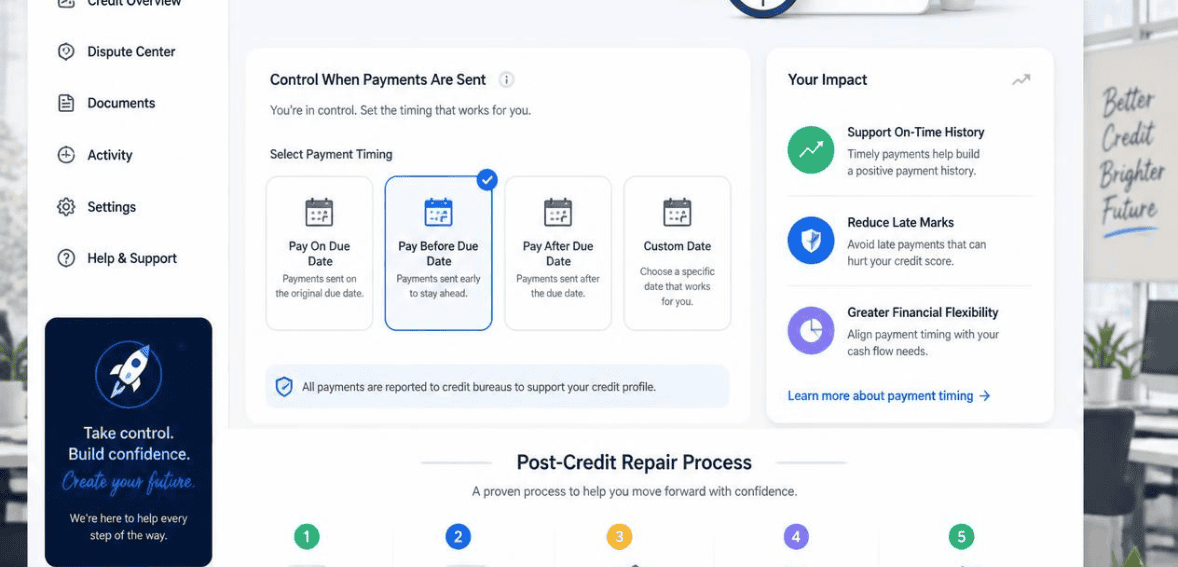
Payment Timing Controls After Credit Repair Work Is Completed

Money and trust move in opposite directions in the credit repair world. Clients want proof before they pay. The law demands it. And one wrong billing decision can cost a business millions. That single tension sits at the heart of every successful credit repair operation.
Owners of credit repair businesses must understand that timing is everything when it comes to collecting payments, and this is just as important as the pricing. Collect payments too soon, and you will be in violation of federal law. Collect payments at the right time, and you will have a viable, compliant business. This is the essence of credit repair payment timing.
This guide will help you understand the rules and risks and the payment timing controls that will safeguard your business. We’ll also discuss how choosing the right merchant services partner will help you remain compliant while providing you with a process that is easy and automated.
What Credit Repair Payment Timing Actually Means
Payment timing is the point at which you legally and practically collect money from a client. In most industries, this is simple. You sell a product, you get paid. Credit repair does not work that way.
Here, the service occurs over time. You dispute inaccurate items. You communicate directly with the bureaus via mail. Then you wait for their response. This process can take weeks or months. Because of this, your service billing occurs at the completion of the work.
The main rule is that you can’t bill for work that is not done. It is also strict. Credit repair work cannot be billed before the work is done. Only after the work is done can billing occur. That rule has to be your guide for every billing decision you make.
The Law Behind Credit Repair Payment Timing
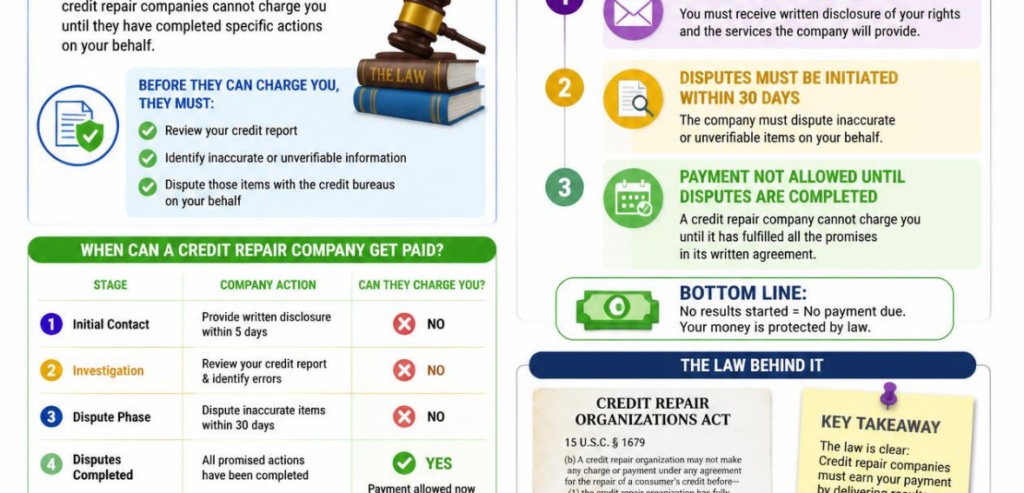
Two federal laws shape how and when you can bill. Understanding both is the foundation of any compliant billing system.
The CROA Advance Fee Ban
The Credit Repair Organizations Act is the primary guidebook. Under 15 U.S.C. § 1679b(b), a credit repair organization is forbidden from charging or receiving payment prior to performing all of the services stated in the contract. This is known as the advance fee prohibition and is straightforward. The service is to be done first and the payment is to be made after.
The rationale for the rule is clear. When a company is paid in full prior to doing the service, there is little to no motivation for the company to do the service for the client. This pattern was observed for many companies in different industries. Therefore, it was determined that the payment to the company is to be made after the service is done to maintain motivation to perform the service for the client.
The Telemarketing Sales Rule Raises the Bar
Selling credit repair services via telephone brings a second layer of restrictions. The Federal Trade Commission’s Telemarketing Sales Rule imposes the advance fee ban on telemarketing. A credit repair company that markets via telephone cannot solicit or accept payment prior to the expiration of six months from the date the promised services are completed. In addition, the company must demonstrate that the results have been sustained for that six-month period.
The Telemarketing Sales Rule creates a greater challenge for credit repair services sold via telephone than does the Credit Repair Organizations Act. Many telemarketing credit repair services are unaware of the Telemarketing Sales Rule until an audit reveals the regulatory void.
The Three-Day Right to Cancel
Clients using either framework have a three-day period in which they can opt to cancel the contract and receive a full refund for amounts paid. During this period, you are required to pause billing. It is illegal to collect and retain money in the contract cancellation window.
There are also challenges presented by state law. More than thirty-five states have their own credit repair laws. Quite a few of these laws require what the federal law does not require. As an example, California requires a surety bond and state registration. CROA is the minimum for the federal law, and these state regulations can require more.
Advance Fees vs. Legitimate Post-Work Fees
Here is where many honest operators get confused. Not every fee collected early is illegal. The difference comes down to whether work has already been done.
An advance fee illegally collects payment before a requested service is rendered. On the other hand, a legally binding signup fee, which can also be called a first-work fee, initial audit fee, or discovery fee, is charged after a company performs a preliminary service, like pulling and reviewing a client’s credit reports. The client is not charged for a service that is never performed.
Legitimacy of a fee is not determined by its name, but by when the fee is charged in relation to a service that has been performed. If no service has been rendered, a “setup fee” is simply a fee to collect payment for an advance service that is, in all likelihood, a compliance fee. This is most often the source of compliance issues.
Compliant Billing Models That Respect Payment Timing
Once you understand the rules, the next step is choosing a billing model that fits inside them. Two structures dominate the industry, and both are built around post-service payment.
Monthly Pay-As-You-Go Billing
The most frequent model has clients paying on a monthly subscription basis to be charged for work already completed. A month of disputes, letters, follow-up, and related work is billed at the end of the month. The client is then charged for the work to be done the following month. Since this model bills clients after the work is completed, it is an appropriate billing model. The clients appreciate the predictability, and it likely improves client retention.
Pay-Per-Deletion Billing
The newer approach ties payment to results. Clients pay only when a negative item is actually removed from their credit report. Nothing gets deleted, nothing gets charged. This model aligns your revenue with real outcomes and sits comfortably within the advance fee ban. It can be harder to forecast, but it builds strong trust because clients pay for proof, not promises.
Both models share one feature. The trigger for payment is a completed service, never an enrollment or a signature. That trigger is the whole point of payment timing controls.
How Merchant Services Support Credit Repair Payment Timing
Knowing the rules is one thing. Enforcing them on every transaction is another. This is where credit repair payment processing and specialized merchant services do the heavy lifting.
Banks and card networks categorize credit repair as a high-risk industry. Numerous factors contribute to this classification. Services are paid for only after completion, high chargeback risk, and many regulations all contribute to the category. Mainstream processors tend to either refuse this category or suspend accounts upon reviewing activity in the accounts. For this reason, credit repair services require a high-risk merchant account to accommodate the industry standards.
What differentiates the best providers of high-risk merchant accounts is more than simply the acceptance of card payments. Their accounts are purpose-built to accommodate the credit repair business model, and in some cases, they enforce the “post-service charge” rule at the system level to ensure compliance. The use of deferred payments and milestone-based charging means that the system will not permit an invoice to be generated until the work is confirmed to be done, thus ensuring compliance with the rule. Repeated charge support and ACH payment support complete the offerings. The providers allow cash flow to continue uninterrupted while still complying with the post-service charge rule for each billing cycle.
Corepay
Corepay offers a stable payment processing solution designed for credit repair agencies to be compliant with the Credit Repair Organizations Act (CROA). Their underwriting team has working knowledge of the CROA and engages exclusively with compliant businesses. Their payment gateway also facilitates CROA-compliant billing structures, including deferred payments and milestone payments. This framework allows for charging customers after the services have been completed and delivered, compliant with the CROA payment timing rule.
Credit Repair Cloud
Credit Repair Cloud connects credit repair businesses with high-risk merchant account providers that specialize in the industry. Because standard processors often shut these accounts down, its partner network is tuned to the category’s compliance and chargeback realities. Once approved, an operator can link the merchant account to the platform’s billing tools and accept card payments from clients without the constant fear of sudden freezes that disrupt cash flow.
The Real Cost of Getting Payment Timing Wrong
The penalties are not theoretical. When a company charges upfront illegally, it can violate two federal laws at the same time. Each illegal transaction can count as a separate violation.
The Telemarketing Sales Rule allows the FTC to pursue penalties of $53,088 for each individual violation. Imagine what that means with a telemarketing client base of any size. Additionally, the Credit Repair Organizations Act (CROA) allows individual consumers to file suit. Clients can recover all amounts paid to the credit repair organization, attorney fees, and possibly punitive damages. The FTC has shut down and penalized numerous violators for ignoring these regulations. For concise and direct explanations by the FTC, see the consumer credit repair guidelines.
There is a considerable risk of liability that can be damaging to a business. Insufficient payment timing controls contribute to regulatory noncompliance, increased risk of liability, and significant financial losses.
Best Practices for Setting Up Payment Timing Controls
Thorough systems simplify compliance. Start by clearly defining what “completed work” means for each of your services. Then pick a billing model, either monthly or pay-per-deletion, that only bills once that work is done. Every client must have a written contract that defines the services and total cost, as well as a three-day right to cancel the contract.
From there, let technology enforce the rules. Use a billing system and a high-risk merchant services account that support deferred and milestone invoicing. With these services, configure your invoices so they cannot be generated until a service is marked complete. Maintain thorough documentation of every completed action that is tied to every charge. When your process, your contract, and your merchant services all point in the same direction, payment timing stops being a worry and becomes a quiet strength.
Conclusion
Credit repair payment timing is not a technicality. It is the rule that separates a legitimate business from an FTC target. The law is clear that you collect after the work is done, never before. CROA sets that standard, the Telemarketing Sales Rule tightens it, and state laws often add more.
The good news is that compliance and profitability are not enemies. Post-service billing models keep you on the right side of the law while building genuine client trust. And the right merchant services partner bakes those timing controls directly into your payment system, so every transaction fires at the right moment. Get the timing right, and you get a business that lasts.
Frequently Asked Questions
Can a credit repair company charge any fee before doing work?
No. Federal law prohibits charging for credit repair services before they are fully performed. A signup or first-work fee is only legal if the company has already completed real initial work, such as reviewing your credit reports. A charge tied to no completed work is an illegal advance fee.
When can a credit repair business legally collect payment?
Payment is legal only after the promised service is completed. For most companies, that means billing monthly for work already done or charging per item after a deletion is confirmed. For telemarketed services, the rules are stricter and require a six-month waiting period after results are achieved.
Why do credit repair companies need high-risk merchant accounts?
Banks and card networks view credit repair as high-risk due to recurring billing, delayed service delivery, chargeback exposure, and heavy regulation. Standard processors often decline or freeze these accounts. A specialized high-risk merchant account supports compliant billing structures and reduces the risk of sudden shutdowns.
What happens if a company violates payment timing rules?
The consequences are serious. The FTC can seek civil penalties of up to $53,088 per violation under the Telemarketing Sales Rule, and each transaction can count separately. Clients can also sue under CROA to recover what they paid, plus potential damages and attorney’s fees