FLSA Workweek vs Pay Period: Why the Difference Changes Overtime
Imagine two employees at the same company. Both work 80 hours over two weeks. Both earn the same hourly rate. Yet one gets an overtime check and the other doesn’t. How? The answer comes down to one of the most misunderstood rules in wage-and-hour law: the difference between a workweek and a pay period.
Many people think that a workweek and a pay period are the same. While the definitions can be similar, confusing the two can mean your company owes employees back pay under federal law, totalling thousands of dollars. This guide will break down the distinctions, if any, between the FLSA workweek and pay period, in order to give you plain and easy definitions of each. Additionally, you will learn the implications of the definitions on deciding overtime pay, and gain an understanding of compliance issues.
What the FLSA Actually Requires

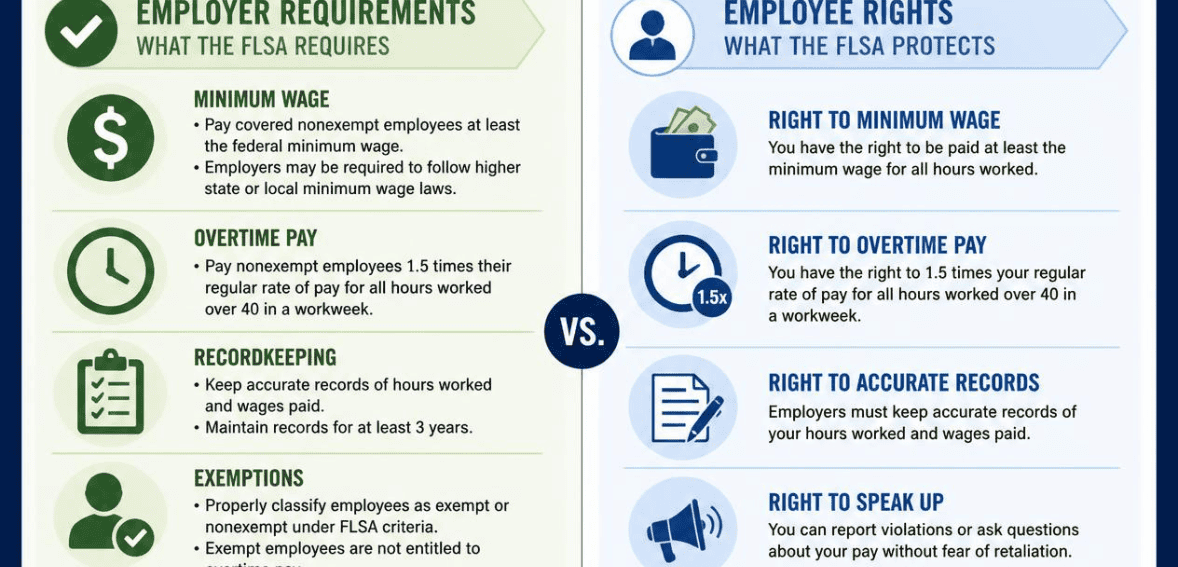
The Fair Labor Standards Act (FLSA) governs pay across America. It outlines provisions for minimum wage, compensation for overtime work, recordkeeping, and employment of minors. Under the FLSA, the federal minimum wage is $7.25 per hour for most non-exempt employees. Employees are compensated at the rate of one and one-half times their regular rate for hours worked in excess of forty in a week.
One of the key phrases of the FLSA is “in a workweek.” The FLSA governs on a workweek basis, not on a pay period basis. This is typically the root cause of most of the errors in overtime calculations that will be discussed. Of utmost importance is the understanding of what each of these terms’ means.
What Is an FLSA Workweek?
A workweek is the unit the FLSA uses to measure overtime. It is not the calendar week, and it is not your pay schedule.
According to the Department of Labor, a workweek is a fixed period of 168 hours (7 days of 24 hours) that occurs repeatedly in the same order. A workweek is flexible with respect to the days of the week. A workweek can be considered to begin on any day and at any hour that the employer decides. A workweek can even begin on a Thursday and end the following Thursday at 3:00 PM.
A workweek is meant to be a fixed period of time, although an employer can have different workweeks for different employees. However, a workweek cannot be flexible from week to week to avoid paying overtime. A change in a workweek is meant to be permanent.
Overtime comes into play when a non-exempt employee works more than 40 hours in a single workweek. Overtime must be paid at a rate of time and a half, and a boss doesn’t have to approve the hours for payment to be required.
What Is a Pay Period?
A pay period is simpler. It’s just the recurring schedule on which employees receive their wages. Common pay periods include weekly, biweekly (every two weeks), semi-monthly (twice a month), and monthly.
A pay period answers one question. When can employees expect to see their pay check? Beyond that, the Fair Labor Standards Act has little to say regarding pay check frequency at the federal level; that void is filled by state law, with several states dictating a minimum number of pay periods for non-exempt employees. The same can be said for payment timing regulations.
What you really want to consider is what the pay period doesn’t answer. When does the clock start for overtime? A pay period does not answer that question, and it is never at the discretion of the payday. Your obligations regarding overtime are independent of the pay check timeline.
FLSA Workweek vs Pay Period: The Core Difference
Now we can put the two side by side. In the FLSA workweek vs pay period comparison, the distinction is clean once you see it.
A workweek is an official period of 7 days that defines work hours and determines overtime. A pay period is an established time frame for processing the payment of wages. While one defines the measuring unit for work, the other defines the scheduling unit for payment. While they can be of the same duration, they serve different legal functions.
When a weekly pay period aligns with one workweek, they are functionally the same. Issues arise when this is not the case. In a biweekly pay period, the payment is processed for two workweeks. In a semi-monthly pay period, the payment can be processed for two and, at times, three workweeks. If the pay period exceeds a week, for overtime calculations, the pay period must be divided into workweeks.
That’s the heart of the issue. The pay period is the container. The workweek is the ruler. You never measure overtime with the container.
Why the Difference Changes Overtime
Here’s the rule that trips up even experienced payroll teams: overtime cannot be averaged across two or more workweeks. Each workweek stands on its own.
Consider the following example. An employee works 45 hours in Week 1 and 35 hours in Week 2. The total hours worked for the two-week biweekly pay period is 80 hours, which appears to be a standard two-week work period with no overtime. However, this is in violation of federal law.
Overtime is owed for Week 1. Week 1 has a total of 5 hours worked over the standard 40 hours and would need to be compensated at time and a half. A lighter Week 2 would not cancel the obligation to pay the overtime. Federal law does not permit you to offset the busy workweek with the slow workweek. The total hours worked is not the focus. The focus is not on the two-week schedule; it is that one workweek exceeded the standard hours.
This is what the FLSA means when it states there is a distinction between a workweek and a pay period. If you were to calculate overtime based on a pay period, you would most likely assume that with the total of 80 hours, there would be no pay for overtime. However, when the calculation is done based on a workweek, 5 hours at premium pay must be paid.
The Most Expensive Overtime Mistake
The single most common wage-and-hour error is treating the biweekly pay period as an 80-hour threshold. Some employers assume overtime only kicks in after 80 hours across two weeks. It’s an easy assumption to make, and payroll software set up carelessly can bake it right in.
It’s not a “Gray area” when it comes to averaging hours over a series of weeks in order to circumvent the overtime requirements of the FLSA. It is simply against the law. The Department of Labor cites this as a common issue in its audits. The impact of this mistake increases exponentially. Usually, one miscalculated pay cycle is not a one-and-done mistake. It is a systemic problem, with a miscalculation on every subsequent pay check for every affected employee, and it usually extends for years.
A small weekly deficiency can lead to a huge financial burden when coupled with the possibility of legal penalties, and the need to pay employees back for all the owed wages. This simple mistake creates a huge and complex problem.
There is a small exception to note. Employees of the public sector, such as firefighters and police officers, do qualify for section 7(k) of the FLSA. It allows for longer designated periods of time rather than the standard workweek. Most private sector employers would not qualify for this exception.
How to Set and Change a Workweek the Right Way
Setting a workweek is a decision, not an accident. An employer should choose a start day and time on purpose and document it. Once chosen, that workweek applies consistently for the affected employees.
The law gives employers some flexibility. For example, different divisions of the same business can operate on different workweeks. Shifts can have different or even varying starting and ending times. However, there is no flexibility when it comes to secretly changing the workweek to reduce the amount of overtime incurred during a peak period of business. When the workweek is changed, the employer must intend the change to be permanent and must have a legitimate business reason for the change. It is acceptable for an employee’s overtime to be reduced as a consequence of a legitimate business change, so long as the reduction of overtime was not the purpose of the change.
To minimize risk, the employer should designate the workweek, document it, and avoid changing it unless it is absolutely necessary for the business.
Recordkeeping: Where Compliance Actually Holds Up
Understanding the rules is only half the job. Proving you followed them is the other half. This is where the wage-and-hour recordkeeping requirements come in, and they connect directly to the workweek concept.
The FLSA mandates certain records for each non-exempt employee. One of these records is the start time and day of the workweek for each employee. Employers are required to keep records of the hours worked during each day and the total hours worked during the workweek. Employers are also required to keep records of the employee’s regular hourly rate, earned straight-time, total overtime pay, and the amount earned for each pay period.
You will notice that the workweek and the pay period are both referenced in these records, but for different reasons. Hours and overtime are tallied in the workweek, and the pay period indicates the date of the payment. Clearly differentiating the two protects you in the event that the Department of Labor comes to inquire.
There are also retention requirements established by the law. Payroll records must be retained for at least three years. Supporting records for wage calculations, such as time cards and work schedules, must be retained for at least two years. Maintaining good records is essential for business operations, as they are the deciding evidence in lawsuits and audits.
State Overtime Laws Can Raise the Bar
Federal law is the floor, not the ceiling. Several states add rules on top of the FLSA, and those rules can change the math entirely.
States such as California, Alaska, Nevada, and Colorado have unique daily overtime stipulations. If a person works more than 8 hours in one day in any of these states, they are entitled to overtime, even if the total is under 40 hours in the week. These states have the ability to set higher minimum wages as well. When comparing state and federal laws, workers are entitled to the greater benefit.
The FLSA workweek versus pay period structure is a baseline to start. However, you always want to be sure to see if your state adds any other protections on top. When in doubt, the regulation that benefits the employee the most is the one you want to apply.
Conclusion
The difference between an FLSA workweek and a pay period sounds like a technicality. It isn’t. It’s the exact line that decides whether an employee gets an overtime check.
A workweek is a fixed 168-hour period used to measure hours and calculate overtime. A pay period is simply the schedule on which wages are paid. Overtime is earned week by week, at more than 40 hours in a single workweek, and it can never be averaged across a longer pay period. Get that one idea right, and most overtime errors disappear. Get it wrong, and a routine payroll setup can quietly create years of liability.
Set your workweek on purpose. Calculate overtime one workweek at a time. Keep clean records. And always check your state’s rules. That’s how the FLSA workweek vs pay period distinction moves from a compliance risk to a routine part of running payroll correctly.
Frequently Asked Questions
Is overtime calculated weekly or biweekly under the FLSA?
Overtime is calculated weekly. Even if you run payroll every two weeks, each seven-day workweek is measured on its own. An employer cannot add two weeks together, average them to 40 hours, and skip overtime. If one workweek crosses 40 hours, the extra hours earn time and a half, no matter what the two-week total looks like.
Can an employer change my workweek to avoid paying overtime?
No. An employer can set different workweeks for different groups and can change a workweek for legitimate business reasons. But the change must be intended as permanent. Shifting the workweek temporarily just to reduce overtime in a busy period violates the FLSA.
Does a biweekly pay period mean overtime starts at 80 hours?
No, and this is one of the most common and costly mistakes. A biweekly pay period covers two separate workweeks. Overtime still starts after 40 hours in each individual workweek, not after 80 hours across the pay period. The pay period only decides when you get paid, not how overtime is measured.
What records does my employer have to keep about my hours?
Employers must record the start of your workweek, your daily hours, your total hours each workweek, your regular pay rate, and your overtime earnings, among other details. Payroll records must be kept for at least three years, and the underlying time records for at least two years.