How to Rank Higher in Google’s Local Map Pack
When someone searches for a nearby service, store, restaurant, office, contractor, clinic, or professional, they are often ready to take action. They may want to call, get directions, read reviews, compare options, or visit a website before choosing a business.
That is why the local map pack is one of the most valuable search features for businesses that depend on nearby customers.
Learning how to rank higher in Google’s local map pack is not about chasing shortcuts. It is about helping Google and potential customers clearly understand who you are, where you operate, what you offer, and why your business deserves trust.
A well-optimized local presence can lead to more phone calls, direction requests, website visits, appointment bookings, quote requests, and walk-in traffic.
The businesses that win in local search usually do several things consistently. They maintain accurate business information, choose the right categories, earn real customer reviews, build trustworthy local citations, publish helpful local content, and keep their website easy to use.
They also avoid risky tactics like keyword stuffing, fake reviews, duplicate listings, and misleading business names.
This guide walks through practical, people-first local pack SEO strategies you can apply step by step. You will learn how Google local map pack SEO works, what local map pack ranking factors matter most, how to strengthen your Google Business Profile, and how to build long-term local search visibility without relying on gimmicks.
What Is Google’s Local Map Pack?
Google’s local map pack is the group of local business listings that often appears near the top of search results when a query has local intent.
It usually includes a map, business names, ratings, review counts, hours, addresses or service-area details, phone buttons, website links, and directions. For many searches, this section appears above traditional organic results, which makes it highly visible.
A search does not always need to include “near me” to trigger the map pack. Google can often understand local intent based on the searcher’s location, query wording, device, and behavior. Searches for services, food, repairs, stores, professional offices, and urgent needs can all produce local results.
For example, a person searching for a nearby emergency repair service is probably not looking for a long educational article first. They want fast options, proof of trust, and an easy way to contact someone. The map pack gives them that information quickly.
This is why local search visibility matters so much. A business that appears prominently in the local map pack can earn attention before the searcher scrolls to the rest of the page. Even when a user does not click a website, they may still call, request directions, read reviews, or view photos directly from the business profile.
The map pack is especially important because it combines ranking, reputation, and conversion. Your position matters, but so does the way your listing looks. A business with strong reviews, complete information, attractive photos, relevant services, and accurate hours may earn more actions than a poorly maintained listing that happens to rank nearby.
For businesses that serve specific locations, Google Business Profile optimization is the foundation. Your profile acts as a local search asset, a reputation hub, and a quick-conversion landing page. However, it does not work alone. Google also evaluates signals from your website, citations, reviews, links, and broader online presence.
That means ranking higher requires a complete local SEO system. You need a trustworthy profile, a useful website, consistent business data, and real-world credibility. The stronger those signals are together, the better your chances of improving local pack visibility.
How Google Local Map Pack SEO Works
Google local map pack SEO is the process of improving the signals that help your business appear for relevant local searches. Google’s own local ranking guidance explains that local results are mainly based on relevance, distance, and prominence.
In practical terms, Google wants to show businesses that match the search, are reasonably close to the searcher or searched location, and appear trustworthy enough to recommend. Google’s guidance on improving local ranking is a helpful reference for understanding these core concepts.
Relevance is about match quality. If someone searches for a specific service, Google looks for signs that your business offers that service. Your primary category, secondary categories, services, description, reviews, website content, and structured data can all help clarify relevance.
Distance is about location. Google considers how close the business is to the searcher or to the location included in the query. You cannot fully control proximity, but you can make your location and service areas clear. You can also create helpful website content for the areas you genuinely serve.
Prominence is about reputation and authority. Google evaluates how well-known and trusted your business appears online and offline. Reviews, ratings, links, citations, brand mentions, website authority, and user engagement can all contribute to prominence.
Search intent also matters. A search for “best local bakery” may rely heavily on reviews, photos, and popularity, while a search for “emergency plumber open now” may emphasize availability, proximity, and category relevance. This is why local SEO for Google Maps should focus on real customer needs, not only rankings.
Business categories are one of the strongest relevance signals inside your profile. Choosing the most accurate primary category helps Google understand your main business type. Secondary categories can support additional services, but they should still be accurate.
Reviews also influence local decisions. Review quantity, quality, recency, and response patterns can all affect trust. A business with current, detailed reviews often appears more credible than one with old or vague reviews.
Local signals work together. A strong profile with weak website content may limit growth. A good website with inconsistent NAP data may create confusion. Strong reviews with an inaccurate category may still miss relevant searches. The best local pack SEO strategies build consistency across every customer-facing and search-facing touchpoint.
| Ranking Factor | Why It Matters | Optimization Tip |
| Relevance | Helps Google match your business to the searcher’s need | Choose accurate categories, list services clearly, and align website content with real offerings |
| Distance | Helps Google show nearby or location-relevant businesses | Keep your address or service area accurate and create helpful content for areas you actually serve |
| Prominence | Helps Google evaluate trust, reputation, and authority | Earn real reviews, build local citations, attract quality links, and maintain a strong brand presence |
| Reviews | Builds customer confidence and supports prominence | Request reviews ethically, respond consistently, and address concerns professionally |
| NAP Consistency | Reduces confusion across directories and platforms | Use the same name, address, and phone format across listings |
| Website Quality | Supports relevance, conversion, and organic visibility | Build service pages, location pages, schema markup, and mobile-friendly content |
| Engagement | Shows that searchers interact with your listing | Add photos, posts, products, services, and accurate hours to encourage actions |
Relevance
Relevance is the degree to which your business matches what someone is searching for. If a customer searches for a specific service and your profile does not clearly mention that service, Google has less reason to show your listing. That is why accurate categories, services, descriptions, and website content are essential.
Start with your primary Google Business Profile category. This should describe your core business as precisely as possible. Do not choose a category only because it has high search volume. Choose the category that best matches what customers actually hire you to do or visit you for.
Secondary categories can help when your business offers multiple legitimate services. For example, a business may have one primary specialty and several related offerings. Add only categories that reflect real, customer-facing services.
Your website also supports relevance. Service pages, location pages, FAQs, testimonials, and structured data can reinforce what your profile says. For example, a strong service page can explain who the service is for, when it is needed, what the process looks like, and which nearby areas are served.
Reviews can also provide relevance clues. When customers naturally mention specific services, problems solved, staff names, or location details, those reviews can help future customers and search engines understand your business better. Never script reviews, but you can ask customers to describe their honest experience.
Distance
Distance is the proximity between the searcher, the searched location, and your business. For local results, this factor can be powerful. A business close to the searcher may appear even if another business has more reviews or a stronger website, especially when the query suggests urgency or convenience.
You cannot optimize your way into being physically closer to every searcher. However, you can make your location data clear and trustworthy. If customers visit your location, your address should be accurate across your profile, website, and citations. If you serve customers at their locations, your service areas should reflect where you realistically operate.
Distance also depends on search wording. A search that includes a neighborhood, district, street, or nearby landmark may produce different results than a broad “near me” search. This is why local content matters. If you serve specific areas, create useful pages or sections that explain your services in those areas without duplicating thin content.
Service-area businesses should be careful not to overstate coverage. Listing too many places where you rarely serve customers can weaken trust and create a poor user experience. A focused, accurate service area is usually better than an inflated one.
Your website can support distance-related intent by answering location-specific questions. Include information about service availability, appointment windows, parking, directions, landmarks, or local conditions where relevant. These details help real customers and support local SEO for Google Maps.
Prominence
Prominence reflects how well-known, trusted, and authoritative your business appears. Google looks at signals across the web, including reviews, links, citations, articles, directories, and general online reputation. A business with strong prominence has more proof that it is real, established, and trusted by customers.
Reviews are one of the most visible prominence signals. A steady stream of detailed, authentic reviews can improve trust and influence clicks. Review responses also matter because they show that the business is active and attentive.
Links and mentions can strengthen prominence too. Local news mentions, community pages, sponsorship pages, industry directories, chamber-style listings, event pages, and partner websites can all help establish local authority. The key is relevance and legitimacy. A handful of meaningful local links is often more valuable than many weak links from unrelated sites.
Citations also support prominence and trust. A citation is a mention of your business information on another website, usually including your name, address, and phone number. Consistent citations help confirm that your business details are accurate.
Brand searches can also signal prominence. When people search directly for your business name, interact with your profile, view photos, call, or ask for directions, those behaviors can support overall visibility. Prominence grows when your business becomes known both online and in the real world.
Optimize Your Google Business Profile
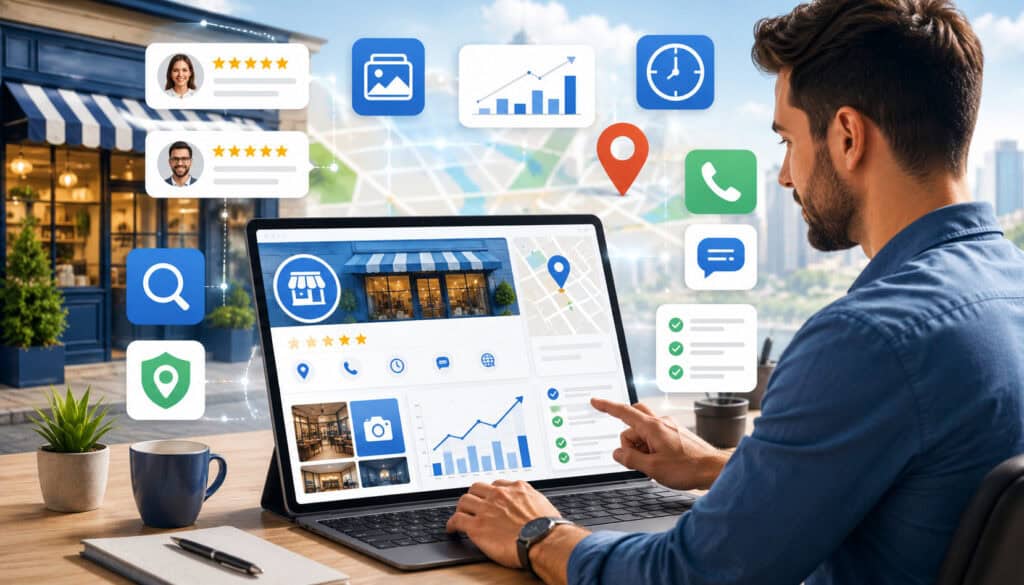
Your Google Business Profile is one of the most important assets for improving local search visibility. It gives Google structured information about your business and gives potential customers a fast way to evaluate you. A complete, accurate, and active profile can improve trust before a customer ever reaches your website.
Start with your business name. Use the real-world name customers recognize. Do not add extra keywords, locations, taglines, or service phrases unless they are part of your actual business name. Keyword stuffing in the business name can create trust problems and may violate platform guidelines.
Next, choose the most accurate primary category. This should describe the main thing your business does. Then add secondary categories only when they represent genuine services. Categories help Google understand relevance, so accuracy matters more than volume.
Your services section should be clear and specific. Add the services customers actually search for, but avoid turning the section into a keyword dump. Each service should be easy to understand and connected to a real offering.
Business hours are another critical detail. Keep regular hours, special hours, holiday hours, and temporary closures updated. Incorrect hours create customer frustration and can reduce trust. If customers arrive when your listing says you are open but the business is closed, that experience can hurt your reputation.
Photos help customers understand what to expect. Add real images of your location, team, work, products, vehicles, menu items, office, storefront, or completed projects where appropriate. Avoid relying only on stock images. Real photos tend to feel more trustworthy.
Products and posts can also support engagement. Products are useful when you sell specific items, packages, or featured offerings. Posts can highlight updates, events, promotions, new services, seasonal information, or educational tips.
Your description should explain what your business does, who it helps, and what makes it useful. Keep it factual and customer-focused. Mention key services naturally, but do not force the focus keyword into every sentence.
Attributes can help customers make decisions. Depending on your business category, you may be able to add details such as accessibility features, appointment options, service options, payment methods, amenities, or identity-related attributes. Select only what is accurate.
Accurate contact details are essential. Your phone number, website URL, appointment link, address, and service areas should match your website and citations. This supports NAP consistency and reduces confusion.
For deeper support, connect your profile with a strong local website. A profile can earn visibility, but the website often closes the gap by answering detailed questions, explaining services, and converting visitors. Helpful guides on tracking local SEO performance can also help you measure whether your profile improvements are producing calls, clicks, and direction requests.
Build Strong Local Citations and NAP Consistency
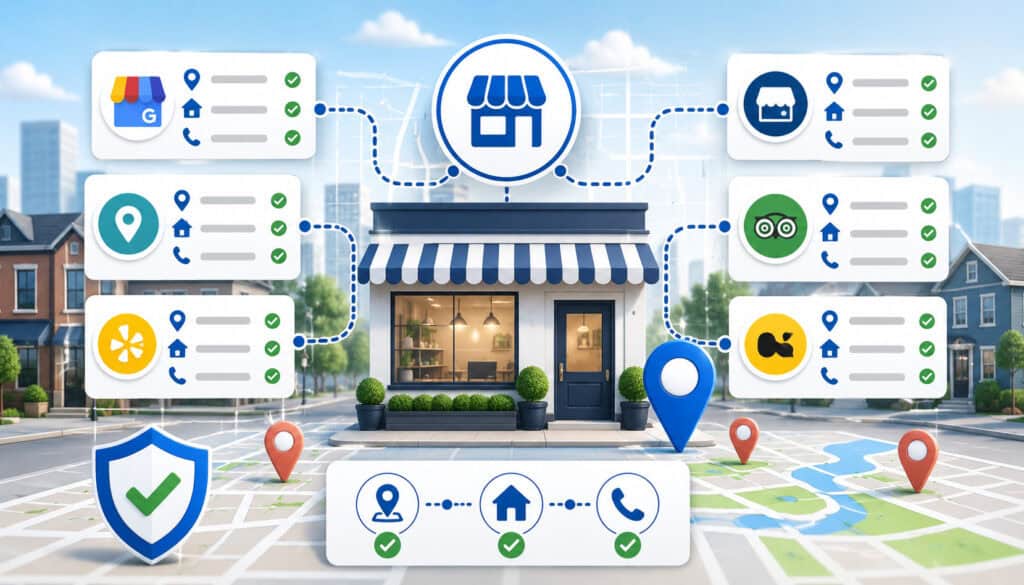
Local citations are online mentions of your business information on directories, apps, platforms, industry sites, social profiles, and local websites. Most citations include your business name, address, and phone number, often called NAP. Some also include your website, hours, categories, services, photos, and descriptions.
Citations help customers discover your business outside your website. They also help search engines verify that your business is legitimate and that your contact information is consistent. When the same business details appear across trusted sources, Google has more confidence in the accuracy of your data.
NAP consistency is especially important for businesses with physical locations. Your business name should be written the same way across major platforms. Your address should use a consistent format. Your phone number should be the same primary number customers should call.
Inconsistent NAP data can happen for many reasons. A business may move locations, change phone numbers, rebrand, merge with another business, or use different tracking numbers across platforms. Over time, outdated listings can remain online and create confusion.
Start with your most important listings. These usually include your Google Business Profile, major map platforms, social profiles, industry directories, review platforms, and well-known local directories. Then expand to niche directories that are relevant to your industry.
Citation cleanup is the process of finding inaccurate listings and correcting or removing them. It can be time-consuming, but it is worth doing. Incorrect listings can send customers to the wrong address, display old hours, or route calls to inactive numbers.
For service-area businesses, citations still matter, but address visibility needs care. If your business does not serve customers at a storefront, follow platform rules about whether to display or hide your address. Do not publish an address in citations if it creates privacy issues or conflicts with how customers interact with you.
Use a citation tracker or spreadsheet to document listings. Include the platform name, URL, login email, business name, address, phone number, website URL, category, and last updated date. This makes future updates easier.
Structured data on your website can also reinforce location data. A guide to schema markup for local businesses can help you understand how to mark up business details in a way that supports search engine understanding.
Citations are not a one-time task. Review them whenever your business changes hours, services, phone numbers, locations, or branding. Strong citation hygiene supports local search visibility and helps prevent customer frustration.
Get More High-Quality Customer Reviews

Customer reviews are one of the most influential trust signals in local search. They help potential customers decide whether to call, visit, book, or keep looking. Reviews also support prominence because they show that real people have interacted with your business.
Review quantity matters because a business with only a few reviews may look untested. However, quantity alone is not enough. Quality matters too. Detailed reviews that describe the customer’s experience, the service performed, the problem solved, or the result achieved are usually more persuasive than short generic comments.
Review recency is also important. A business with many old reviews but little recent activity may look inactive. A steady review flow suggests that the business is still serving customers and maintaining quality.
Ratings influence behavior, but perfection is not always necessary. A profile with a strong average rating and authentic review mix can look more believable than one with only overly polished praise. What matters is the overall pattern: satisfied customers, professional responses, and evidence that the business cares.
Responding to reviews is part of reputation management. Thank customers for positive feedback and personalize responses when possible. For negative reviews, remain calm, professional, and solution-focused. Do not argue, reveal private details, or blame the customer publicly.
Ethical review requests are simple and direct. Ask customers after a successful service, purchase, visit, or project. Make the process easy by sharing a direct review link. Train staff to ask at natural moments, such as after a compliment or successful resolution.
Avoid review gating. Do not ask only happy customers to leave reviews while discouraging others. Do not offer incentives in exchange for reviews. Do not write fake reviews, buy reviews, or ask employees to pose as customers. These tactics can damage trust and create platform risk.
A practical review request process might include:
- Asking in person after a positive customer interaction
- Sending a follow-up email or text with a review link
- Adding a review request to receipts or appointment follow-ups
- Training staff to explain that honest feedback helps future customers
- Monitoring new reviews weekly
- Responding to every review with professionalism
Reviews can also reveal content opportunities. If customers frequently praise a specific service, mention common concerns, or ask similar questions, use those insights to improve your website and profile. Reviews are not only ranking signals; they are customer research.
For businesses that need a more structured approach, resources on reputation management can help with review generation, response habits, and trust-building workflows.
Improve Your Website for Local SEO
Your website supports your Google Business Profile by giving search engines and customers deeper information. While the map pack itself is powered heavily by profile data and local signals, your website can improve relevance, authority, conversion, and trust. Strong website content also helps you rank in localized organic results.
Start with core service pages. Each major service should have a dedicated page that explains what the service includes, who needs it, common problems, process, pricing considerations where appropriate, FAQs, and next steps. Avoid creating thin pages that only swap location names.
Location pages are useful when your business has multiple physical locations or clearly serves distinct areas.
A good location page should include unique details: address, hours, local phone number, team information, directions, nearby landmarks, parking details, area-specific services, reviews, photos, and local FAQs. It should not be a duplicate template with only the place name changed.
Service-area content can help when you travel to customers. Instead of making hundreds of weak pages, focus on your most important service areas and create genuinely helpful content. Explain availability, response times, common local needs, and proof of work in that area.
Schema markup helps search engines understand your business information. LocalBusiness schema, service schema, FAQ schema where appropriate, breadcrumb schema, and review-related markup used carefully can support structured understanding. Keep structured data accurate and aligned with visible content.
Internal links also matter. Link from your homepage to key service and location pages. Link from service pages to related FAQs, case studies, contact pages, and booking pages. Internal links help users navigate and help search engines understand page relationships.
Mobile experience is critical for local searches. Many local searches happen on phones, often when the customer is ready to act. Your site should load quickly, display cleanly, make phone numbers tappable, and keep forms short. Avoid intrusive popups that block important information.
Page speed affects user experience. A slow website can reduce conversions, especially when a customer is comparing several local options. Compress images, reduce unnecessary scripts, use reliable hosting, and simplify page design where needed.
Helpful local content can build trust. This may include buying guides, neighborhood-specific service tips, seasonal advice, maintenance checklists, local event tie-ins, or answers to common customer questions. Content should be created for real people, not just search engines.
Conversion optimization is also part of local SEO success. Ranking without converting leads to wasted opportunity. Make calls to action clear, show trust signals, display reviews, explain next steps, and reduce friction. For more ideas, see resources on conversion optimization.
A local SEO checklist for your website should include:
- Dedicated service pages for core offerings
- Accurate NAP in the footer and contact page
- Location pages for real locations
- Service-area content where relevant
- LocalBusiness schema markup
- Fast mobile performance
- Clear calls to action
- Review and testimonial sections
- Internal links to important pages
- Helpful FAQs that match customer questions
You can also strengthen your broader SEO foundation with educational resources on SEO strategies for business, especially when connecting local content with site structure, technical improvements, and user intent.
Local Pack SEO Strategies That Improve Trust
Trust is the bridge between visibility and action. Ranking in the local map pack can put your business in front of customers, but trust determines whether they choose you. The best local pack SEO strategies improve both search signals and customer confidence.
Local backlinks are a strong trust signal when they come from relevant sources. These can include community organizations, local sponsorship pages, industry associations, suppliers, partners, event pages, schools, charities, local publications, and business groups. The goal is not to collect random links. The goal is to earn mentions that make sense.
Community involvement can support local authority. Sponsoring an event, participating in a fundraiser, hosting a workshop, collaborating with neighboring businesses, or contributing expert advice can create real-world visibility that becomes online visibility. When local websites mention your business naturally, it can support prominence.
Local mentions without links can still help brand awareness. A mention in a local article, event recap, podcast, directory, or community page can reinforce your business’s presence. Over time, these mentions help create a stronger local footprint.
Photos are another trust-builder. Add updated images to your Google Business Profile and website. Show real work, real spaces, real products, and real people where appropriate. For service businesses, before-and-after photos, project images, tools, vehicles, and team photos can help customers feel more confident.
Case studies can be powerful for local SEO and conversion. A case study does not need to be long. It can explain the customer problem, the service provided, the location context, and the outcome. This creates unique local content and demonstrates experience.
FAQs improve trust because they answer objections before the customer contacts you. Strong FAQs can cover pricing factors, timelines, service areas, appointment requirements, preparation steps, warranties, emergency availability, and what happens after booking.
Service-area content should be realistic and useful. Instead of creating low-value pages for every possible location, build pages for areas where you have real experience, demand, and proof. Add customer stories, photos, driving considerations, availability notes, or area-specific service details.
Trust also comes from consistency. Your profile, website, reviews, citations, ads, and social profiles should all tell the same story. If your website says you offer one service, your profile highlights another, and your citations list outdated hours, customers may hesitate.
Businesses that rank higher in Google’s local map pack usually do not rely on one tactic. They build a reliable ecosystem of signals. Their profile is complete, their reviews are active, their website is helpful, their citations are accurate, and their local reputation is visible.
Common Local SEO Mistakes to Avoid
Local SEO mistakes often come from trying to move too quickly. Businesses want better rankings, so they overuse keywords, create duplicate pages, add unnecessary categories, or chase low-quality citations. These shortcuts can create confusion and reduce trust.
Keyword stuffing is one of the most common mistakes. Adding repeated phrases to your business description, services, posts, or website content does not make the content more helpful. It often makes it harder to read. Use keywords naturally and focus on clear explanations.
Business name spam is another risky tactic. Some businesses add services or locations to their Google Business Profile name even when those words are not part of the real business name. This may create temporary visibility, but it can damage trust and violate guidelines.
Duplicate listings can split ranking signals and confuse customers. This often happens when businesses move, rebrand, create profiles for practitioners, or accidentally create multiple profiles for one location. Find duplicates and resolve them carefully.
Wrong categories can hurt relevance. If your primary category does not match your core service, Google may show your listing for the wrong searches or fail to show it for the right ones. Review categories regularly, especially if your services change.
Fake reviews are a serious mistake. Buying reviews, using review swaps, asking employees to review the business, or creating fake accounts can harm reputation and create platform risk. Real reviews are slower to earn but far more valuable.
Inconsistent NAP data weakens trust. If your address, phone number, or business name differs across directories, customers and search engines may not know which information is correct. This is especially harmful after a move, rebrand, or phone number change.
Thin content is another problem. Location pages with only a few generic sentences rarely help users. Service pages that repeat the same text with minor keyword changes are also weak. Every important page should answer real customer questions and provide useful details.
Ignoring review responses can reduce trust. Customers often read how a business responds, not just what reviewers say. Professional responses show accountability and care.
Poor mobile experience can waste local visibility. If your profile sends users to a slow page, confusing menu, broken form, or hidden phone number, you may lose leads even if rankings improve.
Another mistake is failing to measure performance. You should track calls, website clicks, direction requests, profile views, form submissions, local rankings, and conversion quality. Without measurement, it is hard to know which improvements are working.
A simple local SEO checklist can prevent many mistakes:
- Use the real business name
- Choose accurate categories
- Keep hours current
- Maintain NAP consistency
- Remove or merge duplicate listings
- Request reviews ethically
- Respond to reviews
- Build useful service and location pages
- Add real photos regularly
- Track calls, clicks, and conversions
How long does it take to rank higher in Google’s local map pack?
There is no fixed timeline because local rankings depend on competition, proximity, relevance, prominence, and the strength of your current online presence. Some improvements, such as correcting hours or adding missing services, can help quickly. Others, such as earning reviews, building citations, improving website authority, and gaining local links, take longer.
The best approach is to work in stages. First, fix accuracy issues. Then optimize your Google Business Profile. Next, clean up citations, improve website content, and build a consistent review process. Over time, these improvements create stronger local trust signals.
What are the most important local map pack ranking factors?
The most important local map pack ranking factors are relevance, distance, and prominence. Relevance means your business matches the search. Distance means your business is near the searcher or searched location. Prominence means your business appears trustworthy, established, and well-known.
In practice, these factors are influenced by categories, services, reviews, citations, links, website content, photos, NAP consistency, and user engagement. You cannot control every factor, but you can improve the signals that show your business is accurate, helpful, and trusted.
Does Google Business Profile optimization really help rankings?
Yes, Google Business Profile optimization can help because the profile gives Google direct information about your business. Accurate categories, services, hours, photos, products, descriptions, attributes, and contact details all support relevance and trust.
However, profile optimization should not happen in isolation. Your website, citations, reviews, and local reputation should reinforce the same information. A complete profile supported by consistent external signals is stronger than a profile that conflicts with the rest of your online presence.
How many reviews do I need to improve local search visibility?
There is no universal number of reviews that guarantees better rankings. Review needs vary by industry, location, and competition. A business in a competitive category may need many more reviews than a business in a smaller niche.
Instead of chasing a single number, focus on steady review growth, strong average rating, review quality, and recency. Detailed, authentic reviews from real customers are more valuable than a sudden burst of generic reviews.
Are local citations still important for Google Maps SEO?
Yes, local citations still matter because they help confirm business identity and contact details across the web. Accurate citations support NAP consistency and help customers find your business on trusted platforms.
That said, citation quality matters more than quantity. Focus on major platforms, industry-specific directories, local directories, and trusted sources. Avoid low-quality citation blasts that create clutter without real value.
Should I create separate pages for every location I serve?
Only create separate pages when each page can provide unique value. If you have real locations, dedicated location pages are usually helpful. If you serve multiple areas, create pages for important service areas where you can add useful, specific information.
Avoid creating dozens or hundreds of nearly identical pages with only the place name changed. Thin location content can look spammy and may not help users. Strong pages should include local details, service information, FAQs, proof, and clear next steps.
Can I rank higher if competitors are closer to the searcher?
Sometimes, but distance is a strong factor. If a competitor is much closer to the searcher and also relevant, they may have an advantage. However, you can still improve visibility by strengthening relevance and prominence.
Better categories, stronger reviews, helpful website content, accurate citations, local links, and high engagement can help you compete. You may also perform better for searches that include your service area, specialty, brand, or specific customer need.
What is the best local SEO checklist for ongoing improvement?
A useful local SEO checklist includes profile optimization, NAP consistency, citation cleanup, review generation, review responses, service page improvements, location page updates, schema markup, mobile performance, photo updates, local link building, and performance tracking.
Review this checklist monthly. Local SEO is not a one-time setup. Business information changes, competitors improve, customer expectations shift, and search results evolve. Consistent maintenance is what protects and grows visibility.
Conclusion
To rank higher in Google’s local map pack, you need more than a filled-out profile. You need a complete local SEO system built around accuracy, relevance, trust, and customer usefulness.
Start with Google Business Profile optimization. Choose accurate categories, list real services, update hours, add quality photos, use helpful descriptions, and keep contact details consistent. Then strengthen your wider local presence with clean citations, NAP consistency, ethical review generation, useful website content, schema markup, and local trust signals.
The strongest local SEO for Google Maps comes from alignment. Your profile, website, reviews, citations, links, and customer experience should all confirm the same message: your business is real, relevant, trusted, and ready to help.
Ranking higher is not about tricking the algorithm. It is about becoming the clearest and most trustworthy answer for local customers. When you combine a complete profile, strong reviews, accurate citations, helpful content, and consistent local authority, you give both Google and customers better reasons to choose your business.