
Geo-Targeting Strategies for PPC Campaigns
Geo-targeting strategies for PPC campaigns help businesses show paid ads to people in the locations most likely to become customers. Instead of spending budget across every possible area, advertisers can focus on cities, zip codes, neighborhoods, service areas, radius zones, or regions that match real business coverage.
For local businesses, location matters because customer intent is often tied to distance, convenience, availability, and trust. A person searching for a nearby restaurant, contractor, clinic, store, or professional service usually wants a result that is close enough to visit, call, book, or schedule.
Strong PPC geo-targeting can help reduce irrelevant clicks, improve ad relevance, guide users to better landing pages, and make campaign reporting more useful. It does not guarantee lower costs or more leads, but it gives businesses more control over where their ad budget is used.
Geo-targeted advertising works best when it is connected to clear service areas, accurate business information, local keywords, strong conversion tracking, and ongoing campaign optimization.
A location targeting strategy should never be treated as a one-time setup. It should be reviewed as customer behavior, competition, seasonality, budgets, and service coverage change.
What Geo-Targeting in PPC Means
Before launching location-based PPC campaigns, advertisers should understand how official ad systems define location targeting so campaign settings match real business goals.
Geo-targeting in PPC is the process of showing paid ads to people based on selected geographic areas. These areas may include cities, regions, zip codes, neighborhoods, radius zones, service areas, or locations near a physical business.
In a paid search campaign, geographic targeting in PPC helps decide where ads are eligible to appear. For example, a local contractor may target a set of zip codes, while a restaurant may target people within a short radius of its location. A healthcare practice may focus on nearby communities where patients can realistically travel for appointments.
PPC geo-targeting is not only about drawing a boundary on a map. It can influence the entire campaign structure, including ad budget, keyword selection, bidding, landing pages, conversion tracking, ad copy, and reporting.
A campaign targeting a broad region may need different keywords and landing pages than a campaign targeting one neighborhood. A campaign built around urgent service calls may need different ad scheduling and call tracking than a campaign designed to drive store visits.
Location-based PPC campaigns are especially useful when customer intent changes by area. Some locations may produce high-quality calls. Others may create many clicks but few conversions. Some neighborhoods may respond to map ads, while others may respond better to search ads or remarketing.
The goal is not simply to reach more people. The goal is to reach the right people in the right service area with the right message at the right moment.
Why Geographic Targeting in PPC Matters
Running paid campaigns without a clear location targeting strategy can waste budget quickly. PPC ads are charged based on clicks, impressions, views, or actions depending on campaign type, so irrelevant exposure can reduce efficiency.
A business that serves only certain areas may receive clicks from people outside its delivery zone, appointment range, travel limits, franchise territory, or physical store market. Those clicks may look like traffic in reports, but they rarely create useful business outcomes.
Poor geographic targeting in PPC can also affect lead quality. A service provider may receive calls from customers too far away. A retailer may attract clicks from shoppers who cannot visit. A restaurant may advertise delivery in areas it cannot reliably serve. A professional firm may spend money on searchers outside its preferred market.
Geo-targeted advertising helps align ad spend with real customer access. It can improve ad relevance by matching location-based search intent with local ad copy and local landing pages. It can also make PPC analytics easier to understand because advertisers can compare performance by city, zip code, region, or radius zone.
Location targeting also supports better customer experience. When a person clicks an ad, the landing page should confirm that the business serves their area, provides the advertised service, and offers a clear next step. This reduces confusion and helps users make faster decisions.
For small budgets, local PPC targeting is especially important. A limited ad budget spread across too many locations may not gather enough useful data or maintain enough visibility in high-value areas.
How Location-Based PPC Campaigns Work
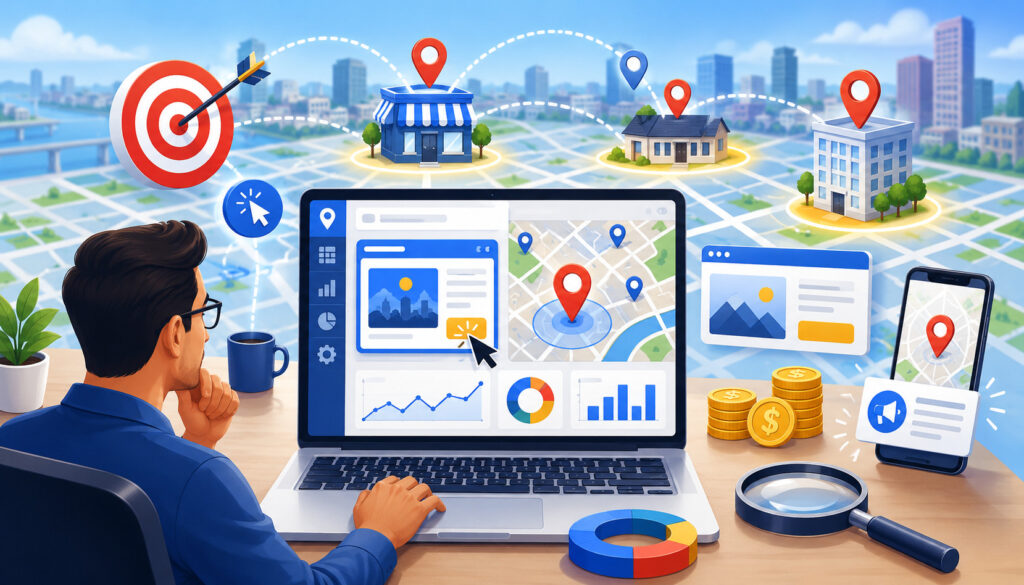
Advertisers using paid search should also review how to add a location target, because setup options may vary by campaign environment.
Location-based PPC campaigns begin with choosing where ads should appear. Advertisers can usually select target areas such as cities, regions, zip codes, radius zones, or service areas. Some campaign types also support store-based targeting, map placements, or location groups.
After target locations are selected, advertisers should review audience location settings. Some systems may allow ads to reach people physically located in an area, people interested in an area, or both.
The right choice depends on the business model. A local emergency service may care about current customer location, while a hotel, event venue, or destination service may also care about people researching from another area.
The next step is adding location exclusions. Exclusions help prevent ads from showing in places the business does not serve or does not want to target. This is one of the simplest ways to reduce wasted PPC spend.
Then advertisers should connect location targeting with ad copy and landing pages. A geo-targeted PPC ad should make the location relevance clear without forcing city names into every sentence.
The landing page should support the same location promise with accurate service details, contact options, business hours, forms, reviews, and calls to action.
Conversion tracking is also essential. Local PPC campaigns should track calls, form submissions, appointment bookings, purchases, direction clicks, quote requests, chat leads, and other meaningful actions. Without conversion tracking, location reports may show where clicks came from but not where value came from.
Target Locations
Target locations are the geographic areas where ads are eligible to show. These can include cities, zip codes, regions, neighborhoods, service zones, or a radius around a business address.
A storefront business may choose a short radius because most customers come from nearby areas. A home service business may choose several zip codes based on driving distance and job profitability. A professional service may target a larger region if clients are willing to travel or book consultations remotely.
Target locations should be based on real service coverage, not assumptions. Businesses can review customer addresses, delivery data, appointment records, sales history, and call logs to understand where good customers come from.
For PPC campaign optimization, it is often better to start with a focused area and expand gradually. This makes early data easier to read and reduces the chance of spending too much on locations that are unlikely to convert.
User Location Signals
Ad systems estimate user location through several signals. These may include device location, search terms, account settings, map activity, network information, and previous behavior. Because these signals are estimates, PPC location targeting is useful but not perfect.
A person may search from one location while planning to visit another. Someone may search for a service in a city name even if they are outside that city. A mobile user may move between areas throughout the day. For this reason, location reports should be reviewed with context.
Businesses should avoid assuming that every location-targeted impression is perfectly matched. Instead, they should use geo-targeting PPC data as a guide. If an area consistently produces useful calls, bookings, or sales, it may deserve more attention. If another area produces clicks but poor lead quality, it may need bid changes, messaging changes, or exclusion.
Location Exclusions
Location exclusions prevent ads from showing in selected areas. They are important for reducing wasted ad spend and protecting campaign focus.
A business may exclude areas outside its service routes, locations with poor lead quality, regions that conflict with franchise territories, or places where it cannot legally or practically provide services. Exclusions can also help avoid clicks from areas that are too expensive to serve profitably.
However, exclusions should be used carefully. Blocking a broad area may accidentally remove nearby customers who would have converted. Before applying major exclusions, businesses should review location reports, search terms, conversion data, lead quality notes, and service coverage maps.
Geo-Targeting Strategy Table
The table below shows how common geo-targeting strategies for PPC campaigns can support different local advertising goals.
| Strategy | Best Use Case | How It Works | Benefit | Common Mistake |
| Radius targeting | Stores, restaurants, urgent services, clinics | Shows ads within a set distance from a point | Focuses on nearby customers | Using too large a radius |
| City targeting | Businesses serving an entire city | Targets users in or interested in a city | Easy campaign setup | Assuming all city areas perform equally |
| Zip code targeting | Local services, delivery areas, territory control | Focuses ads on selected postal areas | More precise budget control | Ignoring how customers move across boundaries |
| Regional targeting | Larger service areas or delivery networks | Targets broader geographic regions | Supports scale | Spreading budget too broadly |
| Service-area targeting | Contractors, home services, appointment providers | Matches ads to real coverage zones | Reduces irrelevant leads | Targeting areas the team cannot serve |
| Negative locations | Any local PPC campaign | Excludes areas from ad eligibility | Helps reduce wasted clicks | Blocking too broadly without review |
| Local landing pages | Multi-location or city-focused campaigns | Sends users to location-relevant pages | Improves relevance and trust | Sending all clicks to the homepage |
| Bid adjustments | Campaigns with location performance data | Changes exposure based on results | Helps prioritize stronger areas | Adjusting before enough data exists |
| Location-based ad copy | Local paid search and map ads | Mentions relevant local availability | Improves message clarity | Overusing city names unnaturally |
Start With Clear Business Service Areas
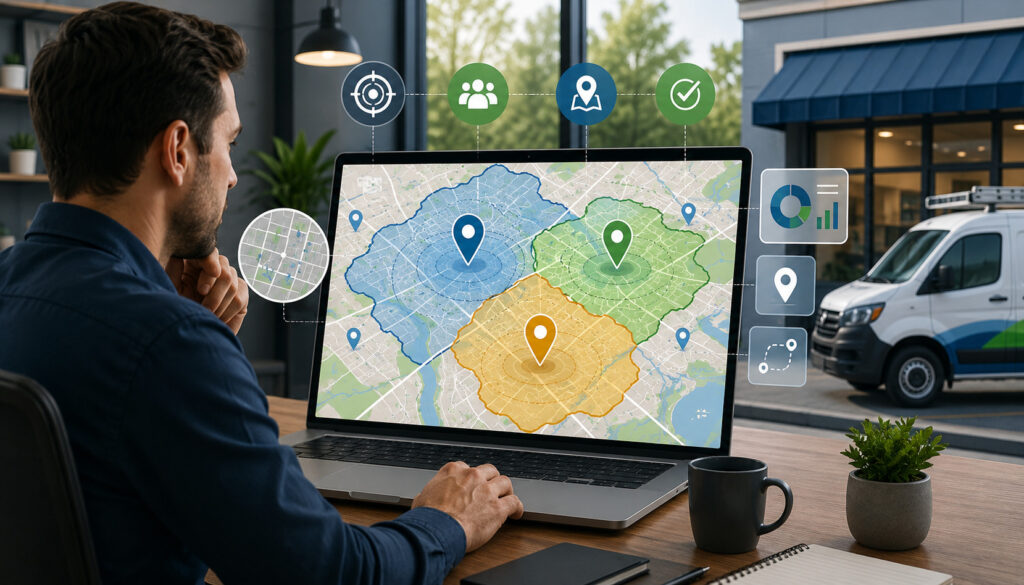
Before launching local PPC campaigns, businesses should define the areas they actually serve. This sounds simple, but many campaigns waste budget because the ad target area is broader than real business coverage.
Service areas may include physical store markets, delivery zones, appointment zones, travel limits, franchise territories, sales regions, or online service availability. Each one affects PPC location targeting differently.
A restaurant may serve dine-in customers within one area and delivery customers within another. A contractor may travel farther for high-value projects but only accept small jobs nearby. A professional service may meet clients at an office, online, or within a specific regional market.
Defining service areas also helps with local PPC strategy. It guides which keywords to use, which locations to target, which landing pages to create, which exclusions to add, and how to allocate budget.
Businesses should also consider profitability by location. Some areas may generate leads but require long travel times, high delivery costs, or low close rates. PPC campaign optimization should focus on meaningful results, not just click volume.
Storefront Businesses
Storefront businesses should focus on areas where customers are likely to visit, call, request directions, book appointments, or check availability. Distance matters because local intent is often tied to convenience.
A retail store may want to reach nearby shoppers searching from mobile devices. A restaurant may target people within a short radius during lunch or dinner hours. A clinic may focus on surrounding neighborhoods where patients can realistically travel.
Storefront PPC campaigns should use location assets, call extensions, map-focused placements where relevant, and landing pages that make visiting easy. The page should include address details, hours, directions, parking notes when useful, service details, and a clear call to action.
The campaign should also track actions that matter for physical locations. These may include calls, direction requests, appointment bookings, online orders, and store visit signals where available.
Service Area Businesses
Service area businesses should target locations where they can realistically travel, schedule appointments, complete jobs, or deliver services profitably. The target area should match actual operations.
A home service provider may serve several cities but only certain zip codes within each city. A mobile provider may accept urgent calls within a tighter radius and planned appointments across a broader area. A delivery business may need different targeting for fast delivery and scheduled delivery.
Service area targeting should also consider travel time, technician availability, fuel cost, job value, and lead quality. A location may produce clicks, but if jobs are too small or too far away, that area may not be worth the spend.
Local PPC targeting for service providers often works best when combined with call tracking, appointment forms, zip code exclusions, and landing pages that clearly explain service coverage.
Multi-Location Businesses
Multi-location businesses need more structure than single-location advertisers. Without careful planning, multiple locations may target the same customers, compete against each other, or send users to the wrong landing page.
Each location should have clear coverage rules. The closest relevant branch should usually serve the customer unless the business has another routing model. Campaigns may need separate budgets, local landing pages, call routing, and reporting for each branch.
Overlapping campaigns can make performance difficult to measure. If two locations show ads for the same search area, reports may not clearly show which branch deserves credit. This can lead to budget inefficiency and confusing local PPC analytics.
For multi-location advertising, campaign segmentation is often helpful. It allows advertisers to compare location-level performance, adjust budgets separately, and keep local messaging accurate.
Choose the Right Geo-Targeting Method
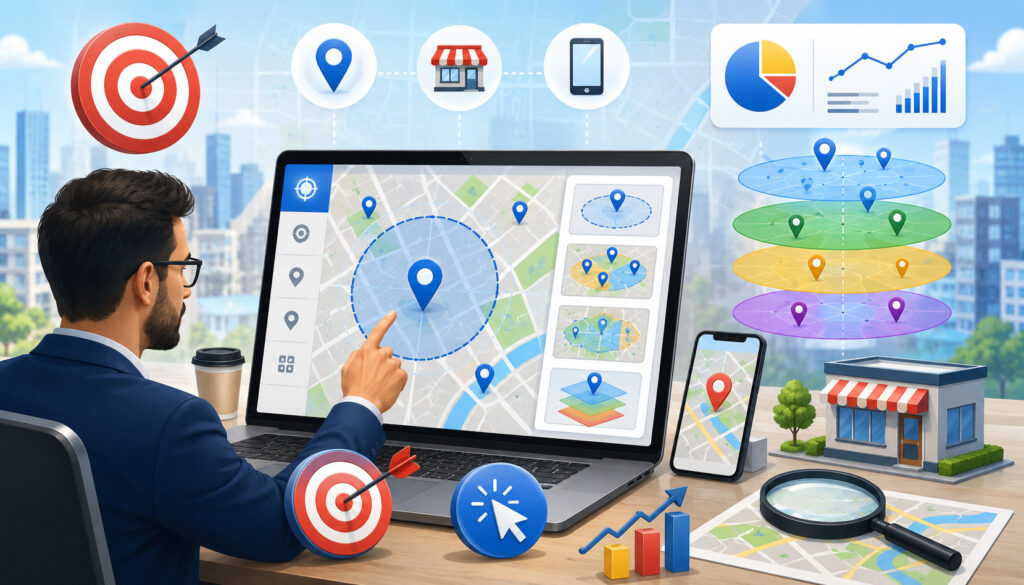
There is no single best geo-targeting method for every business. The right approach depends on business model, ad budget, local competition, customer behavior, campaign goals, and service coverage.
Radius targeting may work well for businesses that rely on nearby customers. City targeting may work for advertisers that serve an entire city. Zip code targeting may help control budget in specific territories.
Regional targeting may work for larger service areas. Neighborhood targeting may support highly local campaigns where platform settings allow that level of precision.
The targeting method should also match conversion value. A low-ticket purchase may not justify a large service area. A high-value appointment or project may support broader reach if lead quality is strong.
Businesses should also test carefully. A campaign may begin with radius targeting, then add zip code exclusions after data shows weak areas. Another campaign may start with city targeting, then split into separate campaigns by high-performing neighborhoods.
Local PPC strategy improves when targeting is connected to performance data. The first setup is only a starting point.
Radius Targeting
Radius targeting shows ads to users within a selected distance from a business address, store, service hub, or chosen point. This method is useful when distance strongly affects customer behavior.
Restaurants, retail stores, urgent-service providers, clinics, gyms, salons, and local repair services often use radius targeting because nearby customers are more likely to act quickly. A person searching from a mobile device may want to call, visit, book, or request directions soon.
Radius campaigns should be tested with realistic distances. A small radius may miss valuable customers. A large radius may include areas where people are unlikely to travel. The right radius depends on competition, convenience, service urgency, and customer habits.
Advertisers can also layer radius targeting with ad scheduling. For example, urgent services may focus on call availability, while restaurants may increase visibility around meal periods.
City Targeting
City targeting allows advertisers to show ads within a selected city or city-like area. It can be useful for businesses that serve a full city, advertise around city-level search demand, or want a simple local PPC campaign structure.
City targeting works well when customer behavior is not limited to a few streets or neighborhoods. A professional service, regional clinic, specialty retailer, or contractor may use city targeting if customers commonly search with city modifiers.
However, city targeting can be too broad for some businesses. A city may include areas that are far from a store, outside a delivery zone, or less profitable to serve. That is why city targeting often needs exclusions, bid adjustments, and location reports.
Businesses should avoid assuming that every part of a city performs the same. Local competition, income patterns, commute routes, search intent, and service demand can vary widely.
Zip Code Targeting
Zip code targeting helps advertisers focus on specific postal areas. This can be useful for service-area businesses, delivery zones, franchise territories, local contractors, and campaigns with limited budgets.
Zip code targeting offers more control than broad city targeting. It can help businesses prioritize high-value areas, exclude out-of-range locations, or separate campaigns by territory.
However, zip code targeting has limits. Customer behavior does not always follow postal boundaries. A person may live in one zip code, work in another, and search from a third. A nearby customer may be excluded if the targeting is too strict.
For this reason, zip code targeting should be reviewed with conversion data. Businesses should compare cost per conversion, calls, bookings, lead quality, and revenue by area before making major changes.
Regional Targeting
Regional targeting works for businesses with broad coverage, larger budgets, delivery networks, franchise systems, or service teams that operate across a wide area.
This method can support brand awareness, regional paid search, multi-location advertising, or campaigns where customers are willing to travel. It can also work for businesses offering online consultations, delivery, or regional services.
The main risk is budget dilution. If a campaign targets too wide an area with too little budget, it may receive scattered impressions and clicks without enough data to optimize effectively.
Regional targeting should often be paired with campaign segmentation. Advertisers may separate high-priority areas from lower-priority areas, use local landing pages, and review performance by location. This makes budget decisions easier and more responsible.
Neighborhood or Local Area Targeting
Neighborhood or local area targeting can help advertisers reach highly specific audiences where supported by campaign settings. It is useful for dense markets, walk-in businesses, local events, community promotions, and areas with distinct customer behavior.
A business near a busy shopping district may target nearby searchers differently than people across town. A service provider may focus on neighborhoods with strong demand or better job profitability. A local paid search campaign may reference neighborhood availability when it helps users understand relevance.
Because neighborhood-level targeting may vary by platform and campaign type, businesses should confirm available settings before building the campaign. They should also avoid making sensitive assumptions about people based on where they live.
Neighborhood targeting should be used to improve relevance and service accuracy, not to unfairly exclude or stereotype audiences.
Radius Targeting vs City Targeting vs Zip Code Targeting
| Targeting Type | Best For | Strengths | Limitations | Optimization Tip |
| Radius targeting | Nearby searches, storefronts, urgent services | Strong for proximity-based intent | Can include weak areas if radius is too large | Test different radius sizes and compare calls, visits, and bookings |
| City targeting | Businesses serving a full city | Simple setup and broad local reach | May include areas outside practical service range | Add exclusions and review city sub-area performance |
| Zip code targeting | Service areas, delivery zones, territory control | More precise than city targeting | Boundaries may not match real customer movement | Compare performance by zip code before increasing or reducing spend |
| Regional targeting | Larger service networks or multi-location coverage | Supports broad reach | Can dilute budget if too wide | Segment high-value regions into separate campaigns |
| Neighborhood targeting | Dense local markets or community campaigns | Can improve message relevance | Availability may vary by ad system | Use only where targeting is accurate and appropriate |
Use Location Exclusions to Reduce Wasted Spend
Location exclusions are one of the most practical tools in PPC geo-targeting. They help prevent ads from showing in places that are outside business coverage, unlikely to convert, or not aligned with campaign goals.
Exclusions can protect the budget from clicks that cannot become customers. A delivery business may exclude areas outside delivery zones. A contractor may exclude distant neighborhoods that are not profitable to serve.
A franchise may exclude another franchise territory. A healthcare practice may exclude regions where appointments are unlikely due to travel distance.
Negative locations can also improve reporting. When poor-fit areas are excluded, campaign data becomes easier to interpret. Advertisers can focus on locations that matter instead of sorting through irrelevant traffic.
However, exclusions should not be applied carelessly. Blocking too much can reduce reach, limit learning, and prevent ads from reaching valuable customers near the edge of a service area.
Exclude Areas You Do Not Serve
Businesses should exclude areas where they cannot deliver services, schedule appointments, ship locally, or fulfill orders reliably. This helps prevent customer frustration and wasted ad spend.
For example, a service provider may not want calls from locations outside its technician routes. A local delivery business may not want paid clicks from areas outside its delivery boundary. A store may not want to advertise curbside pickup to people too far away to visit.
Accurate exclusions also protect ad messaging. If an ad says “local service available” but the business cannot serve that location, the user experience becomes poor. This can reduce trust and create unproductive leads.
Review service boundaries before campaigns launch. If coverage changes, update exclusions quickly.
Exclude Poor-Performing Locations
Campaign data can reveal areas with many clicks but few conversions, high cost per lead, weak phone calls, poor form quality, or low sales value. These areas may need reduced spend or exclusion.
A poor-performing location should not be excluded after only one or two clicks. Look for patterns. Compare conversion rate, cost per conversion, call quality, form quality, close rate, and revenue where possible.
Sometimes the location is not the real problem. The issue may be weak ad copy, the wrong keyword match type, a slow landing page, or poor call handling. Before excluding an area, consider whether the campaign experience can be improved.
If the area consistently performs poorly after reasonable testing, exclusions may help shift budget to stronger locations.
Review Exclusions Carefully
Location exclusions should be reviewed before and after implementation. A broad exclusion can accidentally block valuable customers, especially near city edges, zip code borders, or service boundaries.
Businesses should keep a record of why locations were excluded. This makes future audits easier. If a location was excluded due to poor lead quality, note the date range, data sample, and reason.
Exclusions should also be revisited as business conditions change. A new employee, new delivery route, new branch, new service line, or seasonal demand shift may make a previously excluded location valuable again.
Match Local Keywords With Geo-Targeting
A strong local PPC strategy also depends on understanding local keywords because real customer searches often include service terms, city names, neighborhood phrases, and nearby intent.
Local keywords and geographic targeting should work together. Geo-targeting decides where ads can show, while keywords help decide which searches can trigger ads.
A local PPC campaign may use service keywords, city modifiers, neighborhood terms, “near me” intent, service-area wording, and customer phrases. The goal is to match real search intent, not to repeat city names unnaturally.
For example, a search ad may target people in a selected area who search for a service nearby. Another campaign may target searches that include a city name because users are clearly looking for service in that location.
Keyword match types matter. Broad match may capture more variations but can also bring irrelevant search terms if not monitored. Phrase and exact match can provide more control but may limit reach. Search term reports should be reviewed to find irrelevant queries, new opportunities, and location mismatches.
Local PPC targeting works best when keywords, locations, and landing pages are aligned. A user searching for a service in a specific area should see an ad and landing page that confirm relevance.
Service Plus Location Keywords
Service plus location keywords combine what the customer needs with where they need it. These may include city names, neighborhood names, service area terms, or nearby modifiers.
This approach can work well when people commonly search using local wording. A user may search for a service in a specific city, a specialist near a neighborhood, or a provider close to a landmark. If the business serves that area, these keywords can support ad relevance.
However, advertisers should avoid building huge keyword lists with every possible location variation. Too many near-duplicate keywords can make campaigns harder to manage and may create overlap.
Use search terms and customer language to guide keyword choices. The best local keywords are the ones real customers use when they are ready to act.
Near Me Searches
“Near me” searches are common in local paid search, especially on mobile devices. These searches often show strong local intent because users want nearby options.
However, businesses do not need to force “near me” into every keyword, ad, or landing page. Nearby intent is often understood through user location, search behavior, business relevance, and landing page quality.
A stronger approach is to make sure location targeting is accurate, business information is consistent, landing pages are locally relevant, and conversion paths are easy to use. A user searching nearby should quickly understand whether the business serves them.
For mobile PPC campaigns, click-to-call, directions, appointment buttons, and fast pages can be especially important for near-me intent.
Avoid Overlapping Keyword and Location Waste
Overlapping campaigns can waste budget when multiple campaigns target the same location and similar keywords without a clear reason. This is common in multi-location advertising, franchise PPC, and campaigns split by city or zip code.
Overlap can create internal competition, confusing reports, and uneven budget use. It may also make it harder to understand which location, keyword, or landing page is actually performing.
To reduce waste, define campaign roles clearly. Separate campaigns by location only when it improves budget control, messaging, or reporting. Use exclusions where needed to prevent overlap. Review search terms and location reports to catch duplication.
Create Localized PPC Ad Copy
Localized PPC ad copy helps users understand why an ad is relevant to their location. It can mention a service area, nearby availability, local delivery, appointment access, directions, or a location-specific offer when accurate.
Good local ad copy should feel useful, not forced. Mentioning a city, neighborhood, or service area can improve clarity when it matches the searcher’s intent. But repeating locations too often can make ads sound unnatural and reduce trust.
Ad copy should also reflect the action the business wants. A restaurant may encourage ordering or directions. A contractor may encourage a quote request. A clinic may promote appointment scheduling. A retailer may highlight in-store availability or pickup.
Local PPC campaigns can also use call extensions, location extensions, sitelinks, structured snippets, and other ad assets where available. These features can provide more context and make it easier for users to act.
Mention Location Naturally
Location references should help users understand relevance. A phrase such as “serving nearby neighborhoods” or “appointments available in this area” may be more useful than repeating the same city name in every line.
If the campaign targets one city, mentioning that city in the headline or description may make sense. If the campaign targets several areas, the copy may focus on service availability, fast response, or nearby support instead.
Accuracy matters. Do not claim a physical location in an area where the business does not operate. Do not imply local availability if service is limited.
Local ad copy should support user confidence, not create confusion.
Match the Offer to the Location
Promotions, appointment availability, delivery details, emergency service claims, and service promises should match the targeted area. A local offer that applies to one branch may not apply to another.
For multi-location businesses, each location may have different hours, inventory, staff, appointment times, delivery zones, or service capacity. Ads should reflect those differences.
If a business uses location-based advertising for seasonal or event-driven promotions, the landing page should confirm the same details. Mismatched offers can lead to poor user experience and weak conversion rates.
A location-specific message should always be supportable on the landing page.
Use Clear Calls to Action
The call to action should match the business goal and the user’s local intent. Common local PPC calls to action include call, book, request a quote, schedule, order, get directions, check availability, or visit today.
A service business may focus on calls and quote requests. An appointment-based business may focus on scheduling. A store may focus on directions, product availability, or pickup.
The call to action should also match operating hours. If calls are not answered after hours, the campaign may need ad scheduling or a form-based after-hours option.
Use Local Landing Pages for Geo-Targeted PPC
Businesses that advertise across multiple service areas should connect each PPC campaign to location-specific landing pages so users quickly see the right service area, contact option, and local proof.
Sending every PPC click to the homepage can reduce relevance. A homepage is often too broad for users who clicked a location-specific ad.
Local landing pages help connect geo-targeted PPC ads with the user’s area and intent. These pages may include city pages, service-area pages, store pages, appointment pages, or location-specific service pages.
A strong local landing page should confirm what the user searched for, where the service is available, how to take action, and why the business is trustworthy. It may include service details, contact information, business hours, photos, reviews, staff notes, directions, map embeds, forms, and clear calls to action.
For PPC for local businesses, landing page quality can influence user behavior. If the page is slow, confusing, generic, or missing local details, users may leave without calling or submitting a form.
Local landing pages should be accurate and helpful. Avoid creating thin pages that only swap city names. Each page should provide useful information for that location or service area.
Match Landing Pages to Ad Location
A user who clicks an ad for a specific area should land on a page that reflects that area or the nearest relevant business location. This creates a smoother experience and reduces confusion.
For example, a campaign targeting one city should not send users to a page about a distant branch. A zip code campaign should not send users to a generic page that does not confirm service availability. A radius campaign for a store should lead to a page with store details, hours, directions, and contact options.
Matching ad location to landing page content can also improve local trust. Users want to know the business understands their area and can help them without extra effort.
Include Local Trust Signals
Local trust signals help users feel confident before calling, booking, or submitting a form. These may include reviews, photos, staff details, business hours, local service descriptions, nearby landmarks, directions, service area notes, and examples of common customer needs.
For service businesses, trust signals may include licenses where relevant, insurance notes where appropriate, experience details, project types, and service guarantees only if accurate. For healthcare or professional services, appointment availability, provider details, and office information may matter more.
Photos can also support credibility. Real location photos, team photos, project photos, or store images are often more useful than generic visuals.
Local landing pages should answer the question: “Can this business help me in this area?”
Keep Landing Pages Fast and Mobile-Friendly
Many local PPC clicks come from mobile searches. A slow or difficult mobile page can waste paid traffic, especially when users are trying to act quickly.
Mobile landing pages should load quickly, show key information near the top, and make calls, forms, directions, or bookings easy. Forms should be short enough for mobile users. Phone numbers should be easy to tap. Buttons should be visible without excessive scrolling.
Page speed, readability, and layout all affect user experience. A strong geo-targeted PPC campaign can still underperform if the landing page is frustrating.
Local Landing Page Checklist Table
| Landing Page Element | Why It Matters | Local PPC Benefit | Common Mistake | Best Practice |
| Location name | Confirms relevance | Helps users know they are in the right place | Stuffing city names repeatedly | Use location naturally |
| Service details | Explains what is offered | Matches search intent | Using vague service copy | List relevant services clearly |
| Phone number | Supports calls | Helps call-focused campaigns | Hiding phone number | Make it easy to tap on mobile |
| Contact form | Captures leads | Supports quote requests and bookings | Long forms with too many fields | Ask only for needed details |
| Map or directions | Helps visits | Supports storefront traffic | Embedding incorrect location | Keep map and address accurate |
| Reviews | Builds confidence | Supports trust | Using unrelated reviews | Use relevant local feedback |
| Photos | Shows authenticity | Helps users evaluate the business | Using generic images only | Add real location or service photos |
| Hours | Sets expectations | Reduces missed calls or visits | Outdated hours | Update hours when they change |
| Call to action | Guides the next step | Improves conversion clarity | Multiple conflicting CTAs | Match CTA to campaign goal |
| Mobile speed | Reduces drop-offs | Protects ad budget | Heavy pages that load slowly | Compress images and simplify layout |
| Tracking | Measures results | Supports optimization | No call or form tracking | Track meaningful actions |
Geo-Targeting for Mobile PPC Campaigns
Mobile searches are important for local PPC because users often search while close to a decision. They may need a nearby store, urgent repair, appointment, restaurant, clinic, or service provider.
Geo-targeting for mobile PPC campaigns should focus on convenience and action. Users may want to call, get directions, check hours, book a visit, order, or request service. The campaign should make these actions easy.
Click-to-call, call tracking, map directions, short forms, fast landing pages, and clear service-area details can all support mobile performance. Ad scheduling also matters because mobile users may call immediately after clicking.
Mobile PPC should be reviewed by location and device. Some areas may produce many mobile clicks but few useful calls. Others may generate strong appointment bookings or direction requests. Location reports and device reports should work together.
Click-to-Call Campaigns
Click-to-call campaigns can be valuable for service businesses, appointment-based businesses, and urgent customer needs. A user searching from a phone may prefer calling instead of filling out a form.
Calls should be tracked where possible so businesses can understand which locations, keywords, and ads generate useful conversations. Call length, caller location, missed calls, appointment outcomes, and lead quality can all help improve campaigns.
Call campaigns should also align with staffing. Running call-focused ads when no one can answer may waste budget. If after-hours leads matter, businesses can use forms, booking tools, or recorded call handling where appropriate.
A strong click-to-call strategy connects location targeting with real customer service capacity.
Direction Requests and Store Visits
Storefront businesses can use location-focused ads to encourage nearby visits. Direction requests, map interactions, and store visit signals where available can help show how paid ads support physical traffic.
However, businesses should track these actions carefully. A direction request does not always equal a sale. A store visit signal may not be available for every advertiser or campaign type. Local PPC analytics should be interpreted with care.
To support visits, landing pages and ads should include accurate hours, address details, parking or access information when helpful, and clear reasons to visit.
Local search ads and map ads can be useful when users are comparing nearby options, but performance should still be measured against meaningful business outcomes.
Mobile Page Experience
Mobile page experience can make or break location-based PPC campaigns. A user may leave quickly if the page loads slowly, text is hard to read, buttons are too small, or contact options are hidden.
Local landing pages should place the most important details near the top: service, location, call button, hours, and the next step. Forms should be easy to complete on a small screen.
Images should be optimized, scripts should be limited where possible, and page layout should support fast decisions.
Mobile users often have high intent but low patience. A smooth page helps protect ad budget and improves the chance of a useful action.
Geo-Targeting for Different PPC Campaign Types
Geo-targeting can work differently across PPC campaign formats. Search campaigns, display ads, remarketing, map-based ads, video ads, and social PPC all use location signals in different ways.
Search campaigns often capture active intent. Display and video campaigns may support awareness. Remarketing can reconnect with past visitors. Map-focused placements can reach people comparing nearby options. Social PPC can support local events, promotions, and community awareness.
The campaign type should match the business goal. A business seeking immediate calls may prioritize search ads and call assets. A retail store promoting a local event may use visual placements. A service provider may use remarketing to stay visible after a website visit.
Location targeting should be adjusted for each format. A broad awareness campaign may tolerate wider reach, while a high-cost search campaign may need tighter controls.
Search Campaigns
Search campaigns connect keywords, user intent, location targeting, ad copy, and landing pages. They are often useful for local paid search because users are actively looking for a product, service, location, appointment, or nearby solution.
A strong search campaign should combine relevant keywords with accurate PPC location targeting. If the campaign targets a service area, the keywords and ads should reflect that service. If the campaign targets a store radius, the landing page should support visits, directions, calls, or bookings.
Search terms should be reviewed regularly. They can reveal irrelevant locations, competitor searches, service mismatches, and new local keyword opportunities.
Display Campaigns
Display ads can support local awareness by showing visual ads across websites, apps, or content networks. They may be useful for promoting events, seasonal offers, store openings, service awareness, or brand recognition in a defined area.
Because display users may not be actively searching, geographic targeting and audience controls are important. A display campaign targeting too broadly can spend budget on people unlikely to act.
Display landing pages should be relevant to the location and campaign message. If the ad promotes a local offer, the landing page should clearly explain where the offer applies.
Display performance should be measured differently from search performance because intent may be lower.
Remarketing Campaigns
Remarketing campaigns reach people who previously visited a website, landing page, or other digital property. For local PPC strategy, remarketing can remind users about services, appointments, products, or offers after they leave.
Location relevance still matters. A person who visited a local landing page may be more valuable if they are within the service area. Businesses can combine remarketing with geographic controls to avoid spending on users who are outside practical coverage.
Remarketing should be used responsibly. Messaging should be helpful, frequency should be controlled, and audiences should follow platform policies.
The goal is to stay visible without overwhelming users.
Map-Based Ads
Map-based ads can help businesses reach users looking for nearby options. These placements may be useful for restaurants, stores, clinics, repair services, professional offices, and other local destinations.
Map-focused campaigns should rely on accurate business information. Hours, address details, phone numbers, categories, and landing pages should be consistent. If users request directions and arrive to find outdated hours or incorrect information, trust can be damaged.
Map ads are often connected to mobile behavior. Calls, directions, and store visits may be important actions to track.
Video and Social PPC
Video and social PPC can support local awareness, promotions, events, community campaigns, and service-area visibility. These formats may work well when businesses want to reach people before they actively search.
Location targeting can help keep awareness campaigns focused. A local event does not need broad regional reach if attendance is mostly nearby. A franchise promotion may need territory-specific targeting. A local delivery campaign should match real delivery zones.
Creative should reflect the local message without making unsupported claims. Landing pages should continue the same offer and location details.
Video and social PPC should be measured with realistic expectations. They may support awareness and assisted conversions, not only immediate leads.
Geo-Targeting Strategies for Different Business Types
Different business models need different geo-targeting strategies for PPC campaigns. A restaurant, retail store, contractor, clinic, law office, franchise, and delivery business may all use location-based advertising, but their targeting logic should not be identical.
The key question is: where must the customer be for the business to serve them profitably and responsibly?
For a storefront, distance and convenience may matter most. For a home service provider, travel time and job value may matter. For a healthcare practice, appointment access and patient convenience may matter. For a franchise, territory control may matter. For delivery, service reliability may matter.
Restaurants and Food Businesses
Restaurants and food businesses can use radius targeting, local offers, mobile PPC, map visibility, online ordering, and delivery area targeting. Because food decisions are often time-sensitive, ad scheduling may also be useful.
A restaurant may target nearby users during lunch, dinner, weekends, or event periods. It may use ads to promote dine-in visits, takeout, delivery, reservations, or catering.
Landing pages should match the goal. A delivery ad should lead to ordering details. A reservation ad should make booking easy. A map-focused ad should show accurate hours and directions.
Delivery areas should be targeted carefully. Advertising delivery in areas that cannot be served reliably can create poor customer experience.
Retail Stores
Retail stores can use location-based PPC campaigns to drive store visits, promote local inventory, support curbside pickup, advertise seasonal offers, and reach nearby shoppers.
Retail PPC often benefits from mobile-friendly landing pages, map details, product availability, call options, and clear store hours. If an item is promoted locally, the landing page should help users understand whether it is available, how to buy it, or how to visit.
Retailers should review performance by distance. Customers very close to a store may behave differently from customers across town.
A strong retail local PPC strategy connects advertising with inventory, store operations, and customer convenience.
Home Service Businesses
Home service businesses should target actual service areas, exclude out-of-range locations, and use call-focused campaigns when phone leads are important.
Service coverage should reflect technician routes, travel time, emergency availability, job size, and profitability. A business may accept larger projects farther away but limit smaller jobs to nearby zones.
Local landing pages should describe services, areas served, scheduling options, and emergency availability only when accurate. Forms should capture location details so the business can qualify leads quickly.
Call tracking is often important because many home service leads happen by phone.
Healthcare and Appointment-Based Businesses
Healthcare and appointment-based businesses should target areas where patients or clients can realistically travel or book. Accuracy is especially important because users may be making sensitive personal decisions.
Ads should include accurate service details, availability, location information, and appointment calls to action. Landing pages should make scheduling easy and provide clear information about office hours, services, and contact options.
These campaigns should avoid unsupported claims and should follow advertising policies that apply to the service category. Privacy and data protection should also be handled carefully.
Geo-targeting should support access and relevance, not assumptions about personal conditions or sensitive attributes.
Professional Services
Professional services may use geographic targeting around offices, service regions, consultation areas, or local intent searches. Some clients may prefer a nearby office, while others may be comfortable with remote consultations.
Campaigns should reflect how the service is actually delivered. If in-person meetings are important, local targeting may be tighter. If consultations can happen remotely within a service region, targeting may be broader.
Landing pages should explain service areas, consultation options, office details, and next steps. For trust, professional credentials, experience, reviews, and clear service descriptions may help users evaluate fit.
Professional service PPC should focus on lead quality, not only lead volume.
Local Contractors
Local contractors should focus on profitable service zones, project types, travel distance, and lead quality. A campaign that produces many small or distant leads may not support business goals.
Contractors can use zip code targeting, city targeting, radius targeting, and exclusions based on actual service coverage. They may also segment campaigns by service type if some services justify longer travel.
Landing pages should clarify project types, service areas, quote process, scheduling, and contact options. Form fields can ask for location and project details to help qualify leads.
Location reports should be reviewed alongside job value and close rate whenever possible.
Multi-Location Businesses
Multi-location businesses should structure campaigns so each branch, office, or store can be measured fairly. This may require separate campaigns, location-specific landing pages, unique call routing, and individual budgets.
The closest location should usually serve the customer, but the campaign structure should reflect actual operations. Some locations may specialize in different services or have different hours.
Overlapping targeting can cause internal competition. To avoid this, advertisers can use territory rules, exclusions, and carefully planned campaign segmentation.
Branch-level reporting helps identify which locations need more budget, better landing pages, or different messaging.
Franchises
Franchise PPC requires careful coordination between brand standards and local territory rules. Each franchise location may need its own budget, service area, landing page, call routing, and reporting.
Territory boundaries should be respected to avoid internal conflicts. If two franchise locations target the same searchers, budget may be wasted and reporting may become unclear.
Local landing pages should include accurate location details, local reviews, hours, service availability, and approved messaging. Brand consistency matters, but local relevance also matters.
Franchise PPC works best when national or regional strategy supports local execution instead of replacing it.
Local Delivery Businesses
Local delivery businesses should target actual delivery zones, not broad areas that look attractive on a map. Delivery reliability, travel time, order value, staffing, and customer expectations should guide targeting.
Ads should clearly match the service area. If same-day delivery, scheduled delivery, or pickup applies only to certain areas, the landing page should explain that.
Zip code targeting and exclusions can be useful, but businesses should also review order data. Some areas may generate clicks but low order value or high fulfillment cost.
A good local PPC strategy for delivery balances demand with operational capacity.
Budget Planning for Geo-Targeted Advertising
Businesses with limited budgets can combine geo-targeting with affordable paid advertising strategies to focus spend on high-intent areas instead of spreading campaigns too broadly.
Location targeting affects how PPC budgets are allocated. If every area receives the same budget, the campaign may overspend in weak areas and underspend in strong ones.
Budget planning should begin with priority locations. These may include areas with strong demand, high lead quality, better close rates, nearby customers, higher order value, or realistic service coverage. Lower-priority areas may still be tested, but they should not consume the entire budget without evidence.
Local competition also affects cost per click. Some cities, zip codes, or neighborhoods may be more expensive because more advertisers are bidding for the same searches. A higher cost per click is not automatically bad if conversion value is strong, but it should be monitored.
Businesses should also consider seasonal demand. Restaurants, retailers, healthcare practices, contractors, and local service providers may see different performance by season, weather, events, or community activity.
Prioritize High-Intent Areas
High-intent areas are locations where users are more likely to call, book, visit, request a quote, or buy. These areas may be close to a store, within a profitable service zone, or known for strong customer demand.
Prioritizing high-intent areas can help small budgets work harder. Instead of spreading spend across a large map, businesses can focus on locations where customer action is more likely.
High intent should be confirmed with data. Look at calls, forms, bookings, store visits, sales, close rates, and lead quality. Click volume alone is not enough.
The best areas are not always the areas with the most traffic. They are the areas that produce useful outcomes.
Avoid Spreading Budget Too Thin
A small PPC budget spread across too many locations may not generate enough impressions, clicks, or conversions in any one area to support learning. This can make campaign optimization difficult.
For example, targeting dozens of cities with a limited budget may produce scattered data. Each location may receive only a few clicks, making it hard to judge performance.
A better approach may be to start with a smaller set of priority areas. Once the campaign has useful data, the business can expand carefully.
Focused campaigns are often easier to manage, easier to measure, and easier to improve.
Shift Budget Based on Performance
Budget should move toward locations that produce stronger results. These results may include better conversion rates, lower cost per qualified lead, higher appointment quality, more profitable sales, or stronger return on ad spend.
Weak areas may need reduced budget, lower bids, new landing pages, better ad copy, different keywords, or exclusions. Strong areas may deserve more budget if they can continue producing useful results.
Budget shifts should be based on meaningful trends. One good day or one bad day is rarely enough to make a major decision.
Bid Adjustments and Location Performance
Bid adjustments and budget changes can help businesses respond to location performance. If one area consistently produces strong results, it may deserve more visibility. If another area produces expensive clicks with weak outcomes, exposure may need to be reduced.
Location performance should be judged by multiple metrics. These may include click-through rate, cost per click, conversion rate, cost per conversion, call quality, lead quality, sales value, customer lifetime value, and return on ad spend.
Advertisers should avoid automatic changes without analysis. A high cost per click may be acceptable if conversion value is strong. A low cost per click may still be wasteful if leads are poor. A high conversion rate may not matter if most conversions are unqualified.
Bid changes should also consider data volume. A location with two clicks and one conversion may look excellent, but that is not enough data for a strong conclusion.
Increase Focus on Strong Locations
Businesses may increase focus on locations that show strong conversion quality and profitable results. This can mean raising budgets, adjusting bids, building better landing pages, expanding keyword coverage, or creating dedicated campaigns.
Strong locations may include areas close to the business, high-value neighborhoods, cities with strong search demand, or regions with better close rates.
Before increasing spend, confirm that the business can handle additional leads or visits from that area. More traffic is only useful if the team can respond, schedule, deliver, or fulfill.
Expansion should be gradual and measured.
Reduce Spend in Weak Locations
Weak locations may show high costs, low conversion rates, poor lead quality, low close rates, or service problems. These areas may need lower bids, tighter targeting, better exclusions, or revised messaging.
Before reducing spend, check whether the issue is actually location-based. Poor performance may come from broad keywords, weak ad copy, slow landing pages, bad tracking, or low call answer rates.
If the area remains weak after review, reducing exposure can help protect budget.
Location-based PPC campaigns should focus spend where the business can serve customers well.
Use Enough Data Before Making Changes
PPC optimization should be based on meaningful patterns, not isolated events. A few clicks or one conversion may not represent true location performance.
Businesses should review enough data to compare areas fairly. The right amount depends on budget, industry, conversion volume, and campaign type. For small campaigns, trends may take longer to appear.
Lead quality feedback can be especially helpful. A location may look good in the ad platform but produce weak sales conversations. Another area may produce fewer leads but stronger customers.
Data should guide decisions, but business judgment still matters.
Ad Scheduling and Geo-Targeting
Ad scheduling can improve local PPC targeting by matching ads with business availability and customer demand patterns. Location targeting decides where ads appear, while scheduling helps decide when they appear.
Business hours matter for call-based campaigns. If someone clicks to call and no one answers, the business may pay for a click without a useful outcome. Appointment-based businesses should also consider when users are most likely to book.
Different business types may see different patterns. Restaurants may perform better during meal periods. Urgent services may see demand outside standard hours. Retailers may see weekend activity. Professional services may receive better leads during work hours.
Ad scheduling should also consider local time zones when campaigns cover broad regions. Businesses should make sure ads run at the right local time for the target area.
Align Ads With Business Hours
Call-focused campaigns should run when someone can answer and help the customer. Missed calls can waste ad budget and frustrate users.
If a business wants after-hours leads, it should provide a clear alternative. This may include a booking form, appointment request form, chat option, or call-back request. The landing page should set expectations.
For storefronts, hours should be accurate across ads, landing pages, map listings, and business profiles. If hours change for holidays, events, staffing, or seasonality, campaigns should be updated.
Ad scheduling helps align advertising with real operations.
Adjust for Local Demand Patterns
Local demand can vary by hour, day, and area. Restaurants, urgent services, retailers, clinics, and contractors may all see different patterns.
A restaurant may increase visibility before lunch or dinner. A repair service may keep urgent campaigns active during evenings or weekends if it can respond. A retail store may focus on weekends or promotional periods. An appointment-based business may focus on times when staff can schedule quickly.
Performance reports can show when conversions happen. Businesses should compare time-of-day data with location data to find useful patterns.
Scheduling should be adjusted carefully so valuable demand is not accidentally turned off.
Track Conversions by Location
To understand whether ads are producing real value, businesses should also learn how to track ROI from paid ads instead of judging campaigns only by clicks or impressions.
Conversion tracking is essential for PPC geo-targeting. Without it, advertisers may know where clicks came from but not where results came from.
Local PPC campaigns should track actions that match business goals. These may include calls, form submissions, appointment bookings, purchases, direction clicks, quote requests, chat leads, online orders, and store visits where available.
Tracking should also connect to location data. A business should be able to compare performance by city, zip code, radius zone, region, branch, or service area. This helps identify which locations produce meaningful results.
Not all conversions have equal value. A short call may not be as valuable as a booked appointment. A form submission may not be as valuable as a completed sale. Lead quality should be reviewed whenever possible.
Track Calls
Phone calls are often important in local PPC campaigns, especially for service businesses, appointment-based businesses, and urgent needs. Many users prefer calling when they are ready to act.
Call tracking can show which campaigns, keywords, ads, and locations generate calls. Businesses may also review call duration, missed calls, caller questions, appointment outcomes, and sales quality.
Call tracking should be set up responsibly and disclosed where required by applicable rules or platform settings. Businesses should protect customer information and use call data appropriately.
Tracking calls helps advertisers understand which locations create real conversations, not just clicks.
Track Forms and Bookings
Forms and appointment bookings are important for measuring lead generation. They help businesses understand which locations produce quote requests, consultations, reservations, appointments, or service inquiries.
Forms should ask for enough information to qualify the lead without creating unnecessary friction. For local campaigns, location or zip code fields may help determine service eligibility.
Booking tools should match actual availability. If a user books from a geo-targeted ad, the business should be able to honor the appointment location, time, and service.
Form and booking data should be reviewed by location to identify strong and weak areas.
Track Revenue or Lead Quality
Not all leads are equal. A location may generate many form fills but few paying customers. Another area may produce fewer leads but higher-value sales.
Whenever possible, businesses should connect PPC data with sales outcomes. This may include lead status, appointment completion, quote acceptance, order value, repeat purchases, or customer lifetime value.
For small businesses, even a simple lead quality notes system can help. Mark leads as qualified, unqualified, booked, sold, or not served. Over time, this information can improve location targeting decisions.
PPC Geo-Targeting Metrics to Monitor
| Metric | What It Shows | Why It Matters | Optimization Action |
| Impressions | How often ads appear | Shows reach by area | Review whether target areas are too broad or too narrow |
| Clicks | How often users click | Shows interest | Compare clicks with conversions |
| Click-through rate | Share of impressions that become clicks | Indicates ad relevance | Improve local ad copy or targeting |
| Cost per click | Average click cost | Shows traffic expense | Compare with conversion value |
| Conversion rate | Share of clicks that convert | Shows landing page and offer effectiveness | Improve page, offer, or location match |
| Cost per conversion | Spend required for each conversion | Helps judge efficiency | Shift budget toward stronger areas |
| Calls | Phone leads from ads | Important for local intent | Review call quality and answer rate |
| Form fills | Lead forms submitted | Shows inquiry volume | Check lead quality by area |
| Direction requests | Users seeking location guidance | Useful for storefronts | Compare with store traffic or sales |
| Location conversion rate | Conversion rate by area | Reveals strong and weak locations | Adjust targeting, bids, or landing pages |
| Wasted spend | Spend without useful outcomes | Shows inefficiency | Add exclusions or improve targeting |
| Return on ad spend | Revenue compared with ad spend | Helps evaluate profitability | Prioritize locations with stronger value |
Use Location Reports to Improve Campaigns
Location reports help advertisers see where impressions, clicks, conversions, and costs are coming from. These reports are essential for improving geo-targeted PPC ads.
A location report may show performance by city, region, zip code, radius zone, or other area depending on the platform and campaign type. Advertisers can compare conversion volume, cost per conversion, click-through rate, device performance, and lead quality.
Location reports should not be reviewed in isolation. They should be compared with business data such as service coverage, call quality, appointment completion, delivery cost, close rate, and sales value.
Over time, location reports can guide campaign optimization. Strong areas may receive more budget. Weak areas may receive exclusions, lower bids, better landing pages, or different messaging.
Identify High-Performing Areas
High-performing areas are locations where ad spend produces useful customer actions. These may include calls, form fills, bookings, purchases, direction requests, or qualified leads.
Advertisers should look for both volume and quality. A location with many conversions may be valuable, but only if those conversions are useful. A smaller location with fewer but higher-quality customers may deserve more attention.
High-performing areas can guide expansion. Businesses may create dedicated landing pages, stronger ad copy, or separate budgets for those areas.
The goal is to invest more carefully, not simply spend more.
Identify Wasted Spend Areas
Location data can reveal areas that receive clicks but do not convert. It can also show areas with weak call quality, low appointment rates, or poor sales value.
Wasted spend may come from locations outside service coverage, broad keywords, irrelevant search intent, weak landing pages, or poor ad scheduling. Before excluding a location, diagnose the cause.
If an area consistently underperforms and cannot be improved, reducing spend may help. This can free budget for stronger areas.
Wasted spend reviews should be part of regular PPC analytics.
Update Targeting Regularly
Location performance changes. Competition changes, customer behavior changes, service capacity changes, and business priorities change.
A campaign that worked well in one area may weaken later. A location that used to perform poorly may improve after a new landing page, better staffing, or a new service offering.
Regular reviews help keep PPC location targeting aligned with current conditions. Businesses should audit target locations, exclusions, budgets, bids, ad copy, landing pages, and conversion tracking.
Avoid Common Geo-Targeting PPC Mistakes
Geo-targeting can improve campaign focus, but mistakes can waste budget and create confusing data. One common mistake is targeting too broadly. A business may select a large region even though it only serves a few local areas.
Another mistake is ignoring exclusions. Without negative locations, ads may show in areas that cannot become customers. This is especially risky for service providers, franchises, and delivery businesses.
Using one landing page for every location is also a problem. If users click a location-specific ad but land on a generic page, relevance may drop. Local landing pages should match campaign intent.
Other mistakes include not tracking conversions, failing to review location reports, using irrelevant city keywords, ignoring mobile experience, spreading budget too thin, and making changes without enough data.
Overlapping campaigns are another common issue. Multi-location businesses may accidentally target the same area with multiple campaigns, creating internal competition and unclear reporting.
Keyword stuffing is also a risk. Adding city names everywhere does not automatically improve local PPC performance. Ads and pages should sound natural and provide useful location information.
Geo-Targeting for Multi-Location and Franchise PPC
Multi-location and franchise PPC campaigns require careful structure. Each location may have its own budget, territory, business hours, phone number, landing page, reviews, staff, services, and local competition.
Campaign separation can improve control. A business may create separate campaigns for different branches, service areas, or territories. This makes reporting clearer and helps prevent one location from consuming budget meant for another.
Call routing is important. A user clicking an ad for one location should reach the correct branch or scheduling team. Landing pages should also match the correct location.
Multi-location advertisers should watch for duplicate keyword issues. If several campaigns target similar keywords and overlapping areas, reporting may become messy and budget may be wasted.
Separate Campaigns by Location When Needed
Separate campaigns can help when locations need different budgets, service areas, ads, landing pages, hours, or reporting. This is common for multi-location advertising and franchise PPC.
Campaign separation is especially useful when each location has different performance goals. One branch may need more calls. Another may focus on store visits. Another may promote a specific service.
However, separation should not create unnecessary complexity. If several locations share the same budget, message, and service area, a simpler structure may work.
The campaign structure should support better decisions.
Avoid Internal Competition
Internal competition happens when multiple campaigns or locations from the same organization compete for the same searches. This can increase complexity and make performance harder to understand.
For example, two nearby branches may both target the same zip code with similar keywords. If there is no clear routing rule, the campaigns may overlap and compete.
To reduce internal competition, businesses can use location exclusions, territory maps, campaign segmentation, and clear keyword rules. Landing pages should also guide users to the most relevant location.
A strong structure helps each location serve the right customers.
Use Location-Level Reporting
Location-level reporting helps businesses compare performance fairly. It shows which branches, cities, zip codes, or service areas produce meaningful results.
This data can help identify opportunities. One location may need more budget. Another may need better landing pages. Another may have strong clicks but weak call handling.
Reporting should include cost, conversions, conversion rate, lead quality, and revenue when available. For franchise systems, reporting may also support territory planning and local budget decisions.
Location-level reporting turns geo-targeting from a setup choice into an ongoing management system.
Local PPC Targeting and Privacy Considerations
Businesses should also follow responsible online advertising and marketing guidance so ad claims, data use, and promotional messages remain clear and accurate.
Location-based advertising should be used responsibly. Advertisers should rely on platform-approved targeting settings, follow advertising policies, and avoid making sensitive assumptions about people based on where they live, work, or travel.
PPC location targeting should focus on service relevance, availability, and customer convenience. A business can target an area because it serves that area. It should not use location data to make unfair or sensitive assumptions about individuals.
Landing pages should be clear and accurate. Claims about availability, pricing, service areas, delivery, appointments, or promotions should be truthful and supportable. Advertisers should also protect customer data gathered through forms, calls, bookings, and tracking tools.
Businesses should understand that advertising rules may vary by industry. Some categories may have stricter policies for targeting, claims, or data use. This article is informational and should not be treated as legal advice.
For educational reference, advertisers can review official location targeting documentation from major ad platforms and general advertising guidance from consumer protection authorities. These resources explain how location settings work and why truthful advertising matters.
Geo-Targeted PPC Campaign Checklist
| Checklist Item | Why It Matters |
| Define the service area | Prevents ads from showing where the business cannot serve |
| Choose the targeting method | Matches campaign structure to business model |
| Set location exclusions | Reduces irrelevant clicks |
| Match keywords to locations | Improves search intent alignment |
| Write local ad copy | Helps users understand relevance |
| Create local landing pages | Improves user experience after the click |
| Add call tracking | Measures phone leads by campaign and area |
| Set conversion goals | Connects spend to useful actions |
| Review mobile experience | Protects mobile PPC traffic |
| Monitor location reports | Shows where results come from |
| Adjust budget by performance | Supports better allocation |
| Audit regularly | Keeps targeting aligned with business changes |
Best Practices for Geo-Targeting Strategies for PPC Campaigns
The best geo-targeting strategies for PPC campaigns begin with accurate business coverage. Before choosing cities, zip codes, or radius zones, define where the business can serve customers well.
Use exclusions early. Negative locations help reduce wasted spend and keep campaigns focused. They are especially important for businesses with strict service areas, delivery zones, appointment limits, or franchise territories.
Match ads to local intent. Local PPC campaigns should connect search terms, location targeting, ad copy, and landing pages. A user should immediately understand why the ad is relevant to their area.
Create local landing pages when location matters. These pages should provide helpful service details, contact options, trust signals, and clear calls to action. Avoid thin pages that only swap city names.
Track conversions carefully. Calls, forms, bookings, purchases, direction requests, and qualified leads should be measured wherever possible. Without tracking, location optimization becomes guesswork.
Review location reports regularly. Compare cities, zip codes, regions, devices, and radius zones. Look beyond clicks and focus on meaningful outcomes.
Avoid over-targeting. Too many tiny campaigns, duplicate keywords, and overlapping locations can create complexity. Use segmentation only when it improves budget control, messaging, or reporting.
Test radius sizes, bid adjustments, ad schedules, and landing pages carefully. Make changes based on useful data, not quick reactions.
FAQs
What are geo-targeting strategies for PPC campaigns?
Geo-targeting strategies for PPC campaigns are methods used to control where paid ads appear based on customer location, business location, service coverage, or local search intent.
These strategies may include radius targeting, city targeting, zip code targeting, regional targeting, service-area targeting, location exclusions, local landing pages, and location-based ad copy.
The goal is to focus ad spend on areas where the business can realistically serve customers. Geo-targeting does not guarantee results, but it can help reduce irrelevant clicks and make campaign performance easier to analyze. A strong strategy connects location settings with keywords, ads, landing pages, conversion tracking, and budget decisions.
What is geo-targeting PPC?
Geo-targeting PPC means using geographic settings in a paid advertising campaign to reach people in selected locations. These locations may be based on where users are, where they show interest, or where the business wants to advertise.
For local businesses, geo-targeting PPC helps align ads with real service areas. A restaurant may focus on nearby customers. A contractor may target profitable service zones. A professional office may target surrounding communities.
Geo-targeting PPC should be reviewed regularly because customer behavior and campaign performance can change.
How does geographic targeting in PPC work?
Geographic targeting in PPC works by allowing advertisers to select locations where ads are eligible to appear. The ad system then uses available location signals to determine whether a user may fit the selected area.
These signals may include device location, search terms, settings, and other platform-approved indicators. Because location signals are not perfect, advertisers should review reports and use exclusions where needed.
Geographic targeting also affects campaign planning. It should influence ad copy, local keywords, landing pages, budget allocation, and conversion tracking.
What is the difference between radius targeting and city targeting?
Radius targeting focuses on a selected distance around a point, such as a business address or service hub. It is useful when proximity matters, such as for restaurants, stores, clinics, urgent services, and nearby searches.
City targeting focuses on a selected city or city-like area. It can work for businesses that serve a whole city or want to capture city-level search demand.
Radius targeting is usually more proximity-focused, while city targeting is broader. The best option depends on customer behavior, service coverage, budget, and competition.
How can local businesses reduce wasted PPC spend with geo-targeting?
Local businesses can reduce wasted PPC spend by targeting only areas they serve, excluding poor-fit locations, using local keywords carefully, creating location-relevant landing pages, and tracking conversions by area.
They should also review location reports to find places with many clicks but few useful results. These areas may need exclusions, lower bids, better ad copy, or improved landing pages.
Wasted spend is not always caused by location alone. Businesses should also review search terms, mobile experience, call handling, and conversion tracking.
Should businesses use zip code targeting for PPC?
Zip code targeting can be useful when businesses need precise control over service areas, delivery zones, franchise territories, or local budgets. It can help advertisers focus on areas that are more likely to produce valuable customers.
However, zip code targeting should be used carefully. Customers do not always search, work, live, and buy within the same zip code. Strict targeting may accidentally miss nearby customers.
Businesses should review performance by zip code and adjust based on conversions, lead quality, and service capacity.
Why are location exclusions important?
Location exclusions are important because they prevent ads from showing in areas that are not useful for the business. This may include places outside service coverage, areas with poor lead quality, distant regions, or territories assigned to another location.
Exclusions can help reduce irrelevant clicks and improve campaign focus. They also make performance reports easier to understand because less budget is spent on poor-fit areas. Exclusions should be reviewed carefully. Blocking too broadly can reduce reach and accidentally exclude valuable customers.
How do local landing pages improve geo-targeted advertising?
Local landing pages improve geo-targeted advertising by matching the user’s location intent after the click. If an ad targets a specific city, store, or service area, the landing page should confirm that location relevance.
A good local landing page may include service details, location information, hours, phone number, form, reviews, photos, directions, and a clear call to action. This helps users decide whether the business can serve them. It also gives advertisers a better foundation for tracking local conversions.
What metrics should businesses track in location-based PPC campaigns?
Businesses should track impressions, clicks, click-through rate, cost per click, conversion rate, cost per conversion, calls, form fills, bookings, direction requests, location conversion rate, wasted spend, lead quality, and return on ad spend.
For local campaigns, calls and forms are often especially important. Storefronts may also track directions and store visit signals where available. Metrics should be reviewed by location whenever possible. A campaign may look average overall but perform very differently by city, zip code, or radius zone.
How often should PPC location targeting be reviewed?
PPC location targeting should be reviewed regularly, especially when budgets, service areas, staffing, competition, or customer demand changes. Small campaigns may review location data less often, while higher-spend campaigns may need more frequent checks.
Regular reviews should include target areas, exclusions, location reports, conversion tracking, landing pages, ad schedules, and lead quality. The goal is to keep campaigns aligned with current business conditions instead of relying on old assumptions.
What mistakes should businesses avoid with PPC geo-targeting?
Common mistakes include targeting too broadly, ignoring exclusions, using one landing page for every location, failing to track conversions, overlapping campaigns, stuffing city names into keywords, ignoring mobile experience, spreading budget too thin, and making changes without enough data.
Businesses should also avoid targeting areas they cannot serve. This can waste budget and create a poor customer experience. A better approach is to start with clear service areas, track meaningful actions, review location reports, and optimize gradually.
Conclusion
Geo-targeting strategies for PPC campaigns help businesses focus paid advertising on the locations that matter most. By targeting real service areas, using exclusions, matching ads to local intent, and sending users to relevant landing pages, advertisers can create campaigns that are more useful for both the business and the customer.
Successful geo-targeted advertising depends on more than map settings. It requires clear service coverage, thoughtful keyword choices, accurate ad copy, mobile-friendly landing pages, reliable conversion tracking, and regular location report reviews.
Businesses should use PPC geo-targeting responsibly. Location settings should improve relevance and service accuracy, not create misleading claims or unfair assumptions. Campaigns should be adjusted based on meaningful data, not guesswork.
When done well, PPC location targeting can help local businesses reduce irrelevant clicks, improve campaign clarity, support better customer experiences, and make smarter budget decisions over time.